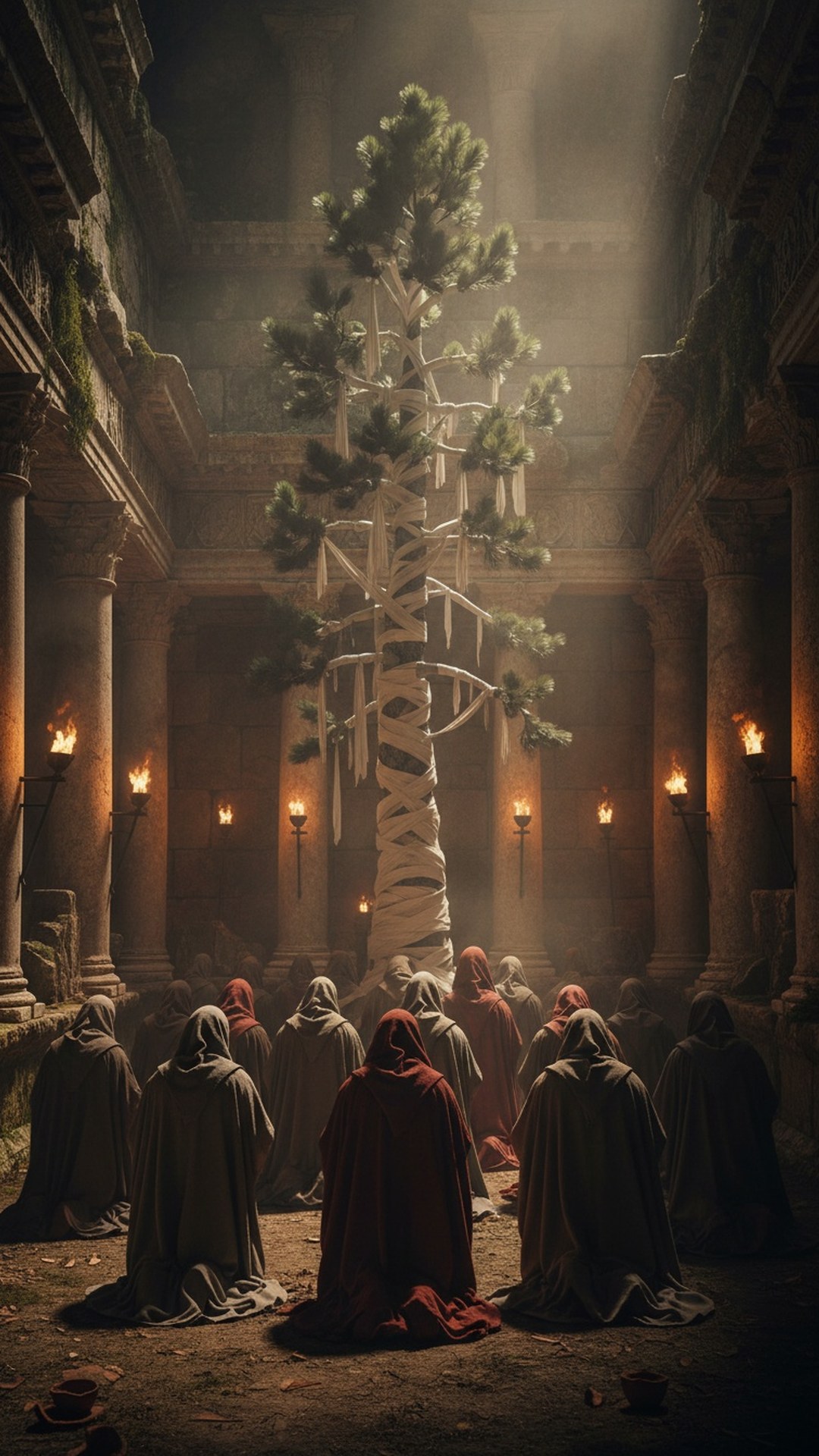
A Roman festival celebrated a god who died and rose again on a fixed spring calendar, in public, with a sacred meal, two centuries before anyone celebrated Easter. The god was Attis, consort of Cybele, the Great Mother of Anatolia. His cult was formally imported to Rome in 204 BC, by vote of the Senate, during the war with Hannibal. It stayed for six hundred years.
This is part 7 of THE BLUEPRINT, our 23-part investigation into the figures who carried pieces of the Jesus story before the story was told. Attis matters because his case does not rest on a buried myth. It rests on a civic calendar.

Three days in March
The spring festival of Cybele and Attis ran on fixed dates that Roman calendars preserve. March 22: the Arbor Intrat, the entry of the tree. A pine, the tree beneath which Attis died in the myth, was cut, wrapped like a corpse, and carried into the sanctuary as the body of the god. March 24: the Dies Sanguinis, the Day of Blood, a day of mourning, fasting and self-inflicted wounds by the priesthood. March 25: the Hilaria, the Day of Joy. The mourning inverted overnight into celebration, because the god was no longer dead.
March 25 is the spring equinox on the Roman reckoning. It is also the date the early Church settled on for the crucifixion, and the date that still anchors the calculation of Easter. Two spring resurrection festivals, same city, same week of the year, and the pagan one was there first.
The witnesses are not friendly ones
We know the sequence because fourth-century writers described it while the cult was still running. The emperor Julian, in his Oration to the Mother of the Gods, walks through the festival stage by stage: the tree, the mourning, the joy. And Firmicus Maternus, a Christian polemicist writing to two Christian emperors, confirms the ritual in the act of attacking it. He was not documenting a curiosity. He was trying to shut down a rival resurrection festival, and the resemblance to his own religion's central feast visibly bothered him.
Take courage, initiates. The god is saved, and for you too there will be salvation from your troubles.
That line is the formula a priest of the cult pronounced over the initiates, preserved by the philosopher Damascius. Read it twice. Salvation for the worshipper, flowing from the rescue of the god. That is the soteriological engine of Christianity, spoken in a pagan sanctuary. The cult also kept a sacred meal: initiates ate from the tympanum and drank from the cymbal of the goddess, a formula Firmicus quotes and condemns.
The myth behind the calendar
The myth itself, recorded by Pausanias and Arnobius, is stranger than the festival. Attis was born of Nana, a virgin who conceived by placing the fruit of a divine tree in her bosom. He died young and violently, bleeding out beneath the pine. From his blood, violets. The Great Mother mourned him, and the cult reenacted her mourning and its reversal every spring on the same dates, the way Holy Week reenacts a death and a reversal every spring on dates fixed by the same equinox.
The one objection, and why it breaks
There is exactly one counter-argument, so let us take it apart. The full, explicit resurrection testimonies for Attis come from writers of the fourth century AD and later, when Christianity already existed, and the claim built on that is that the Hilaria's resurrection emphasis was late, a pagan answer to Easter rather than its ancestor. That claim does not survive contact with the calendar. The cult was in Rome from 204 BC. Catullus wrote his Attis poem around 60 BC. The pine, the mourning, the Day of Blood and the spring reversal into joy belong to the pre-Christian shape of the cult, so a fourth-century writer describing them is describing a machine already centuries old. What the late sources date is the vocabulary, not the ritual. Rome spent those centuries burying a young god in March and celebrating him saved three days later, on the equinox, in public, and the Church fixed its own death and reversal to the same days in the same city. And no, Attis was not crucified. The myth says he bled out beneath the tree. The fake version of this parallel is not needed. The real one is stranger, and it is sitting in the Roman state calendar with the dates written on it.
When Paul arrived in Rome, the sanctuary of the Great Mother had been operating on the Palatine hill for two and a half centuries. The March cycle of death, blood and joy was as familiar to a Roman as Holy Week is to a modern Christian. Whatever the first Roman converts heard in the Easter story, they did not hear it in a vacuum.
A god who died on a tree and was celebrated as saved on March 25, with salvation promised to his initiates, in the same city where Easter took its final shape. Did the Church convert the calendar, or did the calendar convert the Church? Follow THE BLUEPRINT as the investigation continues.
This is Part 7 of 23 in THE BLUEPRINT, an investigation into the pre-Christian figures who carried the pieces of the Jesus story. See every part of the series here.
Before you go
7 books the Vatican doesn't want you reading. Free PDF, the texts they cut, with sources. Joined by 140+ Inner Circle members.
No spam. Unsubscribe anytime.
Go deeper
The Hidden Canon, Vol. I, Enoch. Jubilees. Thomas. Mary. Judas. 90 pages, 14 chapters, every receipt cited. The books your Bible quietly removed.
Read the Canon →Books that informed this investigation
As an Amazon Associate, Hidden Epoch earns from qualifying purchases. Cost to you: nothing.
Research safely
The VPN we use to research without being tracked. First 3 months free.
Get NordVPN →