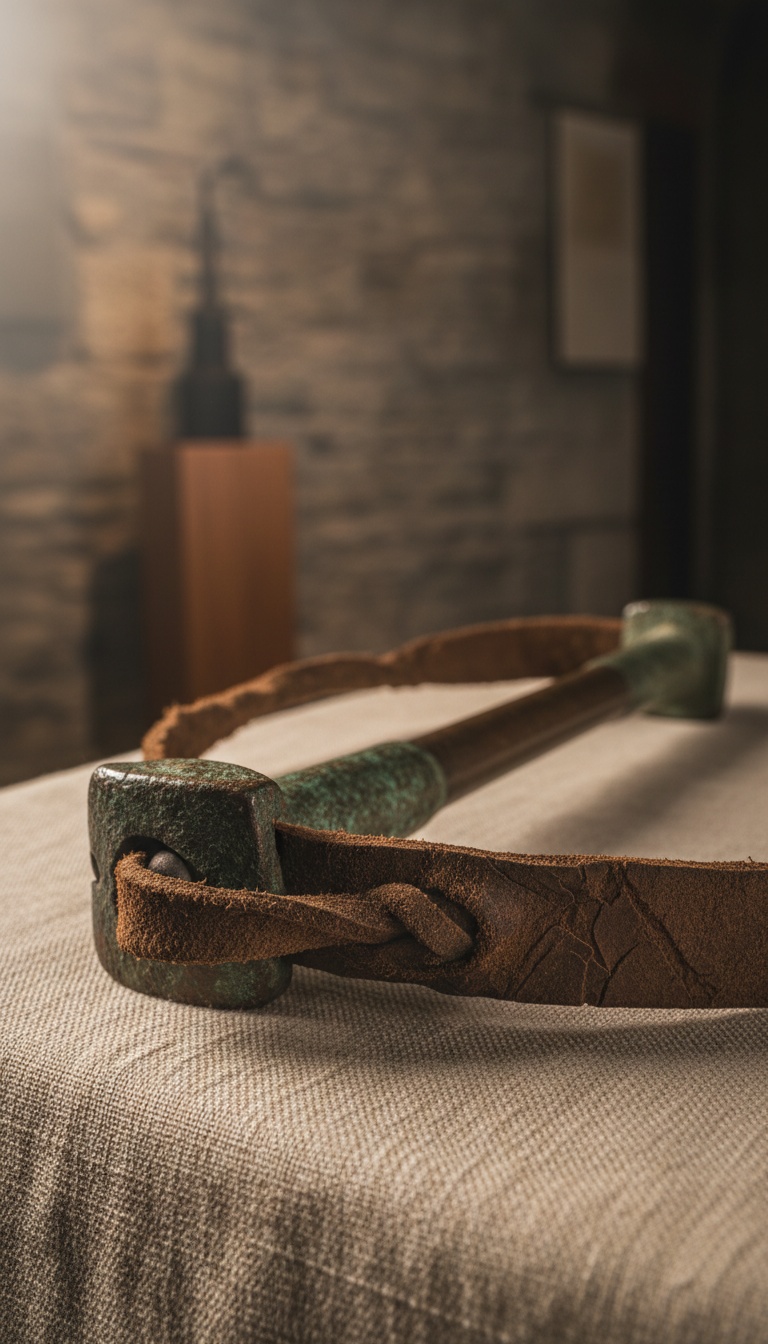
A copper alloy precision drill sat in an Egyptian grave for 5,300 years, and the leather thong that drove it is still attached. That is not the mystery. The mystery is how a pre-dynastic culture with no documented metallurgical tradition built it in the first place.
The Object Cambridge Catalogued in 1924
The drill is not a rumor. It is not a claim from a fringe website. Cambridge Museum of Archaeology and Anthropology holds it under catalog number 1924.948. Copper alloy. Bow drill configuration. Recovered from Badari, Upper Egypt. Dated to approximately 3300 BC, which places it in the pre-dynastic period. Before the First Dynasty of Egypt. Before unification under Narmer. Before hieroglyphics functioned as a writing system. The leather thong that wrapped the bow and transferred rotational force to the drill bit is still attached. It survived 53 centuries in a grave.
That kind of preservation does not happen with tools that were disposable. The person buried with this object treated it as essential. You bury what matters.
What the Badari Culture Was Supposed to Know
The Badari culture occupied Upper Egypt from roughly 4400 BC to 3800 BC, with some archaeologists extending that window toward 3000 BC. Their material record includes fine black-topped pottery, ivory combs, slate cosmetic palettes, and flint blades. They domesticated cattle. They traded with communities as far as the Red Sea coast. What they were not supposed to have was precision copper metallurgy.
The archaeological consensus places Egyptian copper smelting at meaningful scale in the Chalcolithic transition. But sitting at the edge of a period is not the same as having the infrastructure to produce a copper alloy bow drill. The Badari record does not contain smelting furnaces. It does not contain the slag deposits that large-scale copper processing leaves behind. It contains this drill. One object. In a grave. With its thong still attached.
The Metallurgical Demand
Producing copper alloy is not intuitive. It is not something a skilled craftsman figures out by accident over a winter. It requires ore with a specific mineral composition. It requires sustained heat above 1,085 degrees Celsius, the melting point of pure copper. Reaching that heat means controlled airflow. Controlled airflow means bellows. Bellows mean a system, not a campfire.
An alloy adds a second variable. Arsenic bronze, which appears in some of the earliest functional copper objects in the ancient Near East, requires knowledge of which ores to combine, at what temperature, and for how long. Getting that wrong produces a brittle, unusable piece. Getting it right requires a knowledge base transmitted from person to person across years. The University College London Petrie Museum holds objects from the same Badari excavation context that show early copper work. The gap between a simple hammered copper bead and a precision functional bow drill is not a smooth gradient. It is a step function. Something large happened in between, and the record does not say what.
The leather thong is still attached. The grave is 5,300 years old. The metallurgical knowledge required to build this tool did not exist in any documented culture within 500 miles of Badari at that date.
What Flinders Petrie Actually Found
William Matthew Flinders Petrie, the British archaeologist who systematized Egyptian pre-dynastic excavation, worked extensively in Upper Egypt from the 1890s onward. His sequencing method, developed in 1899 and called sequence dating, became the standard framework for ordering pre-dynastic material culture without written records. Petrie identified and catalogued the Badari and Naqada cultures. Objects from his excavations and those of his contemporaries ended up distributed across British institutions: the Petrie Museum at UCL, the Ashmolean at Oxford, Cambridge MAA.
The 1924.948 entry at Cambridge places this drill's formal documentation in 1924. The same year Howard Carter was finishing his cataloguing of Tutankhamun's tomb. Two very different scales of spectacle. One got newspaper front pages across three continents. The other got a catalog number and a description that reads early copper working and nothing further. Early copper working is doing enormous work in that description. It categorizes the object. It does not explain it. Petrie's own site notes from Badari do not resolve the origin of the metallurgical knowledge. They record what was found. They do not record who built the knowledge to make it.
The Sequence That Does Not Exist
When archaeologists describe a technology as having evolved, they are making a specific claim. The claim is that a recoverable chain of intermediate forms exists, each a small step beyond the last, connecting the earliest version of a technology to its sophisticated form. For copper metallurgy in Egypt, that chain exists from the Naqada II period onward, roughly 3500 BC to 3200 BC. You can trace increasing complexity in copper objects correlated with growing trade networks and documented knowledge transfer from the Levant and Mesopotamia.
What you cannot do is trace a clean line from Badari flint-working culture to a functional copper alloy bow drill buried in a Badari grave. The intermediate forms are not there. Petrie's own sequencing system cannot bridge that gap. When the sequence does not exist, the word evolved is not a description of a known process. It is a placeholder for a process no one can name. Placeholder words belong in rough drafts. They do not belong in explanations of a 5,300-year-old precision instrument.
The Transfer Problem
Knowledge of this complexity does not generate spontaneously inside a population with no documented exposure to it. It transfers. Someone who knew how to smelt copper alloy was either in Badari or directly connected to someone in Badari through trade, migration, or contact. The Badari culture had external connections. Badari sites show imported materials: shells from the Red Sea, stone from outside the Nile Valley. A trade network that moves shells can move people. A person who moves carries what they know.
The Mesopotamian record at 3300 BC shows copper working at Uruk-period sites. The Anatolian record shows copper smelting at levels predating this drill by centuries. Something connected those worlds to Upper Egypt. The question is not whether knowledge transfer is theoretically possible. It is. The question is who was carrying this specific knowledge to Badari in 3300 BC, where they learned it, and why they appear in none of the burial records. They brought a precision technology into a culture that had no documented foundation for it. Then they left no grave goods. No tools of their own. No material trace that belongs to an outside culture. They arrived. They transferred. They vanished.
The drill exists. The grave is documented. Cambridge holds the object under a catalog number anyone can look up. What the record does not contain is the teacher. Someone handed this knowledge to the Badari. That person came from somewhere, stayed long enough to transfer a precision craft that would not appear again at scale in Egypt for several hundred years, and left no name in the burial record. They came, they taught, and they disappeared. The pre-dynastic period is dense with objects that should not exist at their date. This one still has its leather thong.
Ask yourself why a 5,300-year-old precision tool survives intact while the name of the person who delivered the knowledge to build it appears nowhere in the record. The tool was buried deliberately. The teacher was not. Someone made a choice about what got preserved and what got erased. That choice was made 5,300 years ago, and we are still living inside it.
Before you go
7 books the Vatican doesn't want you reading. Free PDF — the texts they cut, with sources. Joined by 140+ Inner Circle members.
No spam. Unsubscribe anytime.
Go deeper
The Hidden Canon, Vol. I — Enoch. Jubilees. Thomas. Mary. Judas. 90 pages, 14 chapters, every receipt cited. The books your Bible quietly removed.
Read the Canon →Books that informed this investigation
As an Amazon Associate, Hidden Epoch earns from qualifying purchases. Cost to you: nothing.
Research safely
The VPN we use to research without being tracked. First 3 months free.
Get NordVPN →