A donkey saw an armed being standing in a public road three separate times, and the man riding it, a prophet kings paid to see into the unseen, saw nothing until the animal opened its mouth and spoke.
This is Numbers chapter 22, verses 21 through 35. It is one of the strangest passages ever copied by a scribe, and it keeps getting filed under children's Bible stories. That filing is the cover. Read the chapter slowly and it becomes a field report. It gives you a named witness, a named road, a detection event that repeats three times, and a being with a drawn sword that a trained seer could not perceive until something uncovered his eyes. Then a plaster wall dug out of the Jordan Valley in 1967 turned up with the same prophet's name painted on it.
The Man Kings Hired To See
Balaam son of Beor was a professional. Numbers 22:5 places him at Pethor, near the Euphrates, hundreds of miles from the plains of Moab. Balak, king of Moab, sent elders to him carrying "the rewards of divination" in their hands (Numbers 22:7). Kings do not send delegations across the desert for amateurs.
His whole trade was perception. He was paid to see what ordinary men could not: the intentions of gods, the fate of armies, the shape of what was coming. Numbers 24:4 calls him the man "which saw the vision of the Almighty, falling into a trance, but having his eyes open." That is the job description. That is the man who rode straight toward a drawn sword and saw empty road.
Three Strikes On A Narrowing Road
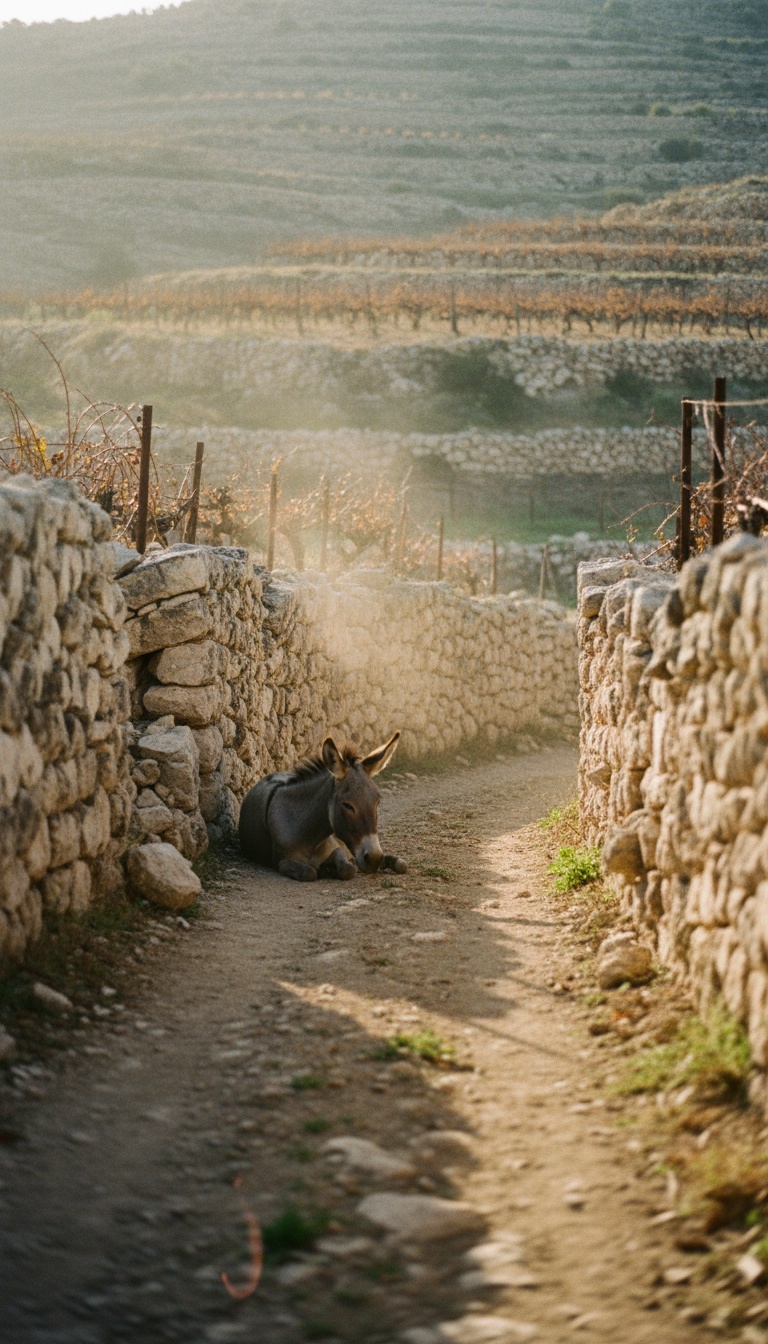
The being stood in the path three times, and each time the geometry got tighter. First it stood on the open road, and the donkey swerved into a field (Numbers 22:23). Second, it stood in a path between vineyards with a wall on each side, and the donkey pressed itself against the wall and crushed Balaam's foot (22:24-25). Third, it stood in a narrow place "where was no way to turn either to the right hand or to the left," and the donkey lay down under him (22:26-27).
Look at that sequence as a pattern. The being was closing the exits. Open field, then a walled lane, then a dead stop. Something was herding the rider toward a spot where there was no escape, and the only creature on that road tracking it in real time was the animal underneath him.
Balaam beat the donkey every time. Verse 27 says his anger was kindled and he struck it with his staff. The prophet was punishing the one witness who was right.
The Mouth Was Opened. The Eyes Were Uncovered.
Numbers 22:28 says the LORD opened the mouth of the donkey. The Hebrew verb is vayiftach, to open. Three verses later, 22:31, Balaam's turn comes, and the text switches verbs. The LORD vayegal the eyes of Balaam. That verb means to uncover, to strip away a covering. The same root is used for exposing what was hidden.
The text is telling you something precise. Balaam's eyes worked fine. They were covered. There was a veil over his perception that his donkey did not have, and it had to be physically removed before the armed being became visible to him.
"If she had not turned from me, surely now also I had slain thee, and saved her alive." The being had already chosen. The prophet was going to die on that road, and the donkey was going to walk home.
The rabbis treated that talking mouth as a planted device. Pirkei Avot 5:6, compiled in the Mishnah around 200 CE, lists ten things created at twilight on the eve of the first Sabbath, before creation was sealed. The mouth of the donkey is on that list, beside the mouth of the earth that swallowed Korah and the rainbow. In their reading, the capability was installed at the foundation of the world and left waiting for one afternoon on one road in Moab.
The New Testament signs off on it as literal history. Second Peter 2:16 says "the dumb ass speaking with man's voice forbad the madness of the prophet." Jude 11 and Revelation 2:14 both name Balaam as a real man whose error was remembered. Three separate texts, one event, zero softening.
The Wall In Jordan That Names Him
In 1967, a Dutch expedition led by Henk Franken of Leiden University was digging at Tell Deir Alla in the Jordan Valley, a few miles east of the Jordan River. In a collapsed building they found plaster fragments covered in black and red ink. Once reassembled, the text opened with a name: Balaam son of Beor, "a seer of the gods."
The inscription dates to around 800 BCE. It describes the gods coming to Balaam at night in a vision, and Balaam rising the next morning weeping, because he had seen the council of the gods decree darkness over the land. The fragments are now held in Amman, Jordan, at the Jordan Museum.
For a century, commentators in the Wellhausen tradition carved Numbers 22:22-35 out of the chapter as a standalone donkey fable, a folk insertion with no man behind it. Deir Alla breaks that in one blow. A non-Israelite community, on the east side of the Jordan, painted this exact prophet's name, his exact father's name, and his exact profession on a public wall. They remembered him as a man who saw beings other people could not see. Two unrelated traditions, one on a scroll and one on plaster, describe the same seer with the same gift. Fables do not leave their names on walls in a rival nation.
The Sword-Bearer Keeps Showing Up
Numbers 22:22 says the being stood in the road "for an adversary against him." The Hebrew is l'satan. This is the same word that later becomes a name, and here it is a job title held by the thing with the sword.
The same figure appears again. In Joshua 5:13, Joshua looks up near Jericho and sees a man standing opposite him "with his sword drawn in his hand," who identifies himself as captain of the host of the LORD. In 1 Chronicles 21:16, David looks up and sees the angel of the LORD standing between earth and heaven with a drawn sword stretched over Jerusalem. Three appearances, three armed standoffs, and in every one the being is solid enough to block a path and stand in a specific spot.
That is the pattern that matters. This is a physical presence that occupies space on a road, a threshing floor, a field outside Jericho. Human eyes need permission to register it. The donkey needed none.
Animals Move First
The donkey's behavior has modern echoes, and they stack in threes. On December 26, 2004, before the Indian Ocean tsunami hit Sri Lanka, wildlife officials at Yala National Park reported finding almost no dead large animals, while dozens of people died there. At Khao Lak, Thailand, tourist elephants broke their chains and headed uphill before the wave came in.
In the spring of 2009, biologist Rachel Grant of the Open University was studying common toads at San Ruffino lake in central Italy. The males abandoned the breeding site days before the L'Aquila earthquake of April 6, 2009, a behavior she published in the Journal of Zoology in 2010. The animals reacted to something the town's instruments did not warn anyone about in time.
Animals detect what humans are blind to. The writer of Numbers knew this three thousand years before seismographs. He also knew the harder thing: that the man with the most spiritual training on that road was the least equipped to see what was standing in it.
Balaam kept riding after this. He went on to Moab, climbed three high places with King Balak, and tried three times to curse Israel, and three times the words came out as blessings (Numbers 23-24). Three swerves on the road, then three failed curses on the mountain. Whatever stood in that road stayed with him the whole way. Joshua 13:22 records that he was later killed by the sword anyway.
Here is the question the chapter leaves on the table. If a donkey could see a sword-bearing being in broad daylight while a paid seer saw open road, what else is standing in our roads right now that the animals register and we walk straight into? Your dog barks at an empty corner. Your horse refuses a bridge. Tell me in the comments the moment your animal saw something you could not, because Numbers 22 says the covering over our eyes was put there on purpose.
Before you go
7 books the Vatican doesn't want you reading. Free PDF — the texts they cut, with sources. Joined by 140+ Inner Circle members.
No spam. Unsubscribe anytime.
Go deeper
The Hidden Canon, Vol. I — Enoch. Jubilees. Thomas. Mary. Judas. 90 pages, 14 chapters, every receipt cited. The books your Bible quietly removed.
Read the Canon →Books that informed this investigation
As an Amazon Associate, Hidden Epoch earns from qualifying purchases. Cost to you: nothing.
Research safely
The VPN we use to research without being tracked. First 3 months free.
Get NordVPN →