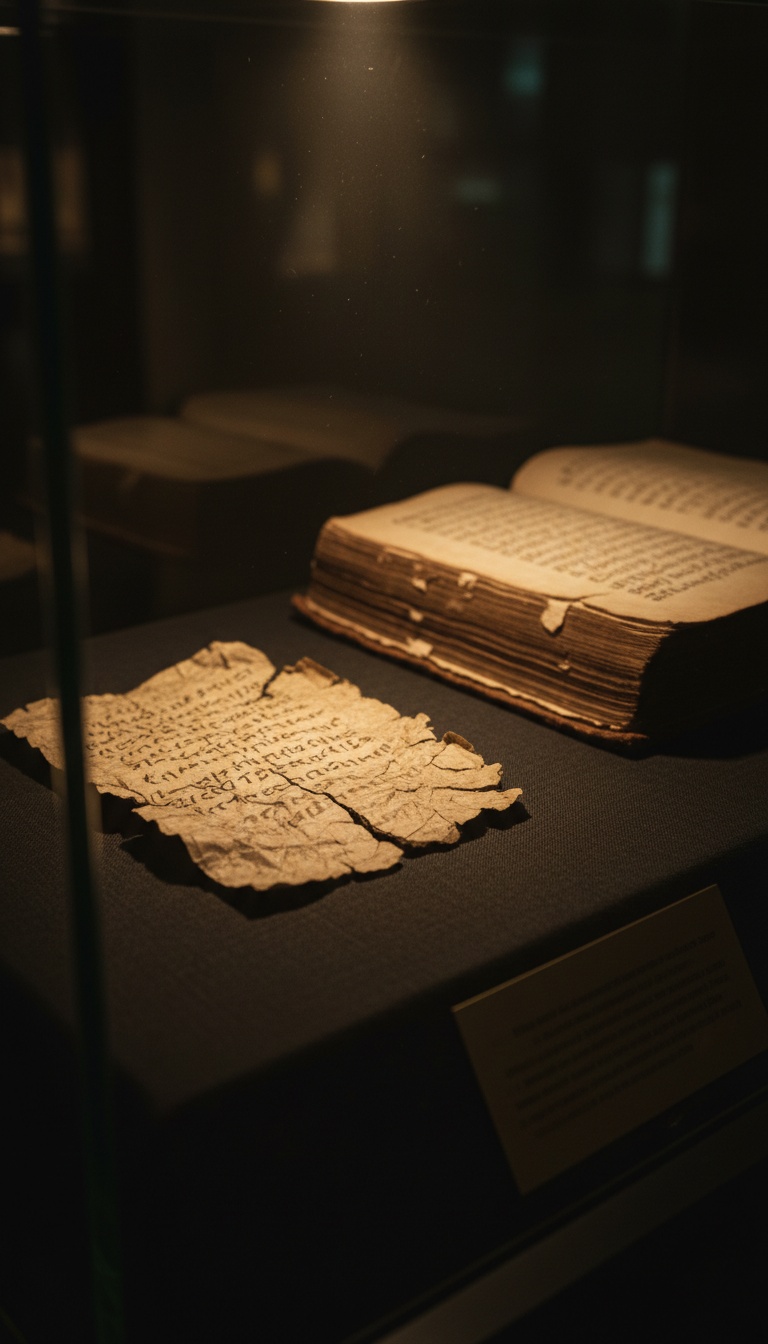
The Ethiopian Bible kept a chapter every other Bible removed, and that chapter is a receipt. A list of angels. A list of skills. A list of what humanity was not supposed to know.
Almost nobody reads it. That is the point.

The Chapter That Names Names
1 Enoch chapter 8 is not a parable. It is a personnel file. Azazel is listed as the one who taught men to make swords, knives, shields, and breastplates, and then taught women the arts of cosmetics, dyed fabrics, and precious stones. The text treats the blade and the eye-paint as equivalent corruptions.
Shemihazah, listed as the chief of the two hundred, taught enchantments and root-cutting. Baraqel taught the signs of the lightning. Kokabel taught the signs of the stars. Ezeqel taught the signs of the clouds. Sariel taught the courses of the moon. Twenty leaders. Two hundred followers. Every corruption assigned to a specific defendant.
Then the flood comes. In the narrative logic of Enoch, the flood is not a random purge. It is a containment operation targeting the knowledge these angels leaked.
The Qumran Receipts
In 1952, a Bedouin-led survey of Cave 4 at Qumran surfaced Aramaic fragments of 1 Enoch. J.T. Milik cataloged them and eventually published them in 1976 through Oxford's Clarendon Press under the title The Books of Enoch: Aramaic Fragments of Qumran Cave 4.
The relevant manuscripts are catalogued as 4Q201 and 4Q202, both containing portions of the Book of the Watchers, the section that includes chapter 8. Paleographic dating puts 4Q201 in the first half of the second century BC. That is roughly two centuries before the crucifixion.
The fragments sit today in the Shrine of the Book and the Israel Antiquities Authority collection in Jerusalem, with additional material at the Rockefeller Museum. You can view digital scans through the Leon Levy Dead Sea Scrolls Digital Library. The physical proof exists. This was scripture at Qumran.
The Ethiopian Holdout
The full text of 1 Enoch survived in exactly one place. Ge'ez, the liturgical language of the Ethiopian Orthodox Tewahedo Church. The Beta Israel Jewish community of Ethiopia kept it. The church at Aksum kept it. Nobody in Rome, Constantinople, Wittenberg, or Canterbury kept it.
Scottish traveler James Bruce carried three Ge'ez manuscripts of Enoch out of Ethiopia in 1773. One went to the Bodleian Library in Oxford. Another went to the Bibliotheque Nationale in Paris. Richard Laurence translated the Bodleian copy into English in 1821, and the West met a book it had officially forgotten for over a thousand years.
The Ethiopian canon still contains 81 books. The Protestant canon contains 66. The difference is not a rounding error. It is a decision made by other people, in other rooms, that you inherited without a vote.
The Dead Sea Scroll fragments date to roughly 200 BC. The decision to bury the book came later. Someone edited the shelf after the evidence was already in the ground.
Who Actually Cut It
The book was cited freely in the first century. The Epistle of Jude, verses 14 and 15, quotes 1 Enoch 1:9 directly and attributes it to Enoch by name. Tertullian defended Enoch as scripture in his treatise On the Apparel of Women around 200 AD, arguing specifically that the book explained why cosmetics were suspect. He knew chapter 8. He named Azazel's teaching as the reason.
By the late fourth century the mood had shifted. Athanasius of Alexandria issued his 39th Festal Letter in 367 AD listing the canonical books, and Enoch is not on it. Augustine, writing City of God around 420 AD, book 15 chapter 23, acknowledges that Enoch wrote divine things but argues the surviving book cannot be trusted because of its antiquity. He does not deny it is old. He uses its age against it.
Jerome, in his letter catalog De Viris Illustribus, classifies Enoch as apocryphal. The Council of Laodicea around 363 AD had already begun formalizing exclusions. By the sixth century, Western Christianity had scrubbed it. Only Ethiopia refused.
What Chapter 8 Actually Threatens
Read the list of teachings and notice the pattern. Metallurgy. Weapons. Cosmetics. Root-cutting for medicine and poison. Enchantments. Astrology. Meteorology. Divination by clouds, stars, moon, sun, and earth.
This is not a list of magical curiosities. This is a functional description of civilization. Metalwork built cities. Herbal knowledge built medicine. Astronomy built agriculture and navigation. The Book of the Watchers frames the entire technological toolkit of the ancient world as stolen contraband.
A canon that includes chapter 8 is a canon that questions where knowledge came from and who paid for it. A canon that removes chapter 8 lets civilization off the hook. One version indicts the tools. The other version blesses them.
The Timing Problem
The fragments in Cave 4 were sealed sometime before 68 AD, when the Romans destroyed the Qumran settlement. The book was scripture then. The formal exclusions come in the fourth century. That is a three-hundred-year gap between the physical proof of canonical status and the paperwork that erased it.
In that gap, empires changed. Christianity became a state religion under Constantine in 313 AD. Canon lists became instruments of imperial theology. The books that stayed were the books that fit the state. The books that walked were the books that did not.
Enoch did not fit. A text that names named angels as the source of weapons and cosmetics and astrology is a text that treats the ruling class's toolkit as compromised. That is not a theological problem. That is an administrative one.
The Ethiopian church never signed the paperwork. They still read chapter 8 out loud. They still name Azazel and Shemihazah and Baraqel. The fragments in the Rockefeller Museum in Jerusalem still say the same names in Aramaic ink dried before Rome was an empire.
The question is not whether the text is ancient. Milik proved that in 1976. The question is who benefits from a canon that does not include a list of who taught humanity to make weapons. Look at what chapter 8 accuses, then look at who inherited the accused industries. Then tell me in the comments which of the twenty leaders you think is still teaching.
Before you go
7 books the Vatican doesn't want you reading. Free PDF, the texts they cut, with sources. Joined by 140+ Inner Circle members.
No spam. Unsubscribe anytime.
Go deeper
The Hidden Canon, Vol. I, Enoch. Jubilees. Thomas. Mary. Judas. 90 pages, 14 chapters, every receipt cited. The books your Bible quietly removed.
Read the Canon →Books that informed this investigation
As an Amazon Associate, Hidden Epoch earns from qualifying purchases. Cost to you: nothing.
Research safely
The VPN we use to research without being tracked. First 3 months free.
Get NordVPN →