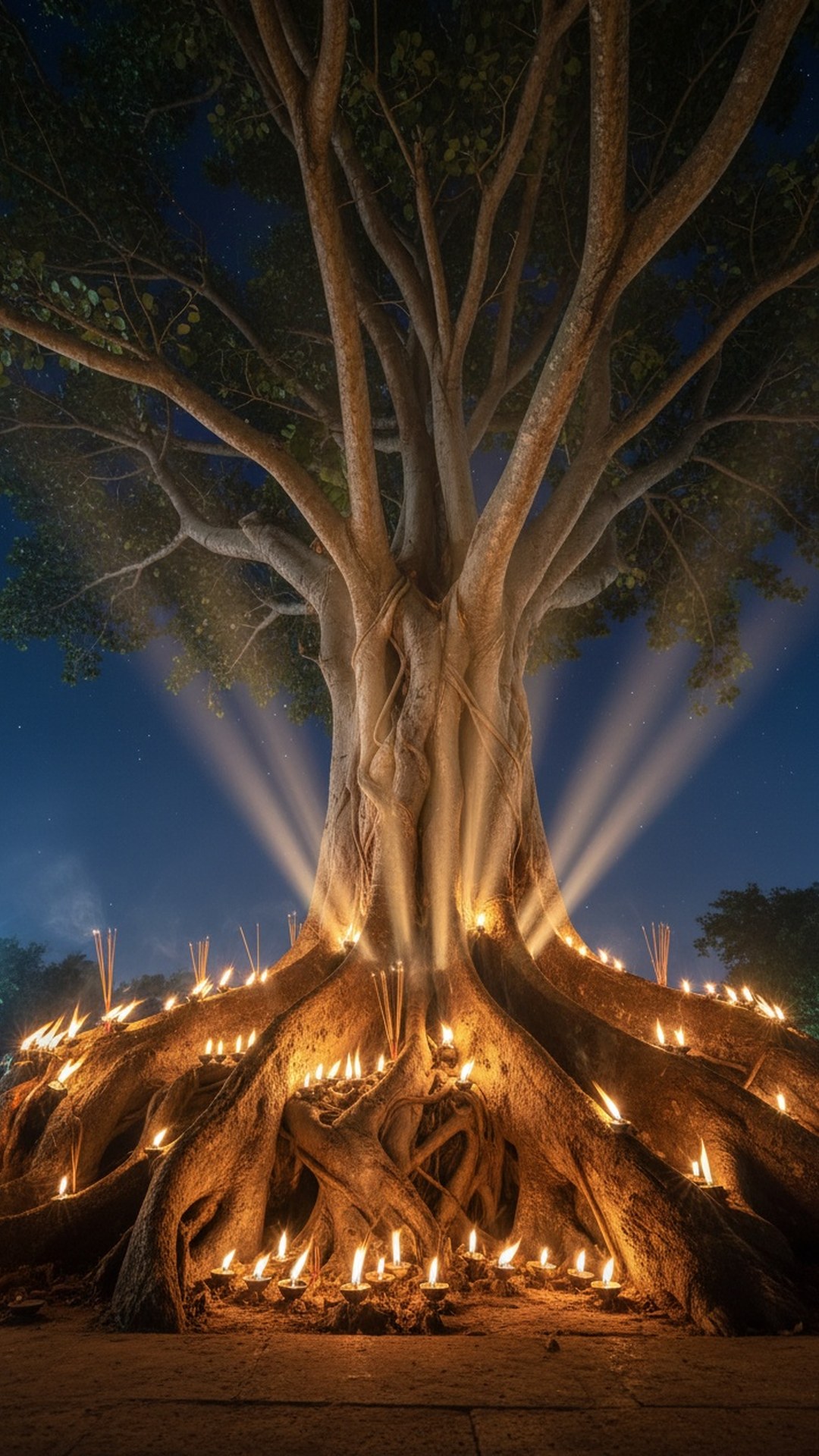
A holy man fasts alone in the wilderness. A named demon comes to break him. The attack comes in three waves: pleasure, fear, and power over the world. The holy man refuses all three. The demon withdraws, and the teaching ministry begins.
That is Matthew chapter 4. It is also the Padhana Sutta, a Buddhist scripture that a stone edict of Emperor Ashoka was already recommending around 258 BC, more than three centuries before Matthew wrote a word. This is part 12 of THE BLUEPRINT, and it carries the investigation east. As always: primary sources on the table, fake parallels killed on sight.
Two deserts, one script
Siddhartha Gautama sits by the Neranjara river, starving himself toward awakening. The demon Mara arrives. In the canonical accounts, the assault unfolds in three movements. Mara sends his daughters, whose names translate as Craving, Delight, and Passion: that is pleasure. He sends storms and armies of demons against the motionless man: that is fear. Then he challenges Siddhartha's very right to awaken, demanding to know who will bear witness for him: that is power and identity. The Buddha touches the earth, the earth itself bears witness, and Mara retreats, defeated.
Five centuries later, the Gospels put Jesus in the Judean desert, fasting. Satan arrives with three offers. Stones into bread for a starving body: pleasure. A leap from the temple to test whether God will save him: fear and identity. All the kingdoms of the world: power. Jesus refuses three times, quoting scripture. Satan departs. In both stories the scene sits at the same hinge: the tempter must be beaten before the public ministry can begin.
The dating is not close
This is the part that survives every audit. The Padhana Sutta belongs to the Sutta Nipata, one of the oldest layers of the Pali Canon, and Ashoka's Bairhat edict, carved in stone around 258 BC, recommends Sutta Nipata verses by name. The canon was first committed to writing around 29 BC in Sri Lanka. The earliest Gospel, Mark, lands around 65 to 70 AD. On the temptation scene, the Buddhist text has priority by at least two and a half centuries, anchored by rock inscriptions, not guesswork.
The dream that entered her side
The birth stories echo too, and the echo gets louder the closer you read. In the Acchariya-abbhuta Sutta, Queen Maya conceives after a white elephant enters her right side in a dream: a descent from heaven into the womb, a conception without desire, a mother the texts describe as morally spotless. Luke gives Mary a visiting angel and conception by the Holy Spirit. Both are divine conceptions announced by visitation, without intercourse as the mechanism.
And the counter, immediately: Maya was married, and no early Buddhist text calls her a virgin, so scholars class her story as miraculous conception rather than virgin birth. The reel says exactly that, and so does this investigation, because that objection only kills the lazy version of the parallel. Nobody needed a virgin. What Luke needed was the shape: a descent from heaven, a womb entered without desire, a mother the texts call spotless, a destiny announced by visitation. That shape was already scripture in the east five centuries early. The parallel is real, and it is sharper than the one the internet sells.
An old sage travels to see a newborn, holds the child, prophesies his cosmic destiny, and weeps that he will not live to see it.
The old man who came to see the baby
The sharpest small parallel in the file. In the Nalaka Sutta, the aged sage Asita perceives that a world-changing child has been born, travels to see the infant Siddhartha, examines him, finds the marks of a great man, prophesies that he will become an awakened one, and weeps because he is too old to live to see it. In Luke 2, the aged Simeon, promised he will not die before seeing the Messiah, comes to the Temple, takes the infant Jesus in his arms, declares his eyes have seen salvation, prophesies the child's destiny, and asks to depart in peace. Elderly seer, foreknowledge, a journey to the child, physical contact, a destiny prophecy, a personal release. Scholars first put these two texts side by side in 1882. Six structural details match. That is no longer a vibe. That is a template.
The road west was open
Could the stories have traveled? Here the evidence is carved in rock. Ashoka's thirteenth major edict, around 256 BC, boasts that he sent his dharma to five named Greek kings: Antiochus of Syria, Ptolemy of Egypt, Antigonus of Macedonia, Magas of Cyrene, and Alexander of Epirus. The Third Buddhist Council dispatched a mission specifically to the Greek lands. Alexandria held Indian traders, and Philo describes a Jewish contemplative sect there, the Therapeutae, whose practices have reminded more than one scholar of Buddhist monastics. The standard objection is that no surviving Greek text of that era mentions receiving those missionaries, and no document shows a Buddhist scripture reaching Galilee. Look at what that objection actually asks you to believe. A king carved his outreach into rock, named five Greek kings he sent it to, and a council dispatched monks to those lands on purpose, down a corridor already carrying Indian traders into Alexandria, where Philo found a Jewish contemplative sect living like monastics. The demand for a customs receipt is a demand no ancient transmission of anything can meet. The corridor was open, official, and in use, and the cargo shows up on the far end.
What the internet gets wrong
Now the machete, because this figure attracts more fabrication than almost any other. Buddha was not born of a virgin: Maya was married. Buddha was not crucified: the Mahaparinibbana Sutta describes him dying around age eighty after a bad meal, lying between two trees. Buddha was not resurrected: he was cremated and his relics distributed, and his final nibbana is by definition the opposite of a return. Buddha did not have twelve disciples: the tradition counts ten chief disciples and eighty great elders, never a canonical twelve. And the famous story that Jesus spent his hidden years studying in India rests on an 1894 book whose author never produced the manuscript and later admitted invention. Every one of those claims is a fabrication, and any case built on them deserves to lose.
The differences are the fingerprint
Here is the objection at full strength, and here is why it works for us. Buddha's death saves no one: there is no atonement in early Buddhism, the teaching liberates, not the dying. Mara is not Satan: he personifies craving and delusion, not cosmic evil at war with God. The Gospel's eighteen-year silence between the Temple and the baptism has no Buddhist twin: Buddha's early years are narrated, palace, marriage, son, renunciation at twenty-nine, six years of striving. And the two systems aim at different targets entirely, release from rebirth on one side, the Kingdom of God on the other. That is precisely what a story looks like after it crosses a border. The theology gets rebuilt for the new audience. The scenes survive intact, which is why the temptation still runs three acts in the same order at the same hinge of the same life. Marcus Borg catalogued the parallel sayings and stopped short of calling it copying, which is the most a career scholar can say out loud and keep his chair. Thundy argues for borrowing and notes that the only thing missing is a signed receipt. Nobody here is claiming Christianity photocopied Buddhism, and the claim on the table is heavier than that: the same three-act temptation, the same annunciation shape, and the same old-man-meets-infant prophecy were already scripture on the other side of the trade routes, centuries early, and they reached Galilee wearing new clothes.
Strip away everything uncertain and this remains: a named demon testing a fasting holy man with pleasure, fear, and power, written down and recommended on stone edicts more than two centuries before the Gospels, in a tradition whose missionaries were officially dispatched toward the Greek world. The desert showdown had a script, and the script is older than the Gospel.
So the question writes itself, and it has one serious answer. Two deserts, two tempters, three temptations in the same order, five hundred years apart, joined by a corridor a king carved into stone and staffed with missionaries by name. Coincidence does not keep a running order. A universal template does not pick the same three tests, sequence them the same way, and drop them at the same hinge in the same kind of life. Somebody carried this west, and Matthew wrote down what arrived. Follow THE BLUEPRINT as the investigation continues.
This is Part 12 of 23 in THE BLUEPRINT, an investigation into the pre-Christian figures who carried the pieces of the Jesus story. See every part of the series here.
Before you go
7 books the Vatican doesn't want you reading. Free PDF, the texts they cut, with sources. Joined by 140+ Inner Circle members.
No spam. Unsubscribe anytime.
Go deeper
The Hidden Canon, Vol. I, Enoch. Jubilees. Thomas. Mary. Judas. 90 pages, 14 chapters, every receipt cited. The books your Bible quietly removed.
Read the Canon →Books that informed this investigation
As an Amazon Associate, Hidden Epoch earns from qualifying purchases. Cost to you: nothing.
Research safely
The VPN we use to research without being tracked. First 3 months free.
Get NordVPN →