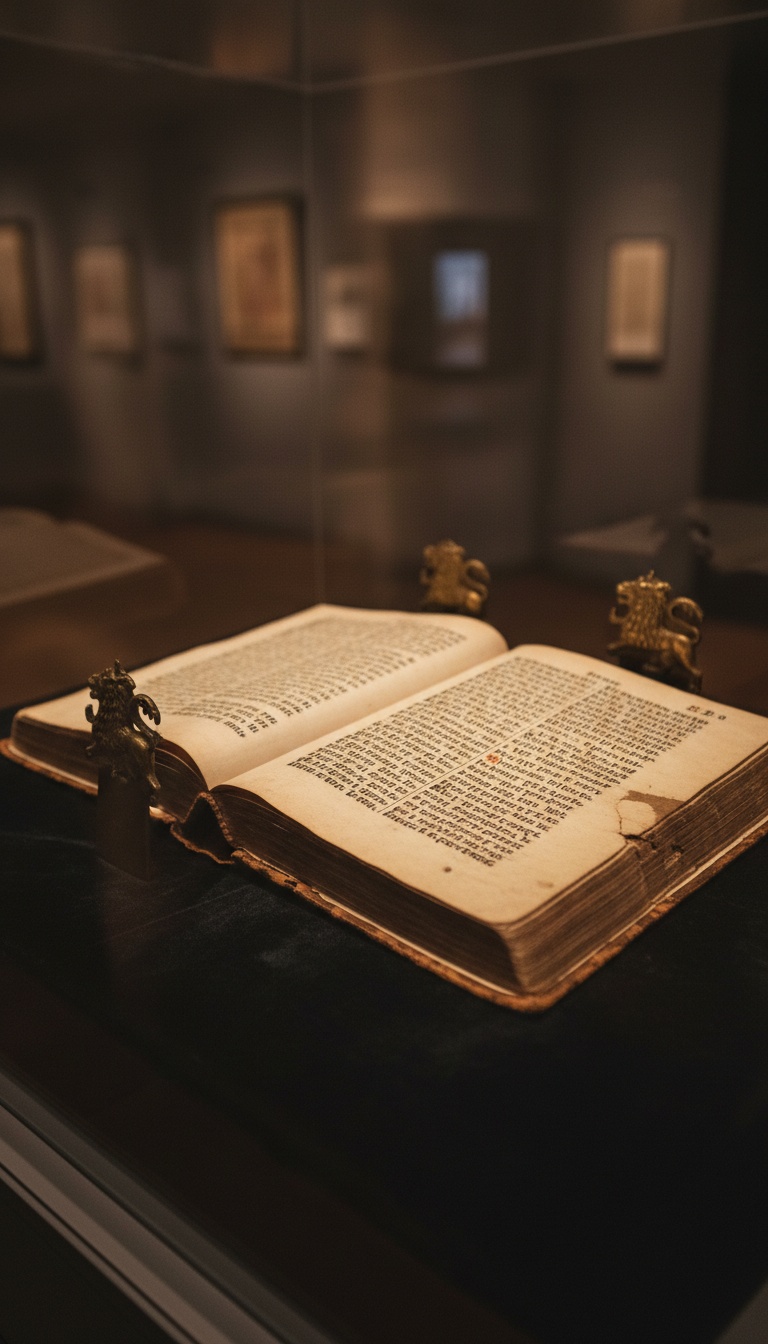
The single verse that anchors the doctrine of the Trinity in the New Testament was not written by John. It was negotiated into the Bible in 1522 by a Dutch scholar who said, in writing, that the Greek manuscript backing it up was a fake.
You were never told this. The footnotes in your ESV know. The textual critics know. The verse is still printed.
The Verse That Built a Doctrine
1 John 5:7 in the King James Version reads: "For there are three that bear record in heaven, the Father, the Word, and the Holy Ghost: and these three are one." It is the only place in the entire New Testament where the Trinity is stated as a unified formula.
Theologians call this passage the Comma Johanneum. For four centuries it functioned as the scriptural keystone of Trinitarian doctrine in the Latin West.
Pull it out, and the doctrine has to be assembled from inference. Which is why pulling it out was unthinkable in 1520, and why the fight over it produced one of the strangest manuscript episodes in church history.
Three Codices. Total Silence.
Codex Sinaiticus, copied in the mid-4th century and held today at the British Library in London (Add MS 43725), does not contain the Comma. The relevant folio of 1 John is intact. The verse is simply absent.
Codex Vaticanus, shelved in the Vatican Apostolic Library as Vat. gr. 1209 and dating to roughly 325-350 AD, also omits it. Codex Alexandrinus, British Library Royal MS 1 D VIII, fifth century, omits it as well.
The pattern extends beyond Greek. The Comma is missing from the early Syriac Peshitta, the Coptic Sahidic and Bohairic versions, the Ethiopic, the Georgian, the Arabic, and Armenian texts before the 12th century. Every Greek manuscript predating the 14th century is silent. That is not a textual variant. That is an absence.
Erasmus in 1516
Desiderius Erasmus of Rotterdam published the first printed Greek New Testament in March 1516 in Basel. He titled it Novum Instrumentum omne. He did not include the Comma Johanneum.
He did not include it because no Greek manuscript in front of him contained it. His sources, including Minuscule 1 and Minuscule 2 from the Basel University Library, were silent. He reissued the omission in his second edition in 1519.
The reaction from Catholic theologians, particularly Edward Lee in England and Diego Lopez de Zuniga in Spain, was furious. The accusation was Arianism. The threat was real.
The Manuscript That Conveniently Appeared
Erasmus made a promise. If anyone could produce a single Greek manuscript containing the Comma, he would include it in his next edition. The promise is preserved in his Annotations and in his correspondence with Lee.
A manuscript appeared. It is now called Codex Montfortianus, held at Trinity College Dublin as MS 30. It was produced in the early 16th century, almost certainly by a Franciscan friar named Froy or Roy. The Greek of the Comma in Montfortianus reads as a direct translation back from the Latin Vulgate, missing the definite articles a native Greek scribe would have included.
Erasmus examined the manuscript, concluded it had been fabricated to confute him, said so in writing, and then included the verse anyway.
The 1522 Surrender
The third edition of Erasmus's Greek New Testament rolled off the Froben press in Basel in 1522. The Comma Johanneum is there. Erasmus added a long defensive annotation explaining that he was including it under protest and that he suspected the Montfortianus manuscript was prepared specifically to force his hand.
His exact phrase, preserved in the 1522 Annotations: the manuscript appeared to have been written "ad confutandum" him. To confute him.
That admission has been in print for five hundred years. It sits in the same edition as the verse it discredits.
How the Forgery Reached the King James Bible
Erasmus's third edition became the backbone of what later editors Bonaventura and Abraham Elzevir called the Textus Receptus, the "received text," in their 1633 preface. Robert Estienne, known as Stephanus, used Erasmus for his 1550 edition. Theodore Beza used Stephanus for his editions between 1565 and 1604.
The translators commissioned by King James I in 1604 used Beza. The 1611 King James Bible printed the Comma as scripture. No footnote. No bracket. No protest annotation. Erasmus's hedging was stripped out somewhere between Basel and London.
From 1611 forward, English-speaking Christianity inherited a verse its first editor had publicly called a fabrication.
What Modern Bibles Actually Say
Open a New Revised Standard Version. The Comma is absent from the main text. Open an English Standard Version. Absent, with a footnote noting "a few very late manuscripts" add the phrase. Open a New International Version. Same footnote treatment.
The Nestle-Aland critical edition, currently in its 28th revision and used as the base text for nearly every modern translation, does not print the Comma in the main text. Bruce Metzger, in his Textual Commentary on the Greek New Testament published by the United Bible Societies, lists the passage among the clearest examples of a late Latin interpolation. Bart Ehrman covers it in Misquoting Jesus. The scholarly consensus is not contested.
The verse stays in pulpits anyway. King James Only congregations still preach from it. Catechisms still cite it. The forgery had momentum.
One manuscript. One coerced promise. One verse. Four hundred years of doctrine resting on a 16th-century Franciscan's back-translation from Latin.
The question is not whether the Comma Johanneum was inserted. That fight is over. The question is what else moved through the same pipeline. Erasmus to Stephanus to Beza to the King James. Four editors. Three centuries. How many other negotiations are buried in the footnotes you scroll past?
If they were willing to put a verse Erasmus called a forgery into the Bible, what did they leave out? Tell me in the comments which passage you want pulled apart next.
Before you go
7 books the Vatican doesn't want you reading. Free PDF, the texts they cut, with sources. Joined by 140+ Inner Circle members.
No spam. Unsubscribe anytime.
Go deeper
The Hidden Canon, Vol. I, Enoch. Jubilees. Thomas. Mary. Judas. 90 pages, 14 chapters, every receipt cited. The books your Bible quietly removed.
Read the Canon →Books that informed this investigation
As an Amazon Associate, Hidden Epoch earns from qualifying purchases. Cost to you: nothing.
Research safely
The VPN we use to research without being tracked. First 3 months free.
Get NordVPN →