The community that hid the Dead Sea Scrolls kept more copies of the Book of Enoch than they kept of most books that made it into your Bible, and the church that assembled your Bible left every one of them out.
That is not a rounding error in an ancient library. Cave 4 at Qumran, excavated starting in 1952, produced seven separate Aramaic manuscripts of Enoch, catalogued today as 4Q201 through 4Q212 and published by Jozef Milik in his 1976 Oxford volume The Books of Enoch: Aramaic Fragments of Qumran Cave 4. Seven copies of a book your priest has never read to you. The people who buried the scrolls in the Judean desert two thousand years ago treated Enoch as scripture. The men who voted on your canon three centuries later did not. The difference between those two decisions is the subject of this article.
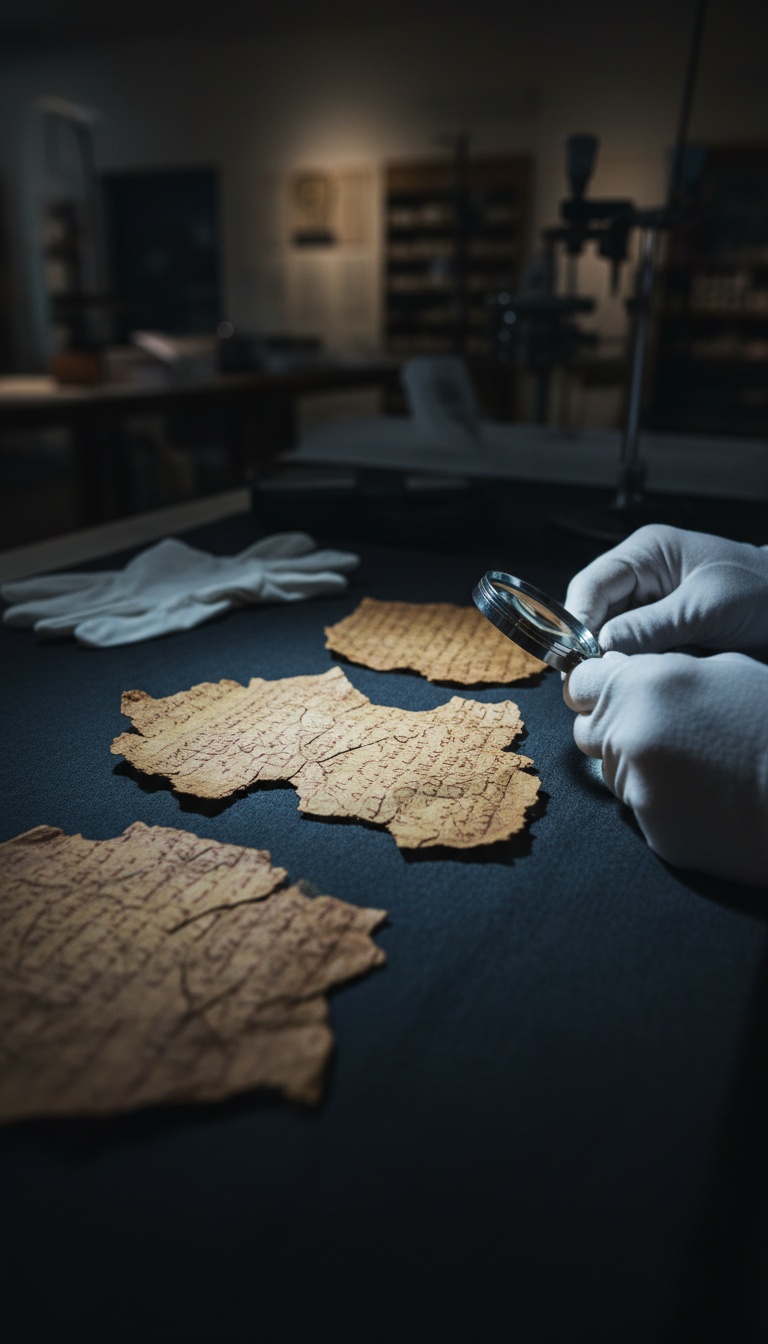
Seven Copies in One Cave
Numbers tell you what a community actually valued, and the Qumran numbers are lopsided. The caves produced more manuscripts of Enoch than of Exodus. More than Joshua, Judges, Samuel, Kings, or nearly any of the prophets. Only Psalms, Deuteronomy, Isaiah and Genesis clearly outrank it. The scribes at Qumran copied Enoch in Aramaic, the street language, the language you copy a book into when you want people to actually read it. Milik dated the oldest fragment, 4Q201, to roughly 200 BC on paleographic grounds, which puts a physical copy of the Watchers story in the ground centuries before a single church council convened. Whatever Enoch was to the people who preserved the oldest Bible manuscripts on Earth, it was not fringe.
The Church That Never Removed It
One church never got the memo. The Ethiopian Orthodox Tewahedo Church has carried the complete Book of Enoch, the Mashafa Henok, in its canon in the Ge'ez language for close to two thousand years, and it sits in their Bible today between the histories and the prophets like it never left. Europe only rediscovered the full text in 1773, when the Scottish explorer James Bruce came out of Ethiopia carrying three complete manuscripts. One went to the Bodleian Library at Oxford, where it still sits. One went to the royal library in Paris. Richard Laurence, a professor at Oxford, produced the first English translation in 1821, and for the first time in over a millennium Western readers could see exactly what had been cut. The point stands on its own: the book was never lost. It was lost to you. An entire branch of Christianity, isolated in the Ethiopian highlands and outside the reach of the councils, kept reading the chapters the rest of Christendom deleted.
The Two Hundred Names on Mount Hermon
Here is what those chapters say. Enoch chapter 6 describes two hundred beings, called Watchers, who descend onto the summit of Mount Hermon on the border of modern Lebanon and Syria. They do not arrive by accident. The text says they swore a mutual oath and bound themselves by a curse so that no single one of them could back out of what they planned to do. That is the structure of a conspiracy, recorded in the oldest religious literature we possess. And the text names names. Shemyaza, the leader. Azazel, who taught humans metallurgy and weapons. Baraqel, Kokabiel, Sariel, and the rest of the chiefs of ten, twenty officers commanding two hundred. Genesis 6 compresses this entire event into four verses and calls them the sons of God who took human wives and produced the Nephilim, the giants. Genesis gives you the crime scene. Enoch gives you the suspect list.
Two hundred beings came down on Mount Hermon, swore a binding oath, and every one of their commanders is named in the chapter your Bible removed.
Your Bible Still Quotes the Book It Banned
The strangest part is that the excision was incomplete. Open the Epistle of Jude, verses 14 and 15, in any Bible in any church in the world, and you will find a direct quotation of 1 Enoch 1:9, attributed by name: Enoch, the seventh from Adam, prophesied. The canon quotes a book the canon excludes. The early church fathers saw the problem and split over it. Tertullian, writing around 200 AD in On the Apparel of Women, defended Enoch as genuine scripture precisely because Jude cited it. Then the tide turned. Athanasius of Alexandria circulated his 39th Festal Letter in 367 AD listing the approved books, and Enoch was not on it. Augustine finished the job in City of God, book 15, ruling that the writings circulating under Enoch's name could not be trusted. Within a few generations the book vanished from every European Bible, while the verse quoting it stayed behind like a fingerprint the cleaners missed.
Too Late to Be Real? Then Explain Daniel
The standard scholarly line, taught in every seminary, is that Enoch was excluded because it was composed in the third century BC and merely attributed to the patriarch, which makes it pseudepigrapha rather than revelation. Follow that rule to its end and it detonates the canon it was built to protect. The academic consensus dates the Book of Daniel to the second century BC on identical grounds, later than the Qumran copies of Enoch, and Daniel sits untouched in every Bible on the planet. The dating rule was applied to exactly one book with surgical precision and waived for another written in the same era, in the same region, in the same apocalyptic genre. A rule enforced selectively is not a rule. It is a decision, and decisions have reasons. The reason was not the date on the manuscript. The reason was the content of chapter six.
The Flood Was Containment
Read the Watcher chapters as a sequence of events and the flood story changes shape. The Watchers cross a boundary they were assigned to guard. Their offspring, the giants, consume everything and turn on humanity itself. Azazel's forbidden teaching spreads weapons and warcraft across the earth. Enoch 10 then records the response: the order to bind Azazel in the desert of Dudael, the order to destroy the offspring, and the flood sent to wipe the surface clean. Qumran even preserved a companion text, the Book of Giants, fragment 4Q203, in which the giants themselves receive dream visions of the coming deluge and panic. In this reading the flood is not a moral punishment for human wickedness. It is a cleanup operation targeting the product of the Watchers' experiment, something that had grown past the point of control. Genesis keeps the flood and cuts the reason. Enoch is the reason.
So line the receipts up in order. Seven copies in Cave 4, buried around the time of Christ by the most scripture-obsessed community in Judea. An unbroken Ethiopian canon that never dropped the book, hiding in plain sight in the Bodleian since 1773. A New Testament epistle that still quotes it by name. And a dating standard that was invented to remove it and then quietly ignored for Daniel. The men who finalized your Bible in the fourth century had the Watcher chapters in front of them. They read the list of two hundred names, the oath on Mount Hermon, the account of what the descent produced and what it took to contain it. They did not conclude the book was unreliable. They concluded it was specific.
Which raises the question the councils never answered and the seminaries still will not touch. If the Watchers were a myth, cutting the book accomplishes nothing, because nobody censors a fairy tale. You censor a record. Two hundred names went into the ground at Qumran and stayed buried for two thousand years, and the institutions that removed them have never once explained the vote. Say what you think they were protecting. The names, or the ones the names belong to.
Before you go
7 books the Vatican doesn't want you reading. Free PDF — the texts they cut, with sources. Joined by 140+ Inner Circle members.
No spam. Unsubscribe anytime.
Go deeper
The Hidden Canon, Vol. I — Enoch. Jubilees. Thomas. Mary. Judas. 90 pages, 14 chapters, every receipt cited. The books your Bible quietly removed.
Read the Canon →Books that informed this investigation
As an Amazon Associate, Hidden Epoch earns from qualifying purchases. Cost to you: nothing.
Research safely
The VPN we use to research without being tracked. First 3 months free.
Get NordVPN →