The brow ridge did not shrink. It vanished.
For roughly 2.5 million years of hominin evolution, every skull in the fossil record carries a supraorbital torus. The shelf of bone above the eye socket that defines Homo habilis, Homo erectus, Homo heidelbergensis, and Neanderthals. Then around 300,000 years ago the record produces a skull without one. Globular cranium. High vault. Flat face. The anatomy so distinct from everything preceding it that when Jean-Jacques Hublin's team unearthed specimens at Jebel Irhoud, Morocco in 2017 and dated them to 315,000 years ago, the announcement ran in Nature as the oldest Homo sapiens ever found. But the braincase on those skulls was still elongated. Still archaic. The fully globular skull that every living person carries came later, and the fossil record has not produced a confirmed bridging specimen between it and what came before.
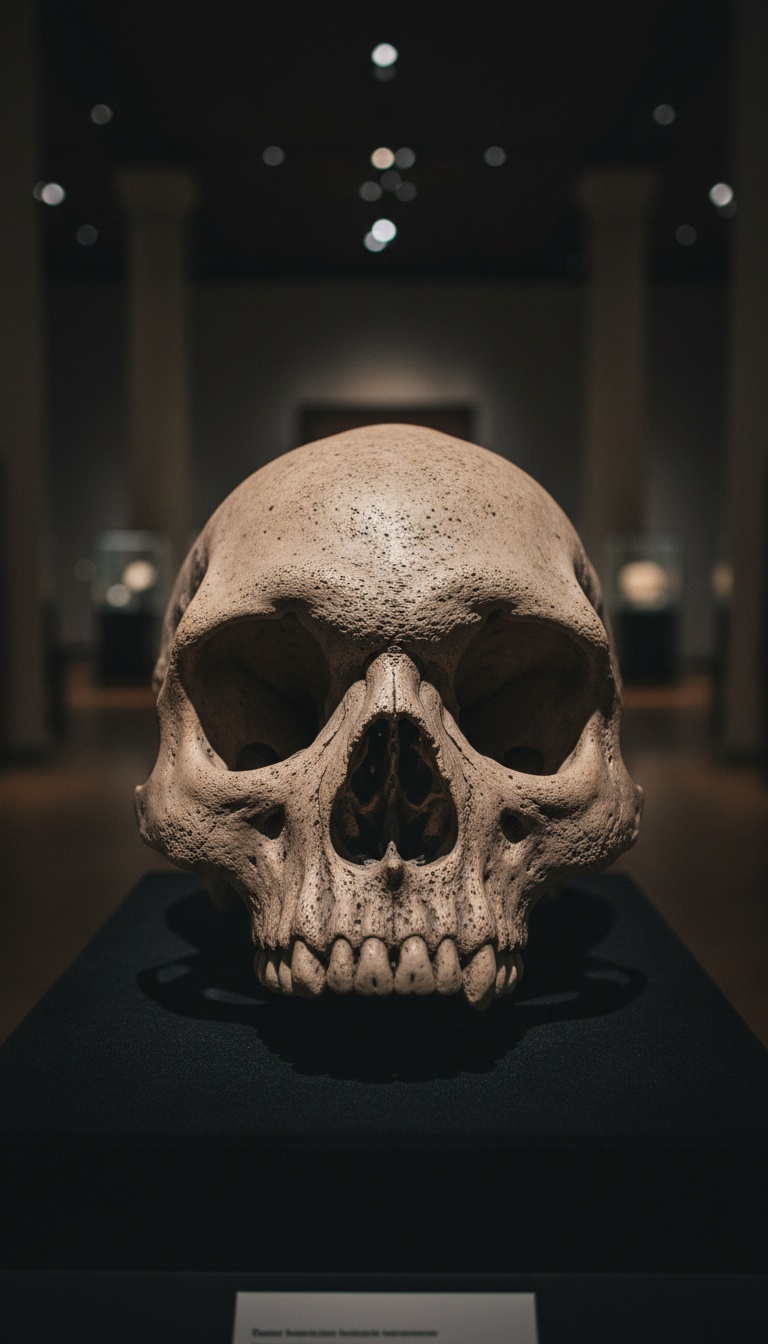
The Fossil Record Draws a Line
The Kabwe skull. Recovered in 1921 from a mine shaft in Broken Hill, Zambia. Now held at the Natural History Museum in London. Homo heidelbergensis. The supraorbital torus on that specimen projects roughly 20 millimeters forward from the orbital rim and spans the full width of the face. The Bodo cranium, recovered in 1976 from the Awash Valley of Ethiopia and now split between the National Museum of Ethiopia and the Smithsonian Institution's physical anthropology collection, carries the same architecture at a date of approximately 600,000 years ago. These are not edge cases. They are the template that held across every hominin lineage that moved, built fire, and buried its dead for over two million years.
In 2018, Simon Neubauer, Jean-Jacques Hublin, and Philipp Gunz at the Max Planck Institute for Evolutionary Anthropology published a morphometric analysis in Science Advances tracking braincase shape across 20 fossil Homo sapiens specimens spanning 315,000 years. The modern globular braincase did not stabilize until between 100,000 and 35,000 years ago. Our species is dated to 300,000 years ago. The skull shape that defines every person alive took another 200,000 years to lock in, and the path from the Jebel Irhoud braincase to yours has no confirmed transitional form in the record.
The standard counter is a mosaic transition. Different anatomical features evolving at different rates, assembling the modern skull in disconnected steps. The Neubauer dataset does not produce a gradient. It produces a gap. Globularity jumps without a traceable intermediate series, and the jump is not correlated with any other anatomical shift in the 20-specimen analysis.
The Genome Heard It at the Same Time
Katherine Pollard was a biostatistician at the University of California, Santa Cruz in 2006 when she ran a computational comparison of the human genome against the chimpanzee sequence and 17 other vertebrate genomes. She was searching for stretches of DNA that changed fastest in the human lineage after the common ancestor split. The results published in Nature on November 9, 2006. She called them Human Accelerated Regions.
HAR1, the top candidate in that dataset, accumulated 18 base-pair changes in the human lineage alone. The identical stretch of DNA across all other sampled vertebrates accumulated 2 changes combined across 310 million years of evolution. Pollard's full dataset identified 202 HARs meeting her stringency threshold. The 49 that land specifically in the regulatory neighborhoods of developmental genes represent the densest signal in the set. They cluster near genes that direct cortical expansion, craniofacial architecture, and limb patterning. The exact systems that separate modern human anatomy from every archaic skull in the Natural History Museum's cabinet.
Pollard's 2006 paper used the phrase "intense natural selection" to account for the acceleration rate. That phrase appears without a named selective pressure, because no documented environmental event in the paleontological record produces a selection force that hits 49 non-adjacent regulatory loci simultaneously and fixes them across an entire dispersing population.
Something rewrote the developmental program in a single pass, left 49 fingerprints in every genome on earth, and never produced a draft copy we can find.
Forty-Nine Fingerprints, Zero Variation
In 2013, James Capra and colleagues at Vanderbilt University published a positional analysis of the HAR dataset in PLOS Genetics. HARs are not distributed randomly across 3 billion base pairs. They cluster near the regulatory regions of transcription factors that govern craniofacial development, cortical expansion, and limb patterning. Capra's team described this as a statistically significant non-random enrichment near developmental loci. A background scatter of accumulated mutations does not produce that pattern.
Every human genome sequenced to date carries the full complement. The ancient DNA record running back 45,000 years in Europe, 40,000 years in Asia, and through the Denisovan and Neanderthal lineages shows the HAR cluster arriving in anatomically modern humans complete. No sampled post-transition genome carries a partial set. The rewrite was finished before the population dispersed out of Africa.
What Selection Cannot Account For
Natural selection is iterative. It builds through incremental advantage, discards failed variants, and leaves intermediate forms in the ground. The horse lineage from Eohippus to Equus spans 55 million years and 12 documented genus-level transitions. The hominin brain expansion from Homo habilis to Homo heidelbergensis traces a recoverable gradient across 1.5 million years of skulls. If the globular braincase and the HAR cluster are products of the same incremental process, the intermediate steps are recoverable. They are not recovered.
The Neubauer 2018 analysis searched the complete fossil record for a smooth transition sequence and returned a gap. The ancient DNA surveys have not produced a genome with a partial HAR complement in any modern human population. No branch of the family tree predates the modification. The populations that left Africa and spread to every continent on earth carried the full package. Selection that works in stages does not leave a uniform result in every descendant. It leaves a distribution. The human HAR profile shows no distribution. It shows a fixed state.
No Trial Run, No Discarded Drafts
Every major morphological transition in hominin evolution is preceded by documented intermediates. The move to bipedalism produced Ardipithecus ramidus, Australopithecus afarensis, and a sequence of committed bipeds across 4 million years before a fully modern gait appears. The transition from the Kabwe skull architecture to the anatomy of a person born today in any hospital on earth has no equivalent sequence. There is no partial-globularity specimen. No skull in any collection showing the ridge beginning to retreat while the vault begins to rise. The anatomy appears. Then it is fixed in every lineage descended from the population that carried it.
The 49 HAR concentrations in developmental regulatory regions are the genomic version of that same absence. A natural rewrite through mutation and selection leaves earlier drafts in subpopulations. It leaves variation. The human HAR profile is uniform across populations separated by 60,000 years of independent history. The probability of a standard mutational process producing that uniformity, at that concentration, near those specific gene families, in one continuous selective sweep, has not been published. No research team has run that number in print. A result that would not survive peer review if it did.
The consensus framing is a population bottleneck. A severe reduction in ancestral group size, followed by intense selective pressure, that swept the skull modification and the genomic rewrite through everyone who survived and dispersed. A bottleneck severe enough to fix 49 independent regulatory loci. Intense enough to simultaneously rewrite the developmental blueprint for the brain, the skull vault, and the hand. A pressure that left no transitional bodies, no failed morphological variants, and no partial HAR complements in any downstream population. Every other documented genetic bottleneck in biology leaves a measurable scar in overall genetic diversity. The human lineage carries normal diversity everywhere except in the HAR regions, where the uniformity is total.
The fossil record shows a skull that appears without a predecessor. The genome shows a rewrite that left no draft copies. The two events are dated to the same window. Paleontology calls this a coincidence of selection pressures. The other reading calls it one event, not two. And the question that neither reading has answered is not whether the modification happened. The data confirms the modification. The question is what kind of process completes a full architectural replacement of the human developmental program, stamps 49 identical regulatory fingerprints into every genome on earth, leaves no failed iterations anywhere in the record, and then stops. That is not a question about missing fossils. That is a question about what was holding the pen.
Before you go
7 books the Vatican doesn't want you reading. Free PDF, the texts they cut, with sources. Joined by 140+ Inner Circle members.
No spam. Unsubscribe anytime.
Go deeper
The Hidden Canon, Vol. I, Enoch. Jubilees. Thomas. Mary. Judas. 90 pages, 14 chapters, every receipt cited. The books your Bible quietly removed.
Read the Canon →Books that informed this investigation
As an Amazon Associate, Hidden Epoch earns from qualifying purchases. Cost to you: nothing.
Research safely
The VPN we use to research without being tracked. First 3 months free.
Get NordVPN →