The biggest radio ear humanity has ever built pointed at another planet, and a signal from that planet's direction survived every filter designed to kill it.
The source is K2-155, a red dwarf star 238 light-years from Earth with worlds in orbit around it. The telescope is China's FAST. The scientists who caught the signal filed it under one word: unclassified. This is everything that word is sitting on.
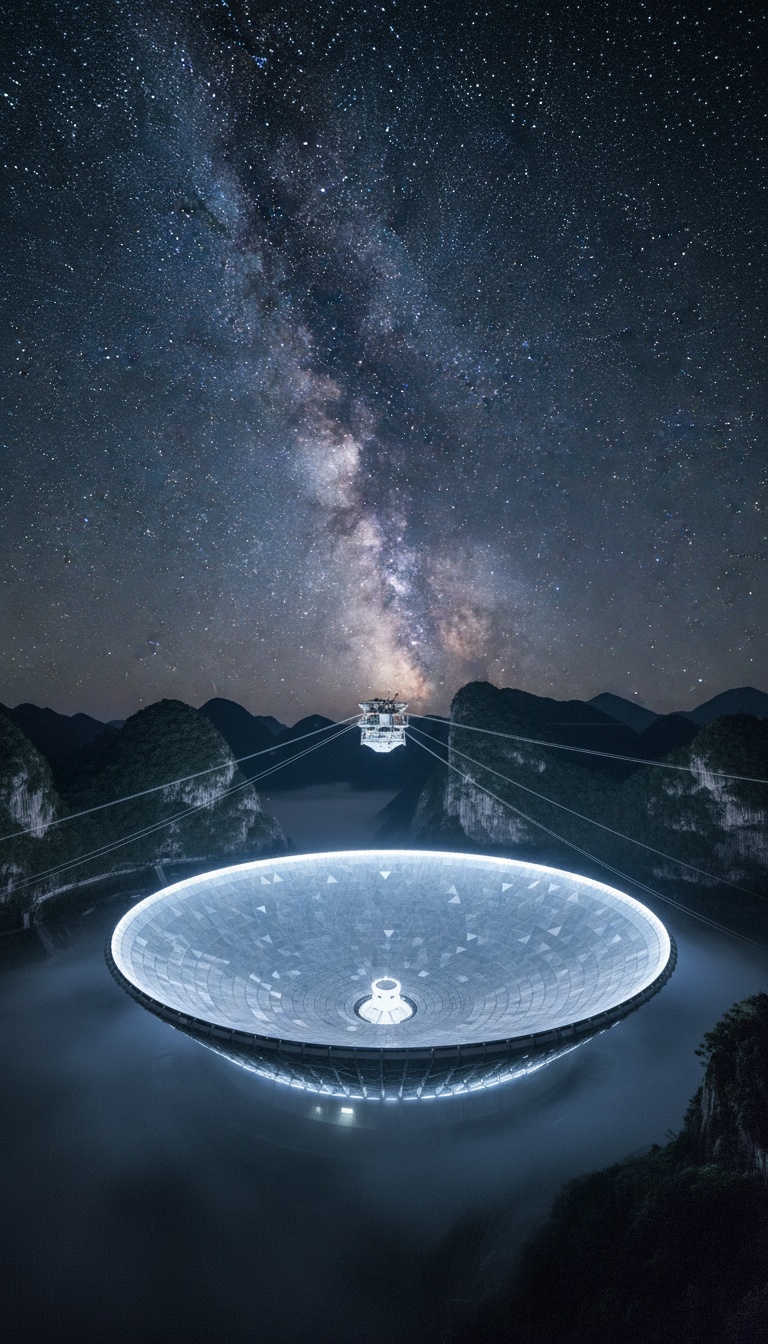
The Ear China Built to Hear Them
FAST stands for the Five-hundred-meter Aperture Spherical radio Telescope. It sits in the Dawodang depression in Pingtang County, Guizhou Province, a natural limestone bowl in southern China. It switched on September 25, 2016. Its dish is 500 meters across and built from 4,450 reflecting panels, a surface area of about thirty football fields. The Arecibo dish in Puerto Rico, 305 meters across and the record holder for 53 years, collapsed on December 1, 2020. FAST now has no rival on Earth.
China cleared the land around it like a sanctuary. Authorities relocated roughly 9,000 residents living within five kilometers of the dish. Phones, cameras and electronics are confiscated at the gate. You do not empty a mountain valley of nine thousand people to listen to static.
The search for alien technology was written into FAST's mission from the start. Zhang Tong-Jie of Beijing Normal University leads its SETI program, working alongside the Berkeley SETI Research Center in California. The telescope carries a 19-beam receiver, nineteen separate ears staring at nineteen patches of sky at once. That design exists for one job: catching a signal that lives in one beam and only one.
Thirty-Three Worlds, 139,127 Kills
The FAST team aimed that receiver at 33 star systems already known to host exoplanets. These were chosen targets, worlds astronomers had confirmed with their own instruments. The telescope was listening for a transmitter on any one of them.
Every hit went into the grinder. The pipeline checked whether a signal showed up in more than one beam, whether it matched known satellite and broadcast bands, and whether it held perfectly still in frequency like a ground transmitter. 139,127 signals failed those tests and were thrown out as human noise.
One signal passed all three. It sat in a single beam. It matched no catalogued human source. It moved in frequency the way a distant, spinning world would make it move. It came from the direction of K2-155.
The Fingerprint SETI Has Hunted Since 1960
In April 1960, a young astronomer named Frank Drake turned an 85-foot dish at Green Bank, West Virginia toward the stars Tau Ceti and Epsilon Eridani. He called it Project Ozma. It was the first deliberate search for alien radio, and it set the rules that every hunt since has followed, including the one at FAST.
Rule one is narrowband. Pulsars, quasars and hydrogen clouds spray their energy across wide stretches of the radio spectrum. A signal squeezed into a sliver only a few hertz wide is what a transmitter makes. Engineers build narrowband carriers because a narrow signal punches farther with less power.
Rule two is drift. A transmitter bolted to Earth rides along with the telescope, so its frequency holds dead flat, and SETI pipelines treat flat signals as local interference for exactly that reason. A transmitter on another planet rotates and orbits relative to us. That motion bends its frequency slowly across the receiver, a Doppler drift. The FAST signal drifted.
Rule three is location. A narrowband, drifting signal that appears in one beam pointed at one target is the full technosignature profile. Drake's generation wrote it down in 1960. FAST matched it more than six decades later, toward a star with planets.
A narrowband signal that drifts is a machine talking. This one was talking from the direction of a planet 238 light-years away.
K2-155: The World on the Other End
K2-155 was found by NASA's Kepler space telescope during its second life, the K2 mission that ran from 2014 to 2018 after two of Kepler's reaction wheels failed. The star sits in the constellation Taurus. It is a red dwarf, smaller and cooler than our Sun, and it carries three known planets.
The outermost of them, K2-155d, made headlines in 2018. A team led by Teruyuki Hirano at the Tokyo Institute of Technology published the system in The Astronomical Journal and ran climate models on K2-155d. The planet is roughly 1.6 times the width of Earth and orbits near the inner edge of its star's habitable zone. Their models allowed liquid water on its surface.
Red dwarfs make up roughly three of every four stars in the Milky Way. They burn steadily for trillions of years, far longer than our Sun will survive. A civilization on a red dwarf world has had more time to grow, more time to build, and more time to aim a transmitter at the sky than anything that has ever lived on Earth.
The Word That Buries It
The standard answer to every candidate signal is radio frequency interference, human noise from some transmitter nobody has catalogued. That answer has a problem here. The FAST pipeline was the interference test. It killed 139,127 signals for looking human. This one walked through it. Calling it interference after it beat the interference filter is a verdict written before the trial.
So the team did not call it interference. They called it unclassified. In plain English, that word means scientists could not assign the signal to a human source and could not assign it to a natural one. Those are the only two boxes on the form besides the one nobody wants to tick.
FAST's alien signals have a history of disappearing. On June 14, 2022, Science and Technology Daily, the newspaper of China's Ministry of Science and Technology, published Zhang Tong-Jie's account of candidate technosignatures picked up by FAST during its exoplanet observations. The story raced around the world. Then the article vanished from the paper's site. A state newspaper deleted its own report about possible alien contact.
The pattern is older than FAST. On August 15, 1977, Ohio State University's Big Ear telescope recorded a 72-second narrowband burst from the constellation Sagittarius. Astronomer Jerry Ehman circled it on the printout and wrote one word in the margin: Wow! Forty-nine years later, that printout is one of the most famous documents in science, and the signal still has no human or natural source assigned to it. Big Ear itself was bulldozed in 1998 to build a golf course.
Why Nobody Says It Out Loud
Every institution in this story has a reason to keep the word small. A government that announces contact owns the next question, which is what it plans to say back. A research program that announces contact stakes its funding and reputation on a claim the whole planet will try to tear down. Unclassified is the safe word. It lets a signal exist on paper without ever existing in the news.
That is why the most important detection FAST has made reads like a footnote. The data says a narrowband, drifting transmission came from the direction of a planetary system, survived 139,127 kills, and fits the technosignature profile Frank Drake wrote down in 1960. The headline that should follow that sentence has never been printed.
Now do the math on the distance. K2-155 sits 238 light-years away, so whatever FAST heard left that system in the late 1700s, while America's founders were drafting the Constitution. Our own first radio broadcasts went out in the 1920s and have only crossed about a hundred light-years of space. They have not reached K2-155 yet.
Which means that signal was never a reply. Someone on that world was calling first, centuries before anyone on Earth could listen. So here is the question nobody at FAST will answer: has that dish been pointed back at K2-155 since, and if it heard the call again, who decided we are not allowed to know? Tell me in the comments what you think they found.
Before you go
7 books the Vatican doesn't want you reading. Free PDF — the texts they cut, with sources. Joined by 140+ Inner Circle members.
No spam. Unsubscribe anytime.
Go deeper
The Hidden Canon, Vol. I — Enoch. Jubilees. Thomas. Mary. Judas. 90 pages, 14 chapters, every receipt cited. The books your Bible quietly removed.
Read the Canon →Books that informed this investigation
As an Amazon Associate, Hidden Epoch earns from qualifying purchases. Cost to you: nothing.
Research safely
The VPN we use to research without being tracked. First 3 months free.
Get NordVPN →