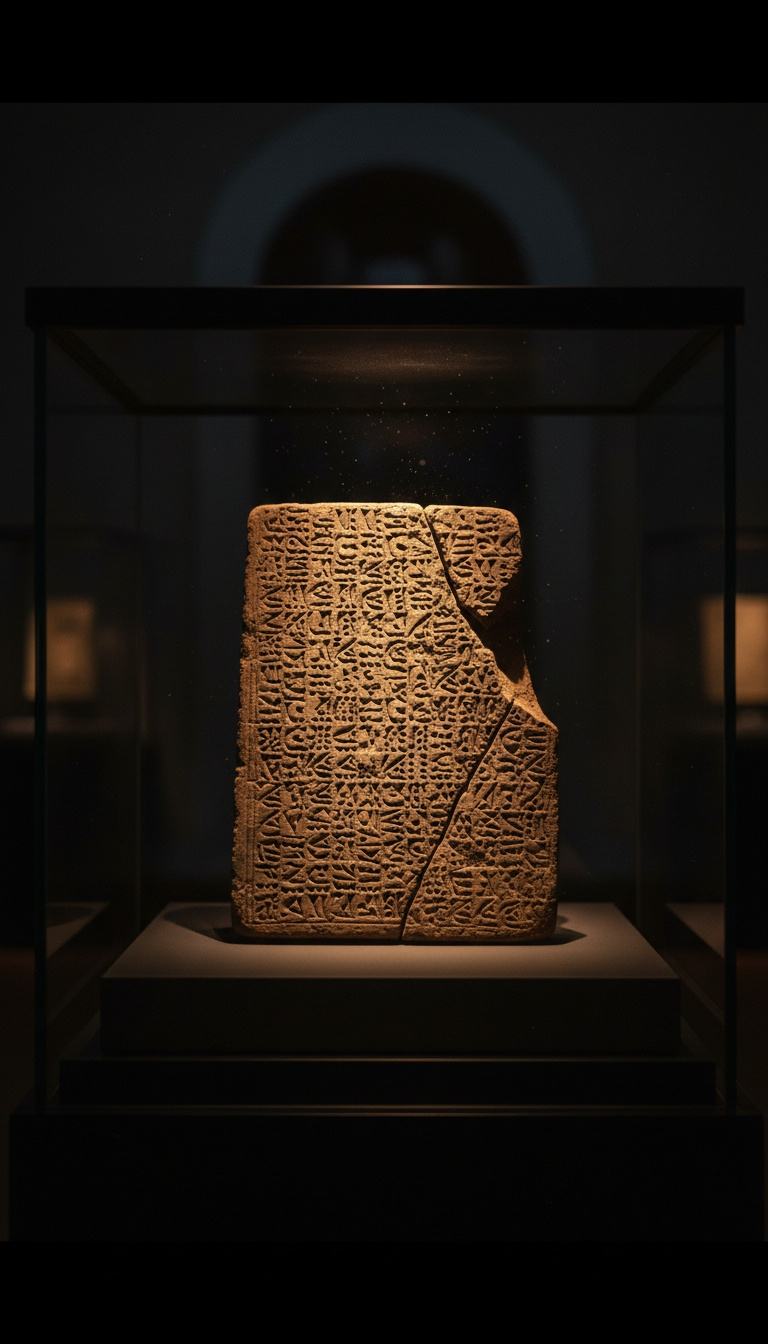
The Flood Tablet, Tablet XI of the Epic of Gilgamesh, is held in the British Museum in London. It says that when the great flood broke, the gods themselves were terrified. They fled upward to the heaven of Anu, the highest sky god, and crouched against its outer wall like dogs. The clay was pressed in the 7th century BC for the library of King Ashurbanipal at Nineveh. It records the makers of humanity losing control of the disaster they started.
That line sits behind glass in London. Mesopotamia credited these beings with making mankind out of clay and blood. Then it recorded them watching their own storm tear the world apart, and running from it. The tablet says so plainly, and it has waited more than 170 years for someone to read it as a report.
Where the Flood Tablet Sits Today
The British Museum catalogues the Flood Tablet as K.3375. The K stands for Kuyunjik, the mound across the Tigris from Mosul that holds the ruins of Nineveh. Hormuzd Rassam dug the library of Ashurbanipal out of that mound in 1853. It held thousands of clay tablets from the last great king of Assyria, who ruled from 668 BC to around 631 BC.
Ashurbanipal collected with a purpose. He sent scribes across his empire to copy the oldest texts in Babylonia and bring them home. Tablet Eleven of Gilgamesh is one of those copies, and the story it carries is far older than the clay. Its flood hero, Utnapishtim, descends from Atrahasis in the Old Babylonian epic of about 1700 BC, and from the Sumerian king Ziusudra before that.
That gives three receipts for one object: a museum number, a royal library, and a city the Bible names. Nineveh is the city Jonah was sent to warn. The flood record survived there, in the archive of the king who ruled it.
The Day George Smith Read It
In 1872 George Smith was a former banknote engraver working as an assistant at the British Museum. He sorted Nineveh fragments that almost nobody alive could read. On one broken piece he found a ship resting on a mountain and a dove sent out that came back. E. A. Wallis Budge, who later worked in the same department, wrote that Smith jumped up, rushed around the room in excitement and began to undress.
On 3 December 1872 Smith read his translation to the Society of Biblical Archaeology in London. Prime Minister William Gladstone sat in the audience. The Daily Telegraph then paid Smith 1,000 guineas to go to Nineveh and find the missing pieces. In 1873 he dug at Kuyunjik and came home with more of the story.
Victorian Britain knew at once what it was holding. Genesis had a rival that was older than Moses and written in a script dead for nearly two thousand years. This rival told the flood with a whole cast of gods.
Torches, Thunder and Six Days of Storm
Utnapishtim, the man who survived the flood, narrates the tablet. When dawn broke, a black cloud rose from the horizon. The storm god Adad thundered inside it. Errakal tore out the mooring posts of the world, and Ninurta made the dikes overflow.
Then comes the line that opens the reel. The Anunnaki lifted up their torches and lit the land with their flame. These are the high gods of Sumer and Akkad, the same Anunnaki who sit in judgment in the underworld texts. They raised light over the land at the moment it was about to drown.
For six days and seven nights the wind blew and the downpour and the tempest flattened the land. On the seventh day the storm went still. Utnapishtim opened a hatch and saw that all of mankind had turned to clay. Every detail is physical: wind, light, water, mooring posts, a hatch and a count of days.
The Gods Who Ran
Here is what the tablet says the gods did while it happened. The flood frightened them. They drew back and went up to the heaven of Anu. They crouched like dogs, lying flat against the outer wall.
The gods were frightened by the flood. They retreated, climbing to the heaven of Anu, and crouched against the outer wall like dogs.
The same passage stacks three more reactions. Ishtar screamed like a woman in childbirth and regretted the evil she had spoken in the assembly of the gods. The Anunnaki wept with her. Their lips were parched and they sat bowed in grief.
Utnapishtim finally offered a sacrifice on Mount Nimush. The gods smelled the savour and gathered over it like flies. The tablet gives these beings bodies, needs and a place to hide. They ran, they wept, they went thirsty and they swarmed toward food.
Enlil, the god who sent the flood, arrived last. He flew into a rage that anyone had lived. Ea had warned Utnapishtim through a reed wall, and now Ea had to talk Enlil down. The council of makers was split and panicked, arguing over what they had unleashed.
The Makers in the Older Record
The claim that these gods made us comes straight from the source. A copy of the Atrahasis epic dated to the reign of Ammi-saduqa of Babylon, around 1640 BC, opens with the lower gods rebelling against digging canals for the higher gods. The answer was a worker. The birth goddess Nintu mixed clay with the flesh and blood of a slain god named We-ila, and humanity was made to carry the load.
The same text explains the flood. Humans multiplied and their noise kept Enlil awake, so he sent plague, then drought, then the deluge. When the water came, the gods of Atrahasis starved. With no humans left to offer bread and beer, they sat thirsting with feverish lips. The makers depended on what they had made.
| Detail | Flood Tablet (Gilgamesh XI) | Genesis 6 to 9 |
|---|---|---|
| Who sends the flood | Enlil, over the council of gods | One God, alone |
| The warning | Ea speaks to Utnapishtim through a reed wall | God speaks to Noah |
| Duration of the storm | Six days and seven nights | Forty days and nights of rain |
| Landing site | Mount Nimush | The mountains of Ararat |
| Birds sent out | Dove, swallow, raven | Raven, dove |
| The gods during the flood | Terrified, flee to the heaven of Anu, cower like dogs | God remains in full control |
| After the sacrifice | The gods gather like flies over it | The Lord smells a pleasing aroma |
Why the Dog Line Is a Report
Assyriology classrooms usually teach the dog line as a simile, a poet's flourish for divine dismay. The tablet itself breaks that reading. A simile describes a feeling. This passage gives a destination, the heaven of Anu, a position against the outer wall and a posture, crouched low. Then it follows the same beings through weeping, thirst and a rush toward food.
Poets dress their gods in glory. Witnesses record where they hid. The scribes kept this passage through more than a thousand years of copying, from Atrahasis to Tablet Eleven, across languages and dynasties. A line that humiliates the gods survives that long for one reason. The people copying it treated it as history.
Read Genesis beside it and the edit is obvious. The later version keeps the ark, the mountain and the birds, and it removes the panic. The removed record is what we track in the lost books and the vault.
Go back to the moment before the storm. The Anunnaki lifted torches and lit the land with flame while the black cloud rose. Then the same beings climbed to the outer wall of Anu's heaven and pressed themselves flat. Enlil sent the flood as a punishment, and it ended with his own council hiding from it.
The clay in London kept the day the makers lost control. Light went up over the land, and the gods fled from a wall of water they had no power to stop. So what was in that storm, or behind it, that frightened the beings who made us?
Frequently Asked
What does the Flood Tablet say the gods did during the flood?
Tablet XI of Gilgamesh says the flood terrified the gods. They retreated to the heaven of Anu and crouched against its outer wall like dogs. Ishtar screamed like a woman in labor and the Anunnaki wept with parched lips.
Where is the Flood Tablet kept?
The Flood Tablet is in the British Museum in London, catalogued as K.3375. It came from the library of King Ashurbanipal at Nineveh, excavated from the Kuyunjik mound in the 1850s.
Who first translated the Flood Tablet?
George Smith, a self-taught assistant at the British Museum, read the flood passage in 1872. He presented it to the Society of Biblical Archaeology on 3 December 1872, with Prime Minister Gladstone in the audience.
Is the Gilgamesh flood older than Noah's flood?
Yes. The same flood story appears in the Atrahasis epic, with copies from around 1640 BC, and in the Sumerian account of Ziusudra before that. Both are centuries older than the written Book of Genesis.
Who were the Anunnaki in the flood story?
The Anunnaki were the high gods of Sumer and Akkad. In the Flood Tablet they raise torches and light the land before the storm, then flee with the other gods to the heaven of Anu.
Before you go
7 books the Vatican doesn't want you reading. Free PDF. The texts they cut, with sources. Joined by 300+ Inner Circle members.
No spam. Unsubscribe anytime.
Go deeper
The Hidden Canon, Vol. I: Enoch. Jubilees. Thomas. Mary. Judas. 90 pages, 14 chapters, every receipt cited. The books your Bible quietly removed.
Read the Canon →