Translate the first ten names in Genesis from Hebrew, read them in order, and they form one sentence that announces the gospel thousands of years before Bethlehem.
Genesis chapter five looks like the most boring page in the Bible. It is a list of fathers, sons, birth years and death years, repeated ten times with almost no story attached. Scribes copied it letter by letter for three thousand years. The oldest complete Hebrew Bible on Earth, the Leningrad Codex, dated 1008 AD and held today at the National Library of Russia in St. Petersburg, carries it intact. Fragments of Genesis recovered from the caves at Qumran sit under glass at the Shrine of the Book in the Israel Museum, Jerusalem. The list survived because nobody thought it was worth tampering with. That is exactly why it is the perfect place to hide something.
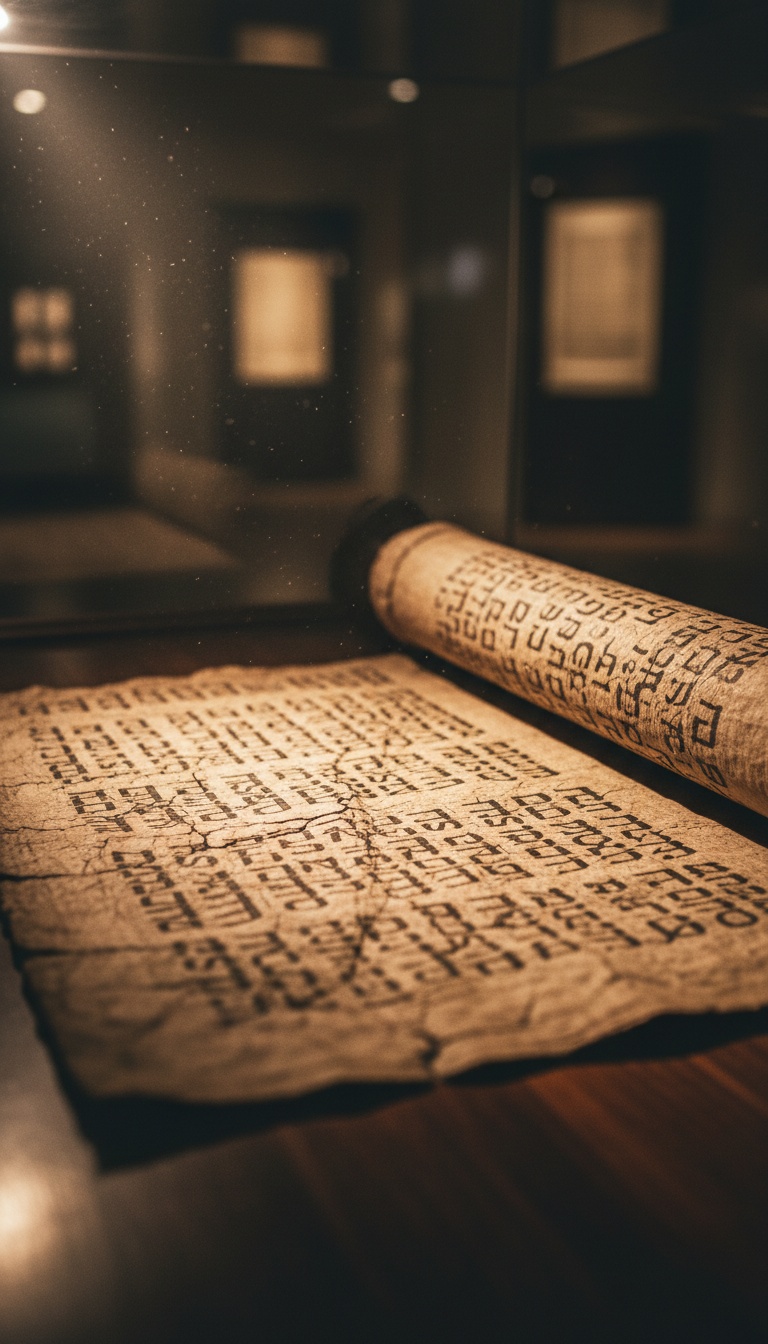
Ten Names, Ten Hebrew Roots
Every Hebrew name is a word, and every word has a root. Start at the top of the line. Adam comes from adam, meaning man, the same word for the red earth he was formed from in Genesis 2:7. Seth comes from shath, appointed, and Eve says it herself in Genesis 4:25: God has appointed me another seed.
Enosh is the Hebrew word for mortal, frail man. Psalm 8:4 uses it when David asks what is man that you are mindful of him. Kenan carries the root qinah, a dirge, a song of sorrow. Four names in and the sentence already reads man, appointed, mortal sorrow. That is the human condition after Eden, stated in four words.
Then the line turns. Mahalalel splits into mahalal, praise or blessed, and El, God. The blessed God. Jared comes from yarad, to descend, to come down. Enoch means teaching, dedicated, the same root behind Hanukkah. Methuselah fuses muth, death, with shalach, to send forth: his death shall bring. Lamech carries the sense of the despairing, the struck down. Noah is nuach, rest, and Genesis 5:29 confirms it when Lamech names his son and says this one shall comfort us.
The Sentence Hiding In Genesis Chapter Five
Lay the ten translations side by side and read them as one line. Man appointed mortal sorrow. The blessed God shall come down teaching. His death shall bring the despairing rest.
That is the entire gospel in a single breath. Humanity is sentenced to death and grief. God himself descends. He teaches. His death delivers rest to the hopeless. Paul spent whole letters unpacking that sequence. Genesis compresses it into ten names written by the hand Jewish and Christian tradition both credit to Moses, roughly fourteen centuries before the cross.
The late Bible researcher Chuck Missler brought this reading to a mass audience in his 1999 book Cosmic Codes, and the Hebrew roots he cited are the same roots any Strong's concordance lists today. Anyone with a lexicon can check every link in the chain in an afternoon. The message has been sitting in the open the whole time.
Methuselah's name meant his death shall bring it. Run the numbers in Genesis and he dies in the exact year the flood arrives.
Methuselah's Name Was A Countdown
Here is the receipt that turns a word puzzle into a prophecy. Methuselah lived 969 years according to Genesis 5:27, longer than any human being recorded in scripture. Now do the arithmetic the chapter hands you.
Methuselah was 187 when his son Lamech was born, per Genesis 5:25. Lamech was 182 when Noah was born, per Genesis 5:28. Noah was 600 when the floodwaters came, per Genesis 7:6. Add them: 187 plus 182 plus 600 equals 969. Methuselah dies in the very year the flood breaks. His father Enoch, the man whose name means teaching, named him that way after walking with God, and Jude 14 records Enoch as a prophet who saw judgment coming. A father who knew the end was coming gave his son a name that worked like a timer. As long as Methuselah breathed, the world was spared. The year he died, the rain started.
Then Noah, the name that means rest, walked into the ark. The genealogy does what its own words say. Death brings the flood, and rest rides through it.
Jared, The Descent, And The Book Of Enoch
The sixth name carries a second layer. Jared means to come down, and the Book of Enoch, a text found in multiple copies among the Dead Sea Scrolls and quoted directly in the New Testament letter of Jude, says the Watchers descended to Mount Hermon in the days of Jared. 1 Enoch chapter 6 names the moment. Two hundred fallen beings came down while Jared was alive.
So the name Jared marks two descents. One is the rebellion that corrupted the world before the flood. The other is the descent of the blessed God that the sentence promises. The same word sits at the hinge of both stories, a corruption from above answered by a rescue from above. Genesis lines up a cosmic war inside a single syllable.
Critics Attack The Dictionary. The Timeline Answers Them.
The strongest counterattack goes after the translations. Lexicon writers such as the editors of the Brown-Driver-Briggs Hebrew lexicon gloss Methuselah as man of the dart, reading shelach as a weapon instead of a sending. Their claim is that the gospel sentence depends on cherry-picked meanings.
Hebrew roots carry several meanings at once, and the dart reading and the sending reading come from the same three letters. The question is which meaning the text itself endorses. Genesis answers with arithmetic. The man whose name can be read as his death shall send it dies in the flood year to the exact digit. Genesis 5:29 explicitly interprets Noah's name as comfort and rest. Genesis 4:25 explicitly interprets Seth as appointed. The author of the chapter is telling you, in his own words, that these names were chosen for what they mean. The lexicon offers options. The timeline picks one.
And the number ten is a signature. The Weld-Blundell Prism, a clay Sumerian King List held at the Ashmolean Museum in Oxford, records kings ruling before a great flood, and the Babylonian priest Berossus counted exactly ten of them. Mesopotamia remembered ten generations before the deluge. Genesis remembered ten as well, and loaded each one with a word.
Why Bury It In A Family Tree
A message hidden in a prophecy gets edited, argued over and fought about. A message hidden in a genealogy gets copied with mechanical care, because no scribe thinks a birth year is theology. Genesis chapter five wraps these ten names in nothing but numbers. Who begat whom, how many years, and then he died. Eight times the chapter repeats the phrase and he died, a drumbeat of mortality, until the sentence underneath promises a death that ends death.
Luke saw it. Luke chapter 3 runs Jesus's family line backward, and verses 36 through 38 walk through these exact ten names in reverse, Noah, Lamech, Methuselah, Enoch, Jared, Mahalalel, Kenan, Enosh, Seth, Adam, ending with the son of God. The physician who wrote the most detailed gospel stitched the carpenter from Nazareth directly onto the sentence that predicted him.
Ten names. One sentence. A man named his son after the flood, and the flood came the year that son died. A genealogy that nobody bothered to alter carried the outline of the cross for fourteen hundred years before anyone stood at Golgotha.
And Genesis has more family trees. The line of Shem in chapter eleven runs another ten generations, from the flood straight to Abraham. If the first ten names spell out the arrival of God, what do the next ten names say about what happens after he leaves? Translate them yourself and drop what you find in the comments.
Before you go
7 books the Vatican doesn't want you reading. Free PDF — the texts they cut, with sources. Joined by 140+ Inner Circle members.
No spam. Unsubscribe anytime.
Go deeper
The Hidden Canon, Vol. I — Enoch. Jubilees. Thomas. Mary. Judas. 90 pages, 14 chapters, every receipt cited. The books your Bible quietly removed.
Read the Canon →Books that informed this investigation
As an Amazon Associate, Hidden Epoch earns from qualifying purchases. Cost to you: nothing.
Research safely
The VPN we use to research without being tracked. First 3 months free.
Get NordVPN →