The Bible named this structure before any archaeologist excavated it. That name is the only explanation that has not collapsed under scrutiny.
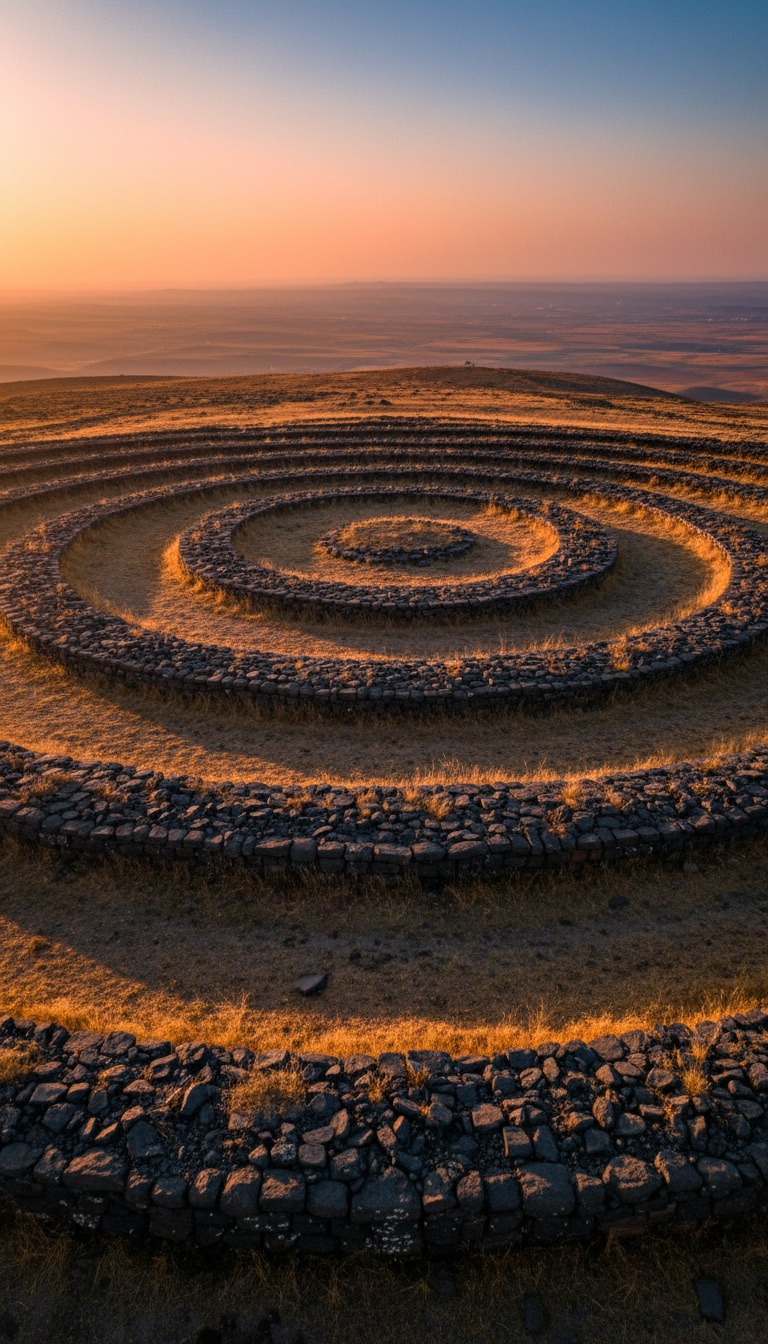
Rujm el-Hiri. Golan Heights, modern Israel. Five concentric rings of basalt stone rising from a volcanic plateau at 1,000 meters elevation. Forty-two thousand tons of material. No mortar. No inscription. Not a single artifact dropped by the builders during construction. The site dates to at least 3000 BCE, placing it a thousand years before the Stonehenge sarsen circle and contemporaneous with the first Egyptian pyramid program at Saqqara. The Bible calls it Gilgal Refaim. The Wheel of Giants. Then it names who built it.
The name the Bible kept
Gilgal Refaim. The word Refaim is rooted in a Hebrew term that carries two distinct registers. In biblical taxonomy it designates a specific lineage: the Rephaim, the race of giant men described in Deuteronomy 2:11 as related to the Anakim and in Genesis 6 as descended from the Nephilim, the offspring of divine beings and human women. In the second register the same word means shades or spirits of the dead, which is why rabbinical commentary treats the Rephaim as a category apart from any ordinary human ethnic classification. The Israelites who named this structure did not call it the Wheel of the Canaanites or the Wheel of Early Bronze Age Farmers. They attached the name of a non-human lineage. In the Hebrew naming convention, a place name encodes the memory of who was found there. Gilgal Refaim is a statement, not a label.
Forty-two thousand tons with no owner
The outermost ring at Rujm el-Hiri measures 160 meters in diameter. The innermost ring encloses a central cairn 20 meters across. Israeli archaeologist Yonathan Mizrachi conducted formal excavations at the site in the 1980s under the Israel Antiquities Authority. His team found no pottery shards attributable to the construction phase. No weapons. No organic material carbon-datable to the building period. The workforce that moved 42,000 tons of basalt across an elevated plateau and set it into five geometrically precise concentric rings left zero material trace of itself. Construction projects at this scale always produce tool deposits, food refuse, and site debris. Rujm el-Hiri produced none of those things. The builders arrived, built, and erased their presence so completely that three decades of professional excavation found no entry point into who they were.
Tel Aviv University ran the alignment test in 2025
The favored institutional explanation for thirty years was astronomical alignment. Researchers at the University of Haifa published papers claiming the northeastern gateway of the outer ring aligned with summer solstice sunrise during the Early Bronze Age. Additional researchers proposed Pleiades alignments for the same period. The theory spread into academic literature because it answered the question of why without requiring anyone to answer who. In 2025, a Tel Aviv University research team applied corrected geodetic data to the verified site position, accounting for tectonic displacement across the Golan plateau since 3000 BCE. Every proposed astronomical alignment failed the corrected coordinates. The structure's current verified position places it off-axis from every celestial event the observatory model required. The theory is not under revision. It is closed. Rujm el-Hiri has no verified construction purpose.
Every proposed alignment failed the corrected coordinates. The observatory theory is not under revision. It is closed. Rujm el-Hiri has no verified construction purpose.
One valley over: the tomb of the last Rephaim king
Deuteronomy 3:11 identifies King Og of Bashan as the last surviving member of the Rephaim lineage. The text records the dimensions of his iron bed: nine cubits long, four cubits wide. At the standard Hebrew cubit of 52.5 centimeters that places the bed at 4.7 meters by 2.1 meters. The Bible notes the measurement because the measurement required noting. Og's territory was Bashan. The exact volcanic plateau where Rujm el-Hiri stands. One valley east of the site, near Khirbet el-Lahun, there is a megalithic dolmen that Arab communities in the region historically called the tomb of Og. A single basalt capstone sits on three upright support stones. The capstone is estimated at 400 tons. No mortar. No inscription. The construction logic is identical to the rings: dry-stacked basalt at a scale that does not match the tools archaeologists have assigned to the period. The Bible buried Og in Bashan. The largest dolmen in the Bashan valley sits where the Bible placed his tomb.
The Golan dolmen field
Rujm el-Hiri is not a single anomaly. Archaeologist Gonen Sharon of Tel Hai College published a survey in 2011 documenting 399 megalithic dolmens distributed across the Golan Heights and the Galilee panhandle. The construction window Sharon's survey assigned runs from approximately 4500 BCE to 3000 BCE. A 1,500-year building program with no administrative center, no capital, no identifying text. Sharon's team found no permanent settlement infrastructure to support the labor: no granaries, no tool production deposits, no evidence of a resident population capable of sustaining industrial-scale stone movement across fifteen centuries. The builders were not from there. They entered the Golan, built at massive scale, and left without residue. The dolmen field occupies the exact territory the Bible assigned to the kingdom of Og and his predecessors among the Rephaim. The Israelites who later entered that territory found the structures already ancient. They named the builders. They named the last king. They kept both names in the canonical text and attached them to specific geography that can still be walked today.
What no explanation has reached
The Israel Antiquities Authority maintains Rujm el-Hiri within a protected archaeological reserve in the Golan. The structure has been photographed from satellite, mapped by ground-penetrating radar, and published across dozens of peer-reviewed journals since the 1960s. None of that work has produced a verified construction purpose. The astronomical answer required alignments the 2025 geodetic study erased. A burial interpretation requires human remains that Mizrachi's excavation did not find in any stratum assigned to the construction phase. A ritual interpretation requires organic residue, offering deposits, charcoal. None of it exists. What exists is 42,000 tons of basalt in five precise rings, constructed by a group that carried no identifiable tools, left no food, and wrote nothing down anywhere on the site or in any contemporaneous Near Eastern record that has been found.
The 2025 Tel Aviv University result removed the last standing institutional answer. Every prior attempt at a functional explanation met a specific evidentiary wall and stopped. The astronomical theory stopped at the corrected coordinates. The burial theory stopped at the empty excavation. The ritual theory stopped at the absent residue. What remains is the stone, the rings, the biblical name, and the biblical attribution. The text names the builders. The same text names their king. The same text records his physical dimensions. The construction sits in the right territory, built in the right era, at the right scale to match the attribution the Israelites preserved across three thousand years of transmission.
Name the alternative. Not the one the University of Haifa proposed and Tel Aviv University closed in 2025. The next one. Tell me who moved 42,000 tons of basalt into five perfect rings on a volcanic plateau, left no tools and no food and no writing, then built the same way in the valley where the Bible buried their last king. The structure is still there. The name is still in the text. The question still has only one address, and every institution that tried to change it ran out of data before it ran out of confidence.
Before you go
7 books the Vatican doesn't want you reading. Free PDF — the texts they cut, with sources. Joined by 140+ Inner Circle members.
No spam. Unsubscribe anytime.
Go deeper
The Hidden Canon, Vol. I — Enoch. Jubilees. Thomas. Mary. Judas. 90 pages, 14 chapters, every receipt cited. The books your Bible quietly removed.
Read the Canon →Books that informed this investigation
As an Amazon Associate, Hidden Epoch earns from qualifying purchases. Cost to you: nothing.
Research safely
The VPN we use to research without being tracked. First 3 months free.
Get NordVPN →