In 4900 BC, three thousand years before the first stone was dragged to Stonehenge, farmers in central Germany who had never seen a wheel built a solar observatory so precise that modern surveying equipment confirms its alignments to within a fraction of a degree.
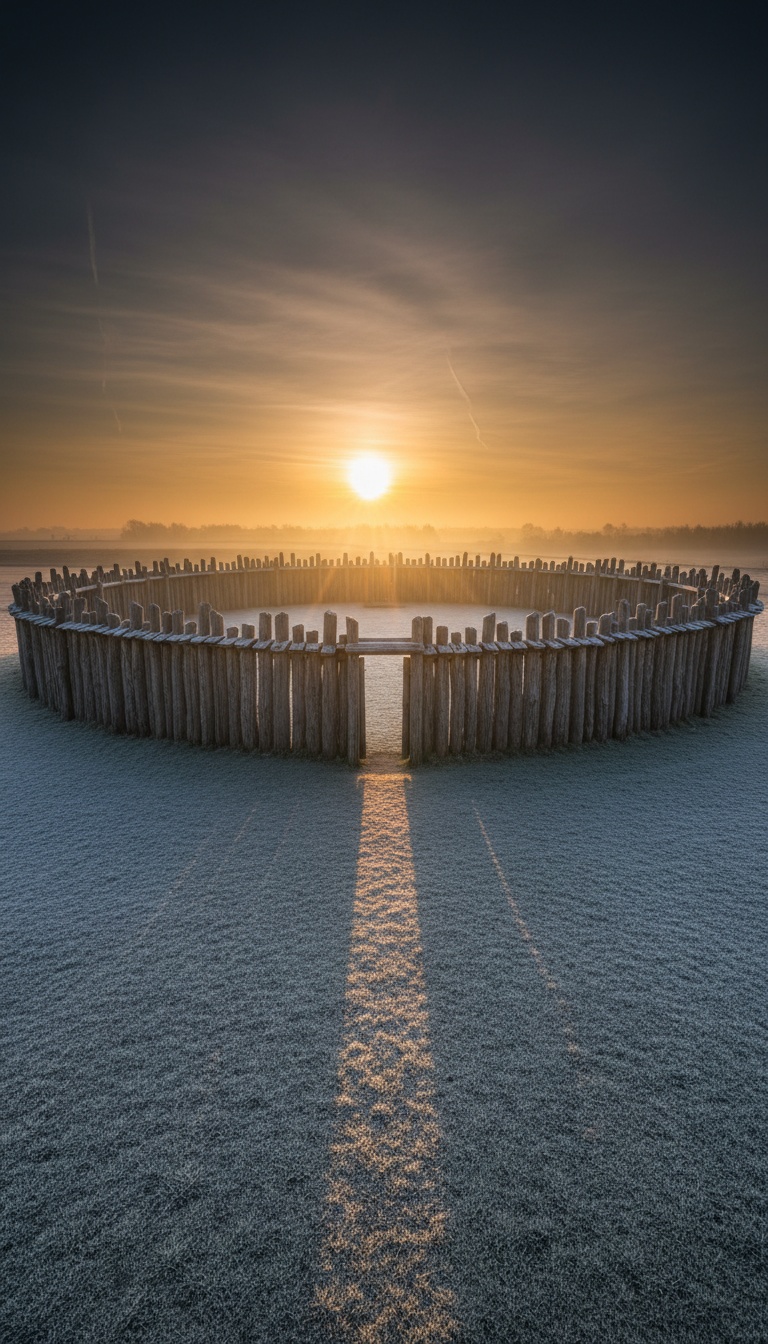
The site is called the Goseck Circle. It sits in a field in Saxony-Anhalt, about 40 kilometers southwest of Leipzig. Three concentric rings. Two wooden palisades inside a circular ditch, 75 meters across, with gates cut at exact angles. The southeast gate catches the winter solstice sunrise. The southwest gate catches the winter solstice sunset. A third opening tracks the summer alignment. This is not a monument that gestures at the sky. This is an instrument. And the people who built it left no explanation, no writing, no successor structure, and no math. They built it, used it for roughly two centuries, and walked away.
The Photograph That Started It
In 1991, aerial archaeologist Otto Braasch was flying survey routes over the Burgenlandkreis district of Saxony-Anhalt when he photographed a set of dark rings pressed into a wheat field near the village of Goseck. Crops grow differently over buried ditches. The rings were the ghost of something enormous. It took until 2002 for a team from Martin Luther University of Halle-Wittenberg, led by François Bertemes and Peter Biehl, to put shovels in the ground. What they uncovered was a circular ditch enclosing two rings of wooden post holes, with three gaps positioned at angles that made the archaeologists stop and check their instruments. Radiocarbon dating of the pottery and organic material in the ditch put construction at approximately 4900 BC. That date has held through every subsequent test.
The Gates Do Not Miss
Stand at the center of the Goseck Circle on December 21 and the sun rises directly through the southeast gate. It sets directly through the southwest gate. The angles are not close. They are exact for the site's latitude, 51.2 degrees north, and surveyors who measured the reconstructed post positions against the original post holes confirmed the alignments fall within a fraction of a degree of the true solstice azimuths. Germany rebuilt the circle on its original footprint using the excavated post hole positions, and the reconstruction opened on December 21, 2005, specifically so the public could watch the sun perform on cue. It did. It has every winter since. Seven thousand years after the builders drove the first oak post, their instrument still works.
The Toolbox That Was Not There
Now inventory what these builders had. The earliest accepted evidence of the wheel anywhere on Earth is the wagon image on the Bronocice pot, held at the Archaeological Museum in Kraków, dated around 3500 BC. That is 1,400 years after Goseck. The earliest writing appears at Uruk in Mesopotamia around 3200 BC. That is 1,700 years after Goseck. Metal tools had not reached central Europe. The builders were the Stroke-Ornamented Ware culture, named for the stab-and-drag patterns on their pottery, farmers living in timber longhouses who left behind grain, cattle bones and clay. No compass. No sighting instrument. No number system anyone has ever recovered. And yet the gates do not miss.
Why the Standard Story Collapses
The textbook answer says Neolithic farmers watched the horizon for generations, marked where the sun stopped its winter crawl, and built around the accumulated observations. Run that answer through the actual construction problem and it falls apart. Generational sky-watching gets you an approximation, a smear of horizon several sun-widths wide, because the solstice sun barely moves for days on either side of December 21. Goseck is not a smear. The gates are fixed architecture, cut into two separate palisade rings and a ditch that all agree with each other, which means the builders knew the exact solstice azimuth before the first post hole was dug. You need the endpoint before you touch the ground. You need the math before the wood. The precision at Goseck is front-loaded, and front-loaded precision means the knowledge arrived complete.
You need to know where the sun rises on December 21 before you dig the first post hole. Someone handed them the endpoint.
The Bones in the Ditch
The excavation found more than post holes. Bertemes' team recovered cattle bones, deer remains and traces of ritual fires concentrated near the gates. They also found human bones, including a headless skeleton deposited near the southeast gate, the winter sunrise gate, the exact point where the instrument does its work. Whatever happened inside those rings, it was serious enough to involve the dead. Then, around 4700 BC, after roughly 200 years of use, the site was deliberately closed. The ditch filled in. The posts rotted or were pulled. Nothing was built to replace it. The people who possessed the most advanced astronomical construction on the planet stopped building. Cultures do not abandon their crown jewel at its peak. They abandon it when the reason for it is gone.
The Disk 25 Kilometers Away
Drive 25 kilometers from Goseck and you reach the Mittelberg hill near Nebra, where looters in 1999 dug up a bronze disk inlaid with gold. The Nebra Sky Disk, now held at the State Museum of Prehistory in Halle, is dated around 1600 BC and encodes the sun, a lunar crescent, the Pleiades cluster, and two gold horizon arcs spanning 82 degrees each. That 82-degree span is the exact angle between the summer and winter solstice sunsets at that latitude. The same solstice geometry built into Goseck's gates, resurfacing in the same river valley, 3,300 years later, in a completely different medium. Knowledge that precise does not independently reappear in the same 25-kilometer radius twice. It gets kept. Someone in the Saale valley was curating solstice mathematics across three millennia, and neither culture wrote a single word explaining where it came from.
Goseck is not alone. Archaeologists have now identified more than 250 of these circular ditch enclosures, the Kreisgrabenanlagen, scattered across Germany, Austria, the Czech Republic and Slovakia, and the dated ones cluster into a window of just a few centuries around 4900 to 4600 BC. The same design. The same gates. The same astronomy. Then the entire tradition shuts off across an entire continent at once, like a program ending.
So hold the sequence in your head. The knowledge arrives complete, before the wheel, before writing, before metal. It gets executed flawlessly at 250 sites. It gets used for two centuries. Then the builders close the ditches, walk away, and the skill vanishes from Europe for thousands of years until it surfaces on a bronze disk down the road. Knowledge that arrives complete was carried in. Knowledge that vanishes cleanly was carried out. The question was never how Neolithic farmers built a perfect solar observatory. The question is who visited the Saale valley in 4900 BC, what they were measuring, and why they needed 250 instruments to do it. Tell me in the comments who you think gave them the numbers. Because somebody did.
Before you go
7 books the Vatican doesn't want you reading. Free PDF, the texts they cut, with sources. Joined by 140+ Inner Circle members.
No spam. Unsubscribe anytime.
Go deeper
The Hidden Canon, Vol. I, Enoch. Jubilees. Thomas. Mary. Judas. 90 pages, 14 chapters, every receipt cited. The books your Bible quietly removed.
Read the Canon →Books that informed this investigation
As an Amazon Associate, Hidden Epoch earns from qualifying purchases. Cost to you: nothing.
Research safely
The VPN we use to research without being tracked. First 3 months free.
Get NordVPN →