The Bible you own is missing 114 sayings attributed to Jesus, and the reason has less to do with heresy than with real estate. Specifically, who owns the real estate between you and God.
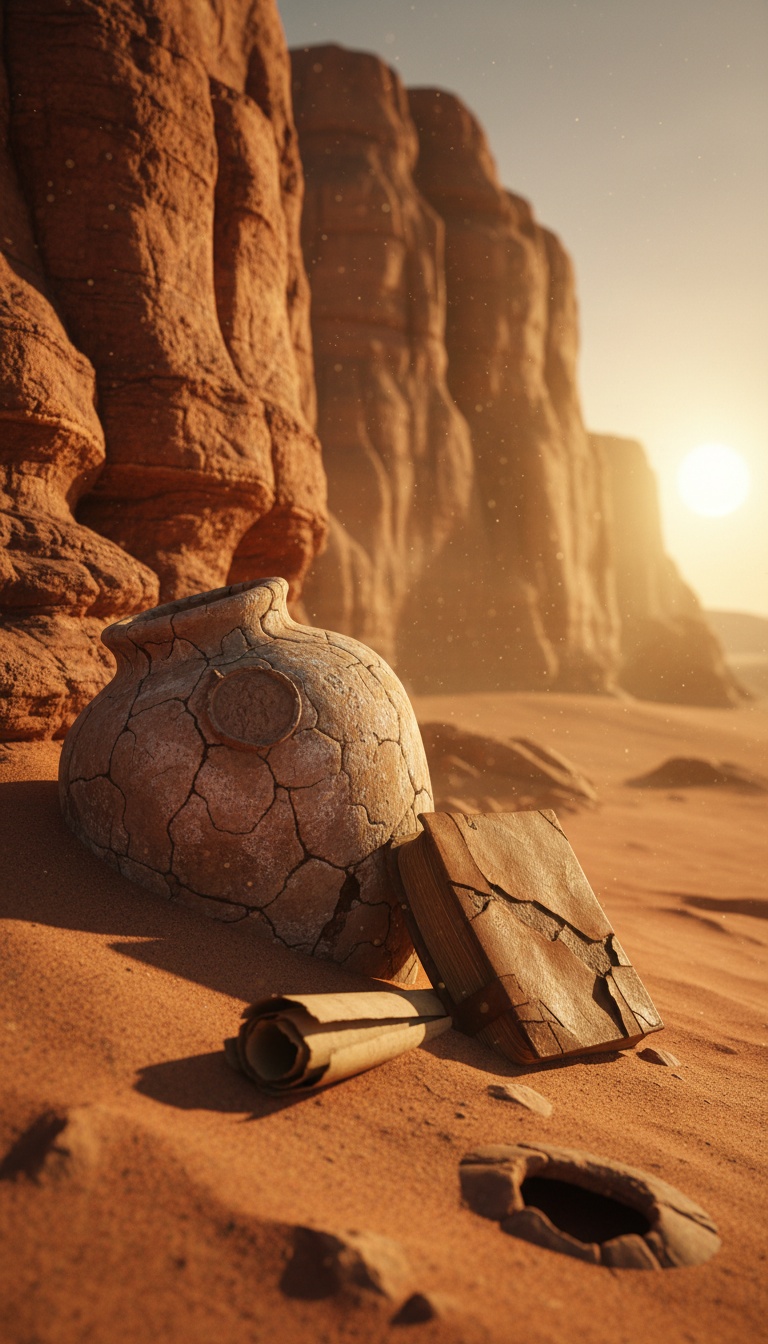
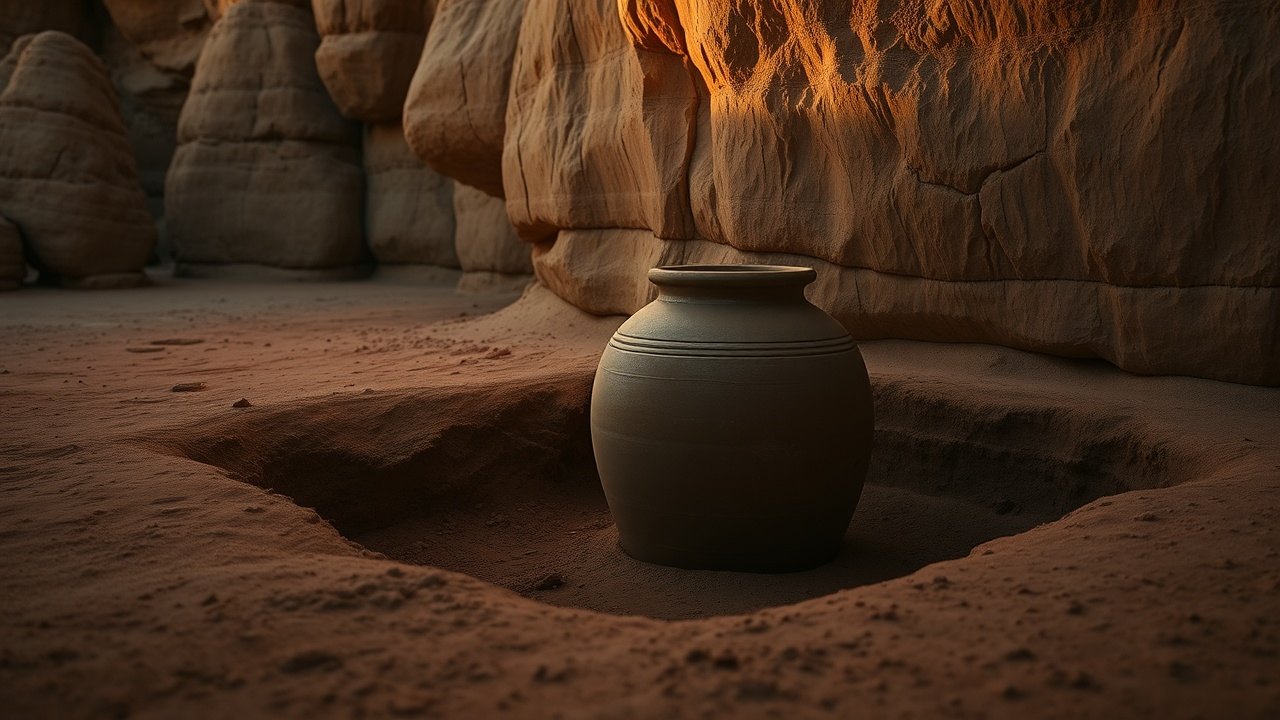
In December 1945, two Egyptian farmers named Muhammad and Khalifah Ali al-Samman were digging for sabakh fertilizer at the base of the Jabal al-Tarif cliffs near Nag Hammadi. Their mattock struck a sealed clay jar. Inside were thirteen leather-bound codices. One of them changed everything we thought we knew about the first three centuries of Christianity.
The Jar Under The Cliff
The find site sits about 10 kilometers northeast of Nag Hammadi in Upper Egypt, near the ruins of the Pachomian monastery of Chenoboskion. The jar contained thirteen papyrus codices bound in tooled leather, radiocarbon and paleographically dated to around 340 AD.
The codices were carried back to the al-Samman home, where the mother reportedly used part of one codex as kindling for the bread oven before the family understood what they were holding. What survived the fire eventually reached the Coptic Museum in Cairo, where the bulk of the collection remains cataloged today as the Nag Hammadi Library.
Codex II, the second book in the stack, contains seven texts. The second text in that codex, running from page 32 to page 51 of the manuscript, is titled in Coptic: peuaggelion pkata Thomas. The Gospel According to Thomas.
What The Text Actually Says
The Gospel of Thomas is not a narrative. There is no manger, no wise men, no wedding at Cana, no cross, no empty tomb. It is 114 numbered sayings, each opening with the phrase “Jesus said.”
Roughly two-thirds of the sayings have direct parallels in Matthew, Mark, or Luke. The mustard seed, the sower, the rich fool, the lost sheep. The editio princeps published by Brill in 1959 counts more than 80 percent parallel material when partial matches are included. This is not a fringe document invented centuries later. This shares source material with the Synoptic Gospels.
The other third is where the problem starts. Saying 3 has Jesus telling his followers the Kingdom of God is not in the sky and not in the sea. It is inside you and outside you. Saying 77 has Jesus saying: cut a piece of wood, I am there. Lift a stone, you will find me. Saying 70 says that if you bring forth what is within you, what you bring forth will save you.
The Athanasius Letter of 367 AD
In the spring of 367 AD, Bishop Athanasius of Alexandria issued his 39th Festal Letter. The document survives in Greek fragments and in a Coptic translation preserved at the White Monastery near Sohag. It is the first known list to define the 27-book New Testament canon we use today.
The letter did not simply recommend the approved list. It ordered that all other writings be rejected as apocryphal and destroyed. Athanasius commanded monks under his jurisdiction to purge non-canonical texts from their libraries.
The Pachomian monastery at Chenoboskion sat directly within his ecclesiastical jurisdiction. The Nag Hammadi codices are dated to roughly the same window as the letter. The jar was buried, not burned. Someone in that monastery decided these books were worth hiding from their own bishop.
The books that required a priest to interpret them survived. The one that told you to look inside your own chest got buried under a cliff for 1,600 years.
Follow The Institutional Money
Read the canonical four gospels and count the sacraments. Baptism requires a minister. Communion requires bread consecrated by clergy. Confession, in the developed tradition, requires a priest. Absolution flows through an ordained hand.
Now read Thomas. There is no baptism scene. There is no Last Supper institution narrative. There is no apostolic succession. Saying 108 has Jesus telling Thomas that whoever drinks from his mouth will become like him, and Jesus will become that person. The mediator collapses into the seeker.
An institution built on gatekeeping sacraments cannot survive a text that removes the gate. This is not a theological quirk. This is a business model conflict. By 380 AD, thirteen years after the Festal Letter, Emperor Theodosius issued the Edict of Thessalonica making Nicene Christianity the state religion of Rome. The financial and political stakes were no longer abstract.
The Syriac Trail And The Oxyrhynchus Fragments
Skeptics argue Thomas is a late Gnostic invention. The physical evidence pushes back.
Three Greek fragments discovered at Oxyrhynchus in 1897 and 1903 by Bernard Grenfell and Arthur Hunt, cataloged as P.Oxy. 1, 654, and 655 and now held at the Bodleian Library in Oxford and the Houghton Library at Harvard, contain portions of the Gospel of Thomas in Greek. They are paleographically dated between 130 and 250 AD. That is at minimum a century before the Coptic Nag Hammadi copy and before Athanasius was born.
The name Judas Thomas the Twin appears in the Syriac Christian tradition centered at Edessa, in texts like the Acts of Thomas and the Book of Thomas the Contender. Scholars including April DeConick at Rice University and Nicholas Perrin have traced core sayings material to a Syrian milieu potentially as early as 60 to 100 AD, contemporary with the writing of the canonical gospels.
Who Decided And Who Benefited
Four men made the calls that shaped what you read today. Irenaeus of Lyon, writing Against Heresies around 180 AD, was the first to insist there must be exactly four gospels because there are four winds and four corners of the earth. Eusebius of Caesarea, writing his Ecclesiastical History around 325 AD, sorted books into accepted, disputed, and rejected. Athanasius of Alexandria, in 367 AD, locked the list. The Council of Carthage in 397 AD ratified it for the Western church.
Each of these men held ecclesiastical office. Each of them derived authority from an institutional hierarchy. None of them were neutral observers. The books that survived were the books that reinforced the office each of them held.
The Gospel of Thomas told readers the Kingdom was already inside them. No office required. That was the threat.
The Coptic manuscript of Thomas sits today in the Coptic Museum in Cairo, catalog number 10544, on display for anyone with a plane ticket and 100 Egyptian pounds. The Oxford fragments sit in a glass case at the Sackler Library. The evidence is not hidden anymore. The jar is open.
What is still hidden is the question of what else was in that library at Alexandria before Athanasius sent his letter. How many other jars are still under how many other cliffs. And why, when you ask a modern seminary professor about Saying 77, the conversation ends fast.
Cut a piece of wood. Lift a stone. Tell me in the comments what you think they were actually afraid you would find.
Before you go
7 books the Vatican doesn't want you reading. Free PDF, the texts they cut, with sources. Joined by 140+ Inner Circle members.
No spam. Unsubscribe anytime.
Go deeper
The Hidden Canon, Vol. I, Enoch. Jubilees. Thomas. Mary. Judas. 90 pages, 14 chapters, every receipt cited. The books your Bible quietly removed.
Read the Canon →Books that informed this investigation
As an Amazon Associate, Hidden Epoch earns from qualifying purchases. Cost to you: nothing.
Research safely
The VPN we use to research without being tracked. First 3 months free.
Get NordVPN →