The Vietnam War escalated over an attack the NSA's own study says never happened.
More than 58,000 American names are cut into the black granite of the Vietnam Veterans Memorial on the National Mall in Washington. The legal machinery that sent them there was built in six days in August 1964, on the strength of a night battle in the Gulf of Tonkin. The National Security Agency's own historian went back through the intercepts from that night and found a ghost.
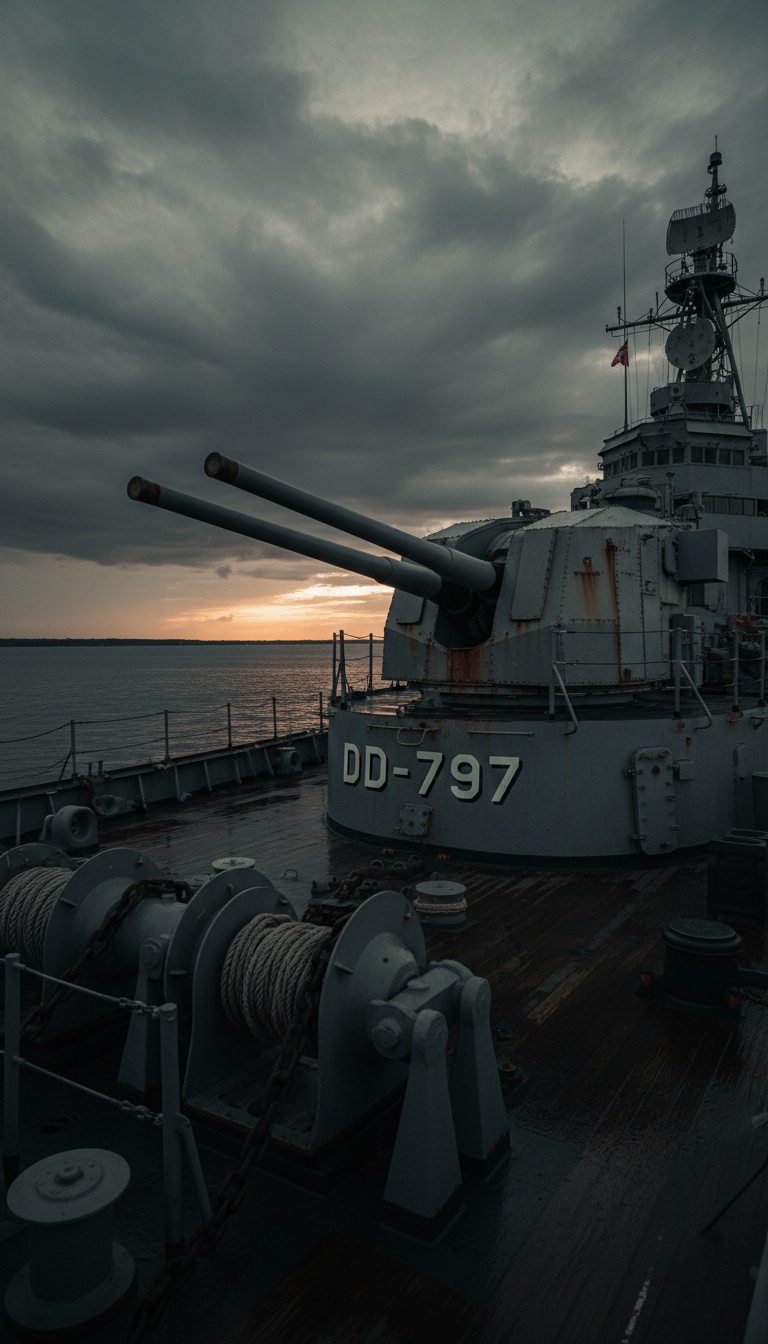
August 2, 1964: The Battle That Happened
The USS Maddox was in the Gulf of Tonkin on an electronic spying run the Navy code-named DESOTO. Captain John J. Herrick commanded the patrol from aboard, with a van of intercept gear bolted to the deck to listen in on North Vietnamese radio.
Two nights earlier, on July 30 and 31, South Vietnamese commandos running under the secret Pentagon program OPLAN 34A shelled the islands of Hon Me and Hon Ngu. Hanoi read the American destroyer sitting offshore as part of the same operation.
On the afternoon of August 2, three North Vietnamese P-4 torpedo boats charged the Maddox. The destroyer fired first, then F-8 Crusaders from the carrier USS Ticonderoga strafed the boats until they limped home damaged. A single machine-gun round struck the Maddox.
That fight was real. Remember those damaged boats. They come back later in this story as the evidence for a battle that never took place.
August 4: Torpedoes Nobody Could Find
On the night of August 4, the Maddox and the USS Turner Joy were back in the gulf under a black, stormy sky. Radar screens filled with contacts. Sonar operators called out torpedo after torpedo, more than twenty by the end of the night.
For roughly four hours the two destroyers poured hundreds of rounds into the dark, swinging hard to dodge torpedoes that only existed on a sonar headset.
Commander James Stockdale flew his F-8 Crusader low over the destroyers that night, with the best view of anyone alive. In his 1984 memoir, In Love and War, he wrote what he saw: “There was nothing there but black water and American fire power.”
Herrick saw it too. Within hours he cabled Washington: “Review of action makes many reported contacts and torpedoes fired appear doubtful. Freak weather effects on radar and overeager sonarmen may have accounted for much.” He closed with a line that should have stopped everything: “Suggest complete evaluation before any further action taken.”
Six Days From a Ghost Battle to a Blank Check
Washington took no pause. At 11:36 p.m. Eastern on August 4, President Lyndon Johnson went on national television and announced that “repeated acts of violence against the Armed Forces of the United States must be met.”
Operation Pierce Arrow hit North Vietnamese boat bases and the oil depot at Vinh the next day. Lieutenant (j.g.) Everett Alvarez Jr. was shot down over Hon Gai and became the first American pilot taken prisoner in the war. He spent eight and a half years in Hanoi's prisons for a battle that never happened.
On August 7, the House passed the Gulf of Tonkin Resolution 416 to 0. The Senate passed it 88 to 2, with only Wayne Morse of Oregon and Ernest Gruening of Alaska voting no. Johnson signed it on August 10, handing himself the power to wage open war without a declaration.
The resolution was ready before the battle. Assistant Secretary of State William Bundy had drafted a congressional war resolution in the spring of 1964, months before a single torpedo was reported. The Pentagon Papers put that draft on the public record in 1971.
The Fog of War Defense Breaks on Its Own Paper
Defense Secretary Robert McNamara spent decades framing August 4 as confusion in the dark, a fog-of-war error made by men under pressure.
The fog lifted in writing before Johnson ever reached the camera. Herrick's doubt cable was in Washington that afternoon. Admiral U.S. Grant Sharp, commander of Pacific forces, told McNamara by phone there was “a slight possibility” no attack had happened at all. The strike order went out anyway.
Johnson knew exactly what he had. In 1965 he told aides, “For all I know, our Navy was shooting at whales out there.” The man who signed the resolution said that out loud, a year into the war he launched on it.
Robert Hanyok Reads the Intercepts
In 2001, NSA historian Robert J. Hanyok published a study in the agency's classified in-house journal, Cryptologic Quarterly. Its title was “Skunks, Bogies, Silent Hounds, and the Flying Fish: The Gulf of Tonkin Mystery, 2-4 August 1964.”
His verdict on August 4 was blunt. No attack occurred that night.
Hanyok traced the intercepts Washington held up as proof. They described North Vietnamese crews recovering and salvaging the boats damaged on August 2. Translations were stretched and message times were shifted until the traffic from one night fit the other.
The selection was the real weapon. The NSA reporting that reached the White House left out roughly 90 percent of the relevant intercepts and kept the handful of fragments that read like an attack.
“The overwhelming body of reports, if used, would have told the story that no attack had occurred.” Robert J. Hanyok, NSA historian
The agency sat on the study for years. In October 2005, The New York Times reported that senior NSA officials were blocking its release because they feared comparisons to the intelligence used to sell the Iraq War. The NSA finally released it at the end of 2005, forty-one years after the intercepts were logged.
Where the Receipts Sit Today
The USS Turner Joy is still afloat as a museum ship in Bremerton, Washington. You can walk the deck of the destroyer that spent four hours firing at phantom boats.
The LBJ Presidential Library in Austin, Texas holds Johnson's recorded phone calls from August 4, 1964, including his calls with McNamara in the hours before he went on the air.
The NSA runs its own National Cryptologic Museum at Fort Meade, Maryland, a few miles from the building where the Hanyok study sat classified for four years.
The other side kept its own receipt. In November 1995, General Vo Nguyen Giap, who commanded North Vietnam's forces in 1964, sat across from McNamara in Hanoi and told him that on August 4 his boats did absolutely nothing.
Count the gap. The intercepts were in American hands in August 1964. The study that read them straight was written in 2001 and held back until 2005. Congress repealed the Gulf of Tonkin Resolution in January 1971, and the war it authorized ran four more years after that.
That is one study, from one historian, about one night. The same agency has been listening to every war America has fought since. How many more battles are sitting in a classified journal right now, waiting forty years for someone to read the intercepts out loud? Drop the one you think is next in the comments.
Before you go
7 books the Vatican doesn't want you reading. Free PDF. The texts they cut, with sources. Joined by 300+ Inner Circle members.
No spam. Unsubscribe anytime.
Go deeper
The Hidden Canon, Vol. I: Enoch. Jubilees. Thomas. Mary. Judas. 90 pages, 14 chapters, every receipt cited. The books your Bible quietly removed.
Read the Canon →Books that informed this investigation
As an Amazon Associate, Hidden Epoch earns from qualifying purchases. Cost to you: nothing.
Research safely
The VPN we use to research without being tracked. First 3 months free.
Get NordVPN →