Haplogroup X is in your mitochondrial DNA right now, and it has no origin point in the fossil record.
It appears in the Druze communities of the Golan Heights at 26 percent concentration. It appears in the Basque people of the Pyrenees. It appears in the Ojibwe of the Great Lakes. Five continents carry it. None of them trace a common ancestor. Twenty-eight years after geneticists first documented the anomaly in peer-reviewed literature, the question of where it came from remains officially open. Not unresolved due to a lack of data. Open by choice.
What Mitochondrial DNA Actually Measures
Mitochondrial DNA passes unchanged from mother to child. No paternal mixing. No recombination. A clean maternal lineage extending back tens of thousands of years. Every human on Earth maps to a chain that traces to a small population in sub-Saharan Africa approximately 150,000 to 200,000 years ago. Every lineage follows this path. Haplogroup X does not. The mutations it carries place its origin at approximately 30,000 years ago. No ancestral haplogroup precedes it in the fossil record. No transitional form. It does not descend from any catalogued lineage. It appeared.
The 1998 Paper That Named the Problem
In 1998, Michael D. Brown, Seyed H. Hosseini, and colleagues at Emory University published "MtDNA Haplogroup X: An Ancient Link between Europe/Western Asia and North America?" in the American Journal of Human Genetics, volume 63, issue 6. The paper mapped Haplogroup X across both Old World and New World populations and confirmed that the populations carrying it share no Siberian genetic bridge. The Beringian corridor is the route every confirmed Native American haplogroup traveled from Asia to the Americas 15,000 to 20,000 years ago. Haplogroup X is absent from the Siberian populations who made that crossing. If X arrived in North America via Siberia, Siberia should carry it. Siberia shows zero. The question mark in Brown's title was not punctuation. It was a flag that has been flying unanswered for twenty-eight years.
Three Populations With No Contact History
The Druze of Lebanon and the Golan Heights carry Haplogroup X at approximately 26 percent. The Ojibwe Nation of the Great Lakes carry it at approximately 25 percent. The Basque of the French-Spanish border carry it at 3 to 5 percent. No shared language family. No trade route documented in any archaeological record. No artifact exchange between any two of these populations. The Atlantic Ocean separates two of them. Fifteen thousand years of geography separates all three. The Solutrean hypothesis attempted to close this gap by proposing that an Upper Paleolithic European population crossed the Atlantic 20,000 years ago and seeded X into the American gene pool. That requires sustained open-ocean navigation with Stone Age tools and zero physical trace on either coastline. It accounts for the Basque and the Ojibwe while explaining nothing about the Druze, who carry the highest concentration of all three populations and sit on the other side of the Mediterranean from Europe entirely.
Geneticists documented Haplogroup X in 1998. The question mark in the title of that paper is still open. Twenty-eight years of no answer is not the absence of evidence. It is a posture.
What the Tablets Actually Describe
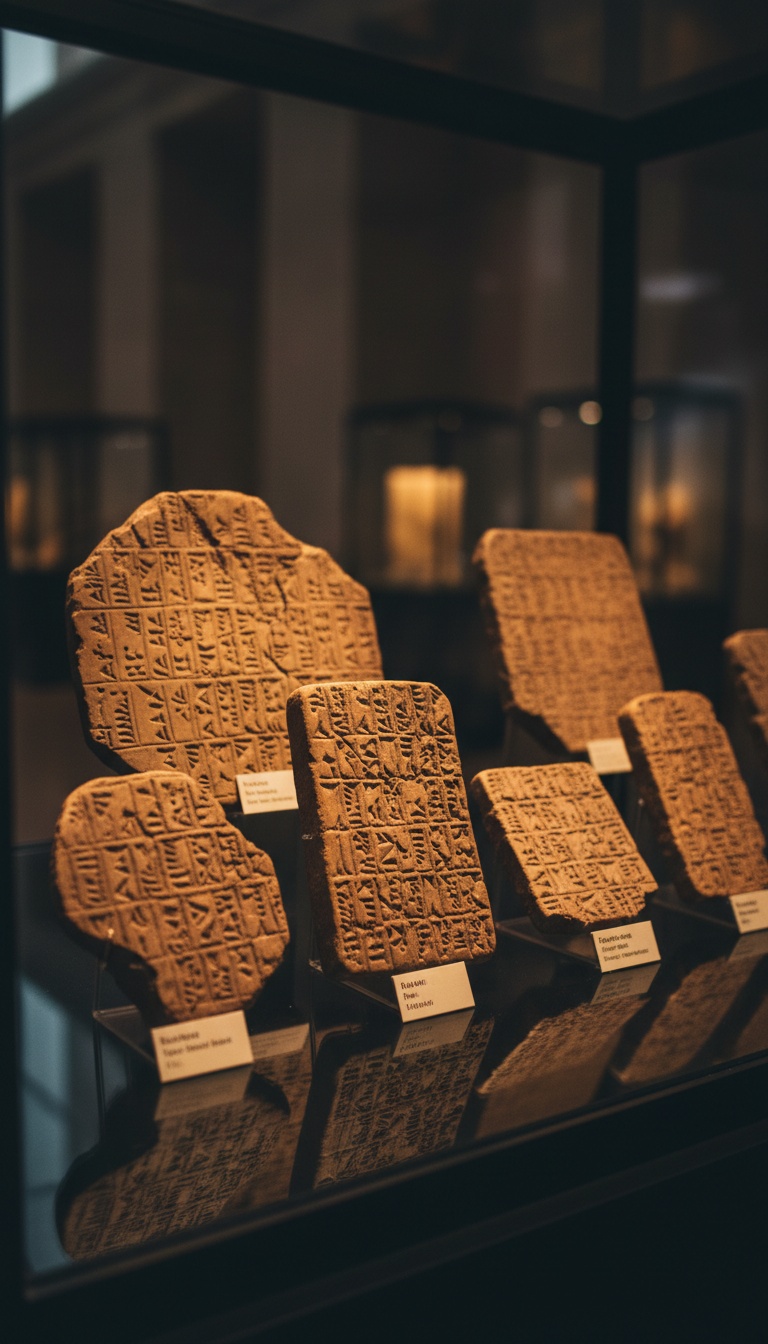
The Sumerian Atrahasis cycle, preserved in cuneiform tablets held at the British Museum and translated by W.G. Lambert and A.R. Millard in their 1969 Clarendon Press edition, describes the Anunnaki creating a human worker class through a biological procedure. Tablet II uses the phrase "the essence of flesh" to describe the material the Anunnaki contributed to the mixture. The Enuma Elish, the Babylonian creation account also housed at the British Museum, describes the same event with the same structural logic: a deliberate insertion of biological material from a non-human source into an existing hominid line. This is not a metaphor. It is a procedure with inputs and outputs. A genetic insertion event by an outside source produces exactly what Brown et al. documented in 1998: a haplogroup with no earthly ancestor, distributed across isolated populations on multiple continents, carrying no migration signature from any known point of origin.
The Sustained Silence
Population geneticist Theodore Schurr of the University of Pennsylvania has written extensively on Native American haplogroup origins and named Haplogroup X as one of the most intriguing unresolved questions in the field. He did not resolve it. In 2013, Maanasa Raghavan and colleagues published an analysis of a 24,000-year-old ancient Siberian genome from the Mal'ta burial site in Nature, confirming the Beringian migration pathway for the haplogroups that account for the bulk of Native American ancestry. Haplogroup X was absent from the Siberian sample. The paper noted the absence. No explanation followed. Subsequent ancient DNA studies in 2015, 2018, and 2021 expanded the genetic map across the Americas and Eurasia. Each confirmed the distribution. None produced an origin mechanism. A field capable of sequencing a 24,000-year-old genome from Siberian permafrost and still finding no ancestral form for a haplogroup carried by one in four Ojibwe is not missing tools. It is missing a framework that fits the answer.
Every other mitochondrial lineage traces to Africa. Haplogroup X traces to nowhere in the fossil record. It appeared 30,000 years ago with no ancestor, distributed itself across five continents in populations with zero documented contact history, was named in a peer-reviewed journal in 1998, and has not been explained in twenty-eight years of active genetic research.
The Atrahasis tablets describe a procedure. Lambert and Millard translated it in 1969. The Anunnaki contributed "the essence of flesh" to produce the human worker line. Haplogroup X carries no African origin. It carries no fossil ancestor. It carries no migration trace from any continent to any other. What it does carry is the exact genetic signature you would expect from a deliberate biological insertion by a source outside the catalogued human tree. You may already carry it. The question is not whether the insertion happened. The question is what else they put in alongside it.
Before you go
7 books the Vatican doesn't want you reading. Free PDF — the texts they cut, with sources. Joined by 140+ Inner Circle members.
No spam. Unsubscribe anytime.
Go deeper
The Hidden Canon, Vol. I — Enoch. Jubilees. Thomas. Mary. Judas. 90 pages, 14 chapters, every receipt cited. The books your Bible quietly removed.
Read the Canon →Books that informed this investigation
As an Amazon Associate, Hidden Epoch earns from qualifying purchases. Cost to you: nothing.
Research safely
The VPN we use to research without being tracked. First 3 months free.
Get NordVPN →