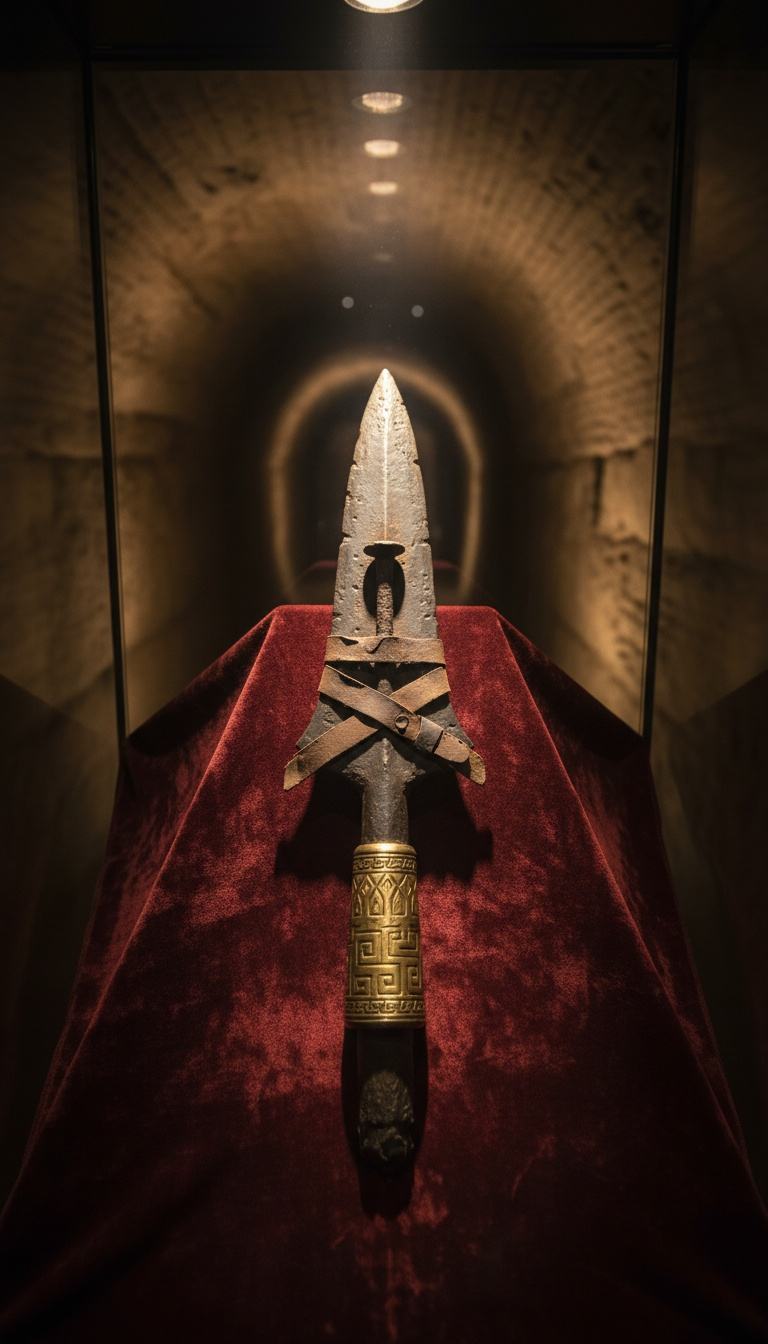
Adolf Hitler moved the Holy Lance, the spear said to have pierced the side of Christ, from the Imperial Treasury in Vienna to Nuremberg on a special train on August 29, 1938, five months after Nazi Germany annexed Austria. The lance was put on display in St. Catherine's Church, the Katharinenkirche, in the city of the Nazi Party rallies. During the war it was sealed in rock-cut tunnels beneath Nuremberg's old town. In 1945 the United States Army found it there, and in January 1946 the Americans sent it back to Vienna, where it sits today in the Kaiserliche Schatzkammer at the Hofburg Palace.
That is the paper trail. Look closer and the dates start to line up too neatly. A dictator obsessed with destiny takes the one object in Europe said to control it. He puts it in the city he built into a stage for his own myth. And the army that broke him walks into the dark under that city and carries it out. Two armies went after the same spear. Neither of them was there for the history lesson.
The Spear That Crowned Emperors
The Holy Lance in Vienna is a Carolingian blade with an iron nail hammered into its center, a nail tradition says came from the cross itself. Emperor Henry IV wrapped it in a silver sleeve around 1084. Charles IV added a gold sleeve around 1350 and had it engraved LANCEA ET CLAVUS DOMINI, the Lance and Nail of the Lord. Three emperors, three centuries, one object they kept dressing in more metal.
Medieval kings treated it as a weapon that won wars. Otto I carried it at the Battle of Lechfeld in 955 and crushed the Magyar army. It travelled with the Holy Roman Emperors as the core of the Imperial Regalia, the set of crown, orb, sword and relics that made a man emperor in the eyes of Christendom. The legend that grew around it is blunt: whoever holds the spear holds the fate of the world.
Why Nuremberg Wanted It Back
Nuremberg had a legal claim, and Hitler used it. In 1424 Emperor Sigismund handed the Imperial Regalia to the Free City of Nuremberg to keep in perpetuity. The city guarded them for almost four hundred years. In 1796, with French revolutionary armies pushing toward Franconia, the regalia were rushed out of Nuremberg, and by 1800 they had reached Vienna. Napoleon dissolved the Holy Roman Empire in 1806, and the treasure never went home.
Nuremberg's Nazi mayor, Willy Liebel, pushed hard to reverse that. Once Austria was absorbed in March 1938, Vienna's treasury became German property overnight. Hitler approved the transfer that summer. The justification was Sigismund's charter. The timing was the Anschluss. The destination was the city where the party staged its rallies.
The Train of August 29, 1938
On August 29, 1938, a special train left Vienna carrying the Imperial Regalia, and the Holy Lance rode with it. The cargo arrived in Nuremberg and went straight into the Katharinenkirche, the medieval church of St. Catherine. Days later the city hosted the 1938 Reich Party Congress, branded the Rally of Greater Germany to celebrate the swallowing of Austria.
Read those three facts together. The relic of world dominion arrives. The rally of territorial conquest opens. The crowds march through the same streets where the spear now sits on display. This was theater staged on purpose, and the lance was the prop at the center of the stage.
He did not move a museum piece. He moved the one object in Europe that kings believed decided who wins wars, and he moved it to his own altar.
The Young Man in the Treasury
Trevor Ravenscroft's 1973 book The Spear of Destiny put the obsession on record. Ravenscroft wrote that a young, broke Hitler stood in front of the lance in the Hofburg treasury during his Vienna years before the First World War, transfixed, and left convinced the spear was bound up with his own fate. He placed the source of that account with Walter Johannes Stein, a Viennese scholar who said he had met Hitler in those years.
Historians who dismiss Ravenscroft have one argument: the book leans on occult testimony. That argument collapses against the hard record. Ravenscroft wrote about an obsession. The archive shows the behavior. Within months of taking Austria, the same man who could have taken any painting, any crown jewel, any gold reserve in Vienna ordered this specific set of relics onto a train and into his rally city. Obsession is exactly what that looks like from the outside.
| The moment | What the Vienna Treasury catalog records | What the pattern shows |
|---|---|---|
| March 1938 | Austria annexed into the German Reich | The spear becomes reachable for the first time |
| August 29, 1938 | Regalia transferred to Nuremberg under Sigismund's 1424 charter | Hitler claims the relic of world dominion |
| September 1938 | Reich Party Congress held in Nuremberg | The relic sits in the rally city as the stage is set |
| 1939 to 1945 | Regalia stored in the Kunstbunker beneath the castle rock | The spear goes underground while the war is fought |
| April 1945 | US forces take Nuremberg | The holder loses the spear and loses the war |
| January 1946 | Regalia returned to Vienna | The victors decide where the spear lives |
Into the Rock
Nuremberg's old town sits on sandstone honeycombed with centuries of brewers' cellars cut into the castle rock. The city converted part of that network into the Historischer Kunstbunker, an air-raid shelter for its greatest treasures, beneath the Obere Schmiedgasse below the Kaiserburg. The Imperial Regalia went down there. The lance spent the war underground in the dark while Allied bombers flattened the city above it.
In the final weeks, with the US Seventh Army closing in, city officials split the treasure further. Several regalia pieces were walled into a separate hiding place, and the men responsible swore they had been sunk in a lake. The lance stayed in the tunnels.
The Americans Go Underground
Nuremberg fell to American troops on April 20, 1945, Hitler's own birthday, after five days of street fighting through the ruins. American soldiers went into the rock tunnels and found the Holy Lance. Ravenscroft goes further. He wrote that US custody of the spear was formalized on April 30, 1945, the same afternoon Hitler shot himself in his Berlin bunker. The spear changed hands, and its holder died.
The rest of the hidden regalia did not stay hidden long. Lieutenant Walter Horn, a German-born art historian serving with the Monuments, Fine Arts and Archives section, interrogated the Nuremberg officials that summer, broke their lake story, and recovered the walled-up pieces in August 1945. The United States Army now held every piece of the regalia Hitler had pulled out of Vienna.
Back Behind Glass
In January 1946 the Americans returned the Imperial Regalia to Vienna, more than seven years after the train left. The lance went back into the Kaiserliche Schatzkammer at the Hofburg, Secular Treasury, where it is on display today. Visitors walk past it in a case lit like a jewel. Most of them never learn it spent the Second World War in a tunnel under the Nazi rally city, or that the US Army decided its fate.
The empires that held this spear form a single chain: Charlemagne's heirs, the Ottonians, the Habsburgs, the Third Reich, the United States. Each one held it at the height of its power. Every handover happened at the end of a war. If you want the full chain of custody laid out case by case, it is inside the Classified Case Files, and the other relics men fought over are logged in the Vault.
So ask the question the guidebooks skip. Why did a general staff fighting across a burning continent assign men to find a spear in a cellar? Why did a city mayor lie to American interrogators about a lake rather than give up a few pieces of old metal? Men do not risk that for decoration.
Hitler believed the spear was destiny, and he lost it. The United States took it, held it through the months it was building a world order out of the rubble, and then handed it back to a museum case. The army that won the war gave away the one object said to win wars. Or did someone decide that holding it for a few months was all that was ever needed? Tell us in the comments which army understood the spear better.
Frequently Asked
Where is the Holy Lance today?
The Holy Lance is on display in the Kaiserliche Schatzkammer, the Imperial Treasury, inside the Hofburg Palace in Vienna. It has been back there since the US Army returned it in January 1946.
When did Hitler move the Holy Lance to Nuremberg?
A special train carried the Imperial Regalia, lance included, out of Vienna on August 29, 1938. It went on display at St. Catherine's Church in Nuremberg in time for that September's Rally of Greater Germany.
Where did the US Army find the spear?
In the Historischer Kunstbunker, the rock-cut tunnels beneath Nuremberg's castle hill where the city sealed its treasures during the war. American forces took the city on April 20, 1945, and the lance was in their hands within days.
Why did Hitler want the Holy Lance?
The legend says whoever holds the spear holds the fate of the world, and Trevor Ravenscroft's 1973 book records Hitler's fixation on it from his Vienna years. He took Austria in March and had the spear on a train by August.
Is the Holy Lance in Vienna the spear that pierced Jesus?
It is the spear the Holy Roman Emperors carried as that relic for a thousand years, with a nail from the cross set into the blade. Charles IV engraved it LANCEA ET CLAVUS DOMINI, the Lance and Nail of the Lord.
Before you go
7 books the Vatican doesn't want you reading. Free PDF. The texts they cut, with sources. Joined by 300+ Inner Circle members.
No spam. Unsubscribe anytime.
Go deeper
The Hidden Canon, Vol. I: Enoch. Jubilees. Thomas. Mary. Judas. 90 pages, 14 chapters, every receipt cited. The books your Bible quietly removed.
Read the Canon →