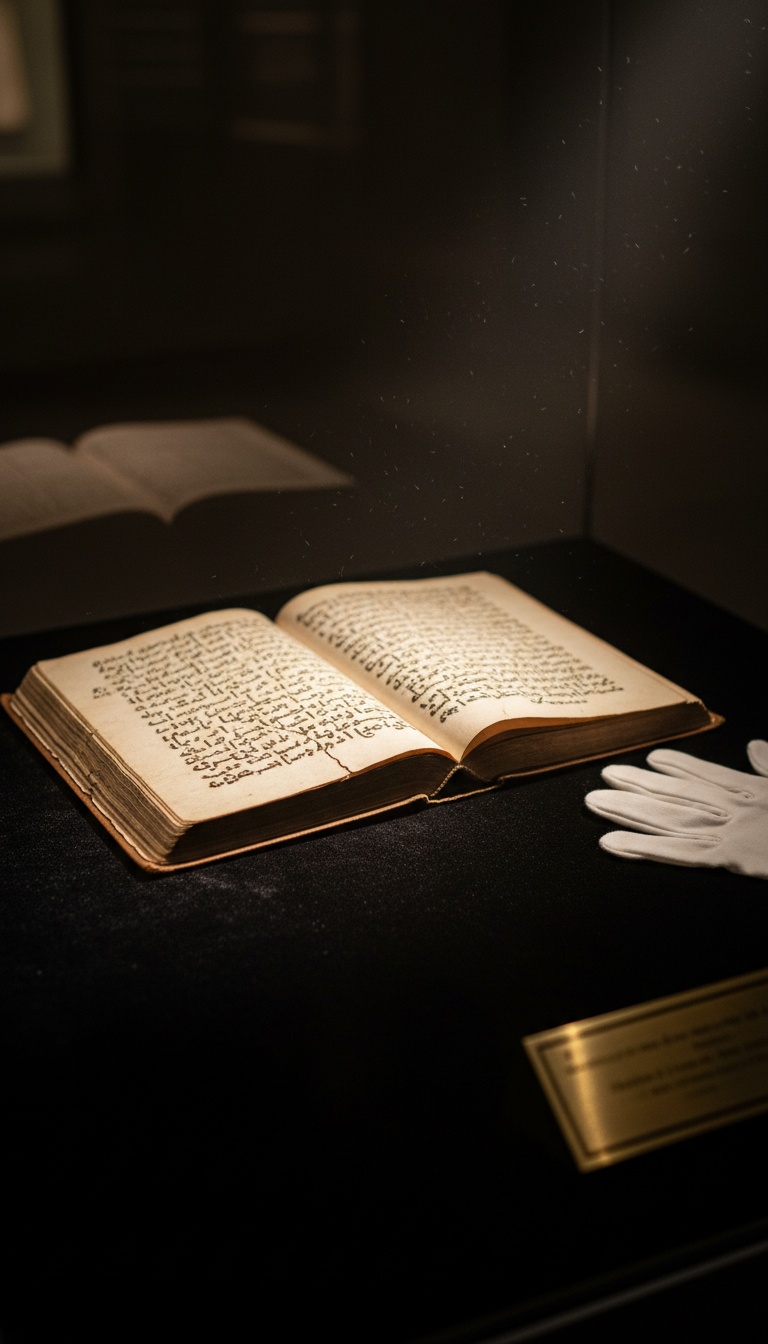
The Holy Spirit was a woman before three rounds of translation made her a man, then a thing, then a doctrine. The receipts are sitting in Cairo, Leiden, and Claremont. Nobody hid them. They just stopped translating them honestly.
I am Jordan Vale. I read the footnotes nobody clicks. This one breaks the Trinity you were handed in Sunday school.
Ruach Is Feminine. Every Time. Without Exception.
The Hebrew word for spirit is ruach (רוּחַ). It is grammatically feminine in every one of its 378 occurrences in the Masoretic Text catalogued by the Brown-Driver-Briggs lexicon, first published 1906 and still sitting on every seminary shelf.
Genesis 1:2 reads 'ruach Elohim merachefet,' and merachefet is the feminine participle for hovering. The same verb form reappears in Deuteronomy 32:11 to describe a mother eagle fluttering over her young. Moses picked the imagery deliberately.
Isaiah 63:10 conjugates the verb 'grieved' in the feminine when describing the Spirit. So does Judges 3:10. So does 1 Samuel 16:13. Three witnesses, three centuries apart, all feminine.
The Aramaic Texts Call Her The Mother
Eastern Christianity did not speak Greek. It spoke Syriac, a dialect of Aramaic, and in Syriac the word rucha is feminine. The Old Syriac Gospels, dated to the second century and held today as Codex Sinaiticus Syriacus in the library of Saint Catherine's Monastery on Mount Sinai, use feminine verbs for the Spirit throughout.
The Odes of Solomon, a Christian hymnbook recovered in 1909 from a Syriac manuscript by James Rendel Harris at the John Rylands Library in Manchester, calls the Holy Spirit 'she' in Ode 19 and describes her milking the Father like a nursing mother. That manuscript predates the Council of Nicaea.
Aphrahat, the Persian sage writing around 340 CE, called the Holy Spirit 'mother' in his Demonstration 18. Ephrem the Syrian, dead 373 CE and buried in Edessa, wrote hymns naming the Spirit as the maternal womb of believers. The Syriac Orthodox Church kept feminine pronouns for the Spirit into the fifth century before pressure from Constantinople flipped the grammar.
Greek Was The First Edit
The Septuagint translators in Alexandria, working in the third and second centuries BCE, hit a problem. Greek has no feminine word for spirit. Pneuma (πνεῦμα) is neuter. Wind, breath, ghost. They picked it anyway.
The New Testament authors inherited that choice. When John 14:26 calls the Spirit a 'paraclete,' the noun is masculine in Greek but the pronoun referring back to pneuma stays neuter. Translators have been smoothing this seam for centuries.
Then came Jerome. His Latin Vulgate, commissioned by Pope Damasus I in 382 CE and completed around 405, rendered pneuma as spiritus. Masculine. One linguistic shift across three languages and the feminine pronouns of Genesis vanished from every Western Bible printed for the next 1,500 years.
The Trinity used to be Father, Mother, and Son. Three translators in three centuries swapped the Mother for a neuter pronoun and a masculine noun, and nobody told the congregation.
Shekinah, The Dwelling Presence
Rabbinic Judaism never lost her. The word Shekinah, from the Hebrew root shakan meaning 'to dwell,' appears across the Targums and the Talmud as the feminine indwelling presence of God. Exodus 25:8 commands the building of the tabernacle so that God may 'dwell' (v'shakanti) among the people. Same root.
The Zohar, compiled in 13th-century Spain by Moses de Leon and now held in major manuscript fragments at the Bodleian Library in Oxford, treats the Shekinah as the feminine consort of the divine. The kabbalists did not invent her. They preserved older Temple-era language that Greek Christianity had abandoned.
Philo of Alexandria, the Jewish philosopher writing in the first century, identified the Spirit with Sophia, the Greek feminine noun for wisdom. Proverbs 8 portrays Wisdom as a woman who was present at creation. Theophilus of Antioch, writing around 180 CE in his letter To Autolycus, named the three persons of the Godhead as God, his Word, and his Wisdom. Feminine.
Nag Hammadi Buried The Evidence For 1,600 Years
In December 1945, an Egyptian farmer named Muhammad Ali al-Samman dug up a sealed jar at the base of the Jabal al-Tarif cliffs near Nag Hammadi. Inside were thirteen leather-bound codices. They now sit in the Coptic Museum in Cairo, with one codex held at the Jung Institute in Zurich until 1975 before being returned.
Codex II contains the Gospel of Thomas. Saying 101 reads: 'My mother gave me falsehood, but my true Mother gave me life.' Saying 105: 'Whoever knows the Father and the Mother will be called the child of a whore.' The Gospel of the Hebrews, quoted by Origen of Alexandria around 230 CE in his Commentary on John, preserves the line: 'My Mother the Holy Spirit took me by one of my hairs.'
Origen knew. He wrote the quote down. He was later condemned posthumously by the Second Council of Constantinople in 553 CE, and his theology of a feminine Spirit was buried with him. The Gospel of the Hebrews itself was suppressed and survives only in fragments cited by the people who banned it.
The Council Of Nicaea Standardized The Edit
The Council of Nicaea convened in 325 CE under Emperor Constantine in what is today Iznik, Turkey. The Nicene Creed it produced refers to the Holy Spirit with masculine grammatical forms in its Greek original. The First Council of Constantinople in 381 CE expanded that creed and locked the masculine reading into imperial law.
Augustine of Hippo, writing De Trinitate between 400 and 428 CE, explicitly rejected the idea that the Spirit could be the divine Mother. He argued in Book 12 that the feminine in the Godhead would 'introduce carnality.' His manuscript tradition survives in the Codex Sangallensis 174 at the Abbey Library of Saint Gall in Switzerland.
By the time the King James translators sat down in 1604 at Hampton Court Palace, the masculine Spirit was 1,200 years of orthodoxy. They did not have to lie. The lie had already been canonized.
The Syriac Christians of Kerala in southern India still preserve liturgies referring to the Holy Spirit in feminine grammar. They have done so continuously since the apostle Thomas arrived in 52 CE. Their manuscripts sit in the Mannanam monastery archive. Rome calls that tradition late invention, which is the one thing it cannot be: an invented feminine Spirit would have had to be invented against 1,200 years of imperial doctrine pushing the other way, in a church that never got the memo because it was never under Constantinople. Kerala is not a deviation from the original. Kerala is what the original sounded like before the edit reached it. Nobody in Rome cites them.
If the original Bible called the third person of the Godhead 'she,' and three layers of translation swapped that out without telling you, what else got swapped on the way to your pew. Tell me in the comments which verse you want me to pull the Hebrew on next.
Before you go
7 books the Vatican doesn't want you reading. Free PDF, the texts they cut, with sources. Joined by 140+ Inner Circle members.
No spam. Unsubscribe anytime.
Go deeper
The Hidden Canon, Vol. I, Enoch. Jubilees. Thomas. Mary. Judas. 90 pages, 14 chapters, every receipt cited. The books your Bible quietly removed.
Read the Canon →Books that informed this investigation
As an Amazon Associate, Hidden Epoch earns from qualifying purchases. Cost to you: nothing.
Research safely
The VPN we use to research without being tracked. First 3 months free.
Get NordVPN →