Job's wife has a name, and it is Sitis. The Book of Job gives her one line, "Curse God and die," in chapter 2, verse 9, and then drops her from the story without ever naming her. The Testament of Job, a Greek Jewish text that scholars date to around the first century, names her Sitis. It tells how she sold her own hair to feed her husband, how Satan tricked her in disguise, and how she died in a stable before Job got his fortune back.
Remembering her was the easy part. Someone had to choose to erase her. A woman who outlived ten children and kept a dying man alive with her bare hands ended up as a single angry sentence in the canon. The book that remembered everything she did was left out of your Bible.
One Line, Then Silence
The Hebrew text of Job is preserved in the Leningrad Codex. It was copied in 1008 AD and sits today in the National Library of Russia in St. Petersburg. That text gives Job's wife exactly one sentence: "Do you still hold fast your integrity? Curse God and die." Job calls her a foolish woman. She never speaks again.
The verb in that sentence is barekh, which literally means "bless." Scribes used it as a polite stand-in for "curse," so her only line is filtered through a euphemism. The one time she speaks, the text muffles her.
Then she disappears completely. In chapter 42 Job gets seven sons and three daughters, and the text never says who their mother is. The woman who stood beside him at the bottom of his life is written out before he is restored.
The Greek Bible Gave Her a Speech
The oldest Greek translation of Job is the Septuagint, preserved in Codex Vaticanus in the Vatican Library and Codex Sinaiticus in the British Library. In that version her line is not one sentence. It runs several verses, and in it she speaks for herself.
In the Septuagint at Job 2:9 she says she is a wanderer and a servant, going from place to place and house to house, waiting for the sun to set so she can rest from her labor. That is a working woman describing her own exhaustion. A scribe somewhere decided the Hebrew had cut her too short and put her voice back.
Three witnesses now disagree about one woman. The Hebrew gives her one sentence. The Greek gives her a lament. A third book gives her a name.
Sitis, the Woman Who Sold Her Hair
The Testament of Job survives in Greek manuscripts, including Paris, Bibliothèque nationale, grec 2658, from the eleventh century, and copies held in the Vatican. A Coptic version on papyrus, now in Cologne, pushes the text back to late antiquity. In every version, Job's wife is Sitis.
Her name carries its own receipt. Sitos is the Greek word for grain, the stuff bread is made from. The woman who keeps her husband alive with bread is named after bread, which sounds like a memory of who she was and what she did.
In the Testament, Job loses everything and sits on a dung heap outside the city. Sitis hires herself out as a water carrier to a nobleman's household and brings home bread for him. When the nobles cut off her wages, she goes begging in the marketplace.
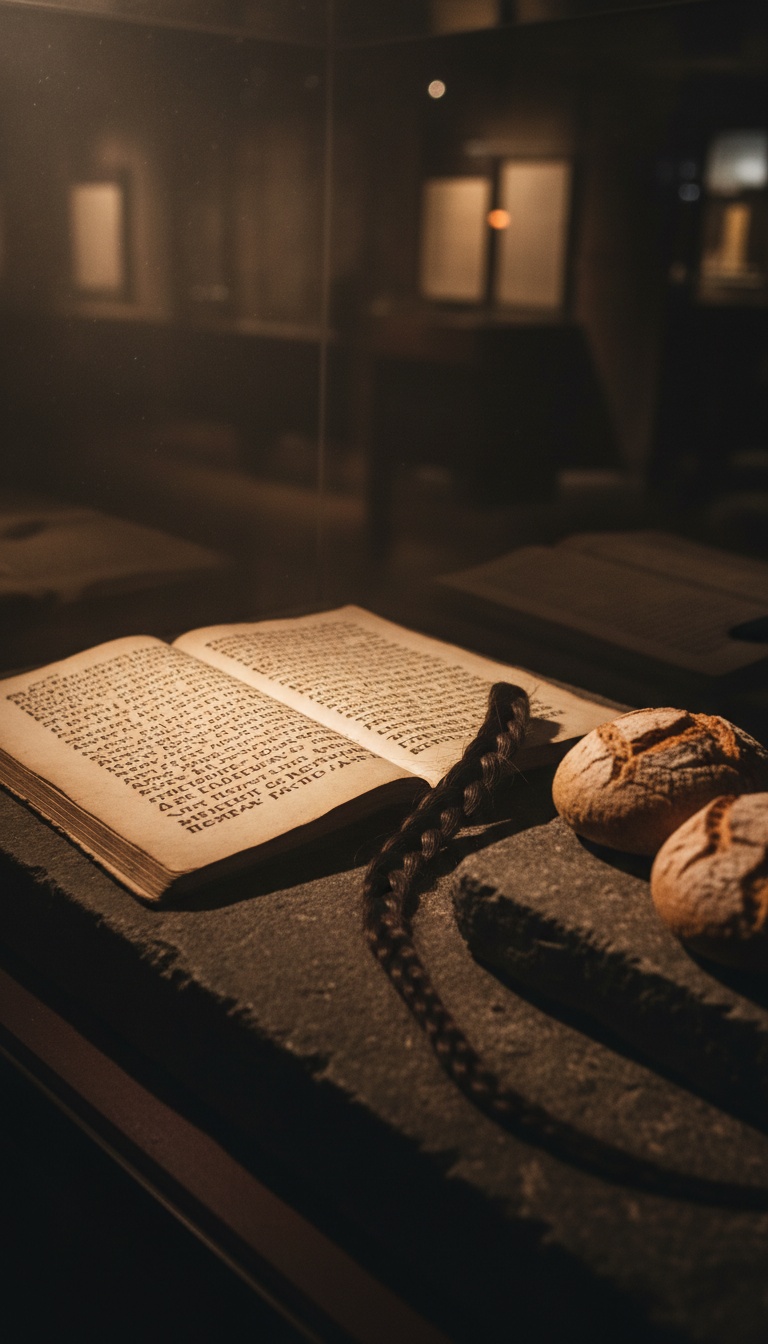
She cut off her hair in the open market and traded it for three loaves. That is the price the Bible chose not to record.
Then Satan steps in disguised as a bread seller. He says the bread will cost her hair. Sitis cuts it off in public and carries three loaves to the dung heap. In her world, a woman's shorn head in the street was a public shame, and she accepted it to feed Job.
The Devil Standing Behind Her
This is where the Testament rewrites the one line the Bible gave her. Sitis arrives with the bread, finally breaks, and speaks the despair that the canon boils down to "curse God and die." Job answers her, and he does not call her foolish.
He tells her he can see Satan standing behind her, unsettling her reasoning. The Testament places the curse in the mouth of the thing at her back. In this version Sitis is the target of the attack, and Satan is the one using her voice.
That one move flips her role. In the canonical reading she is Satan's mouthpiece. In the Testament she is his victim, and Job sees it. The banned book holds the more generous view of her, and the canon took the harsher one.
| Detail | Hebrew Book of Job | Greek Septuagint Job | Testament of Job |
|---|---|---|---|
| Her name | Never given | Never given | Sitis |
| Her words | One sentence | An extended lament | A full speech, plus her own story |
| Her labor | Unmentioned | Wandering servant | Water carrier and beggar who feeds Job |
| The curse | Hers, called foolish | Hers, born of exhaustion | Satan's, spoken through her |
| Her fate | Vanishes | Vanishes | Dies in a stable, mourned by the city |
She Died Before the Happy Ending
Later in the Testament, Sitis begs the kings who visit Job to dig through the rubble of the collapsed house for her children's bodies, so she can bury them. Job stops them. He tells her the children have already been taken up to heaven.
Sitis looks east and sees her children crowned in glory before the Creator. She falls down and worships. Then she walks into the city, goes into a cattle stall, lies down by a manger, and dies in peace.
The Testament says the poor of the city grieved for her, which is a funeral the canon never held. She died in a stable beside a manger, and later Christian readers could not have missed that image.
Why the Canon Kept Her Nameless
The standard dismissal is that the Testament is a later Greek elaboration with no claim on the Hebrew original. That argument cuts the other way. Elaborations reach for something already circulating. The Septuagint was expanding her voice before the Testament existed, and Jewish tradition in the Targums gave Job's wife a name too, Dinah, the daughter of Jacob. In Jewish memory she always had a name. The silence belongs to one textual line.
After that, the nameless wife became useful to the people reading her. Augustine called her the devil's helper. Calvin called her an instrument of Satan. With no name, no labor and no death, a woman is easy to turn into a symbol of temptation.
The books that gave her a name and a sacrifice stayed outside the walls. You can read them yourself in the Lost Books collection and the Hidden Canon, where the Testament of Job sits beside the other texts that were removed.
The Testament of Job does not stop with Sitis. Job's three daughters inherit shimmering cords from their father, wrap them around their chests, and start speaking in the language of angels. Their names are Hemera, Kasia and Amaltheia's Horn. One of them sings hymns in the dialect of the cherubim.
So one banned book holds a named mother, a devil in disguise, a death beside a manger, and three daughters speaking angelic tongues. The canonical version kept only one angry sentence. Who decided which version of this family you were allowed to read, and what else did they cut with her?
Frequently Asked
What is the name of Job's wife?
Job's wife is named Sitis in the Testament of Job, a Greek Jewish text from around the first century. The Book of Job in the Bible never names her. Jewish Targum tradition calls her Dinah, the daughter of Jacob.
What did Job's wife say in the Bible?
In Job 2:9 she says, "Do you still hold fast your integrity? Curse God and die." It is her only line in the Hebrew text. The Greek Septuagint expands it into a lament about wandering from house to house as a servant.
Why did Sitis sell her hair?
In the Testament of Job, Satan comes to her disguised as a bread seller and asks for her hair as the price of bread. She cuts it off in the marketplace and trades it for three loaves to keep Job alive on the dung heap.
How did Job's wife die?
The Testament of Job says Sitis saw a vision of her dead children crowned in heaven. She then walked into a cattle stall, lay down beside a manger and died, and the poor of the city mourned her.
Why is the Testament of Job not in the Bible?
It was never accepted into the Jewish or Christian canon and survived only in Greek, Coptic and Slavonic copies outside the official collections. It remembered Job's wife as a named, suffering woman, while the canon kept her as one nameless line.
Before you go
7 books the Vatican doesn't want you reading. Free PDF. The texts they cut, with sources. Joined by 300+ Inner Circle members.
No spam. Unsubscribe anytime.
Go deeper
The Hidden Canon, Vol. I: Enoch. Jubilees. Thomas. Mary. Judas. 90 pages, 14 chapters, every receipt cited. The books your Bible quietly removed.
Read the Canon →