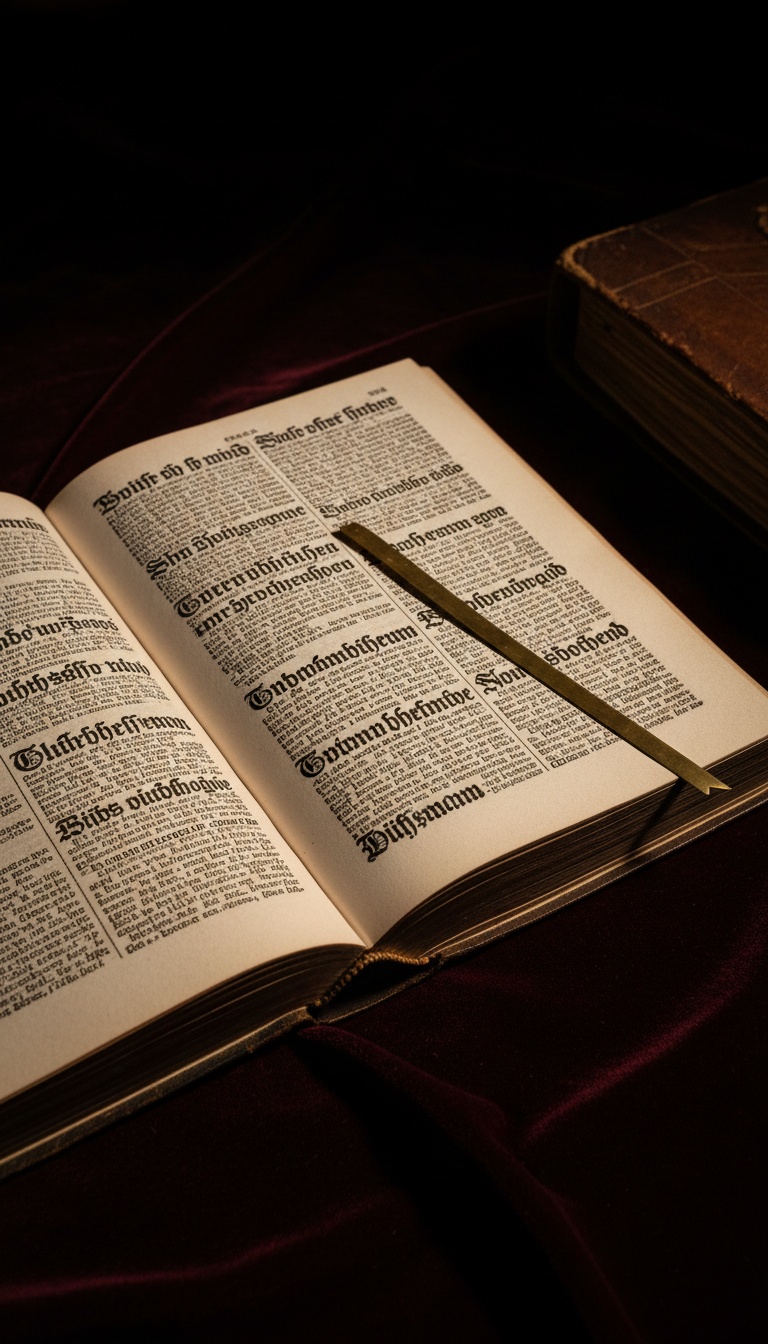
They kept this one quiet. One translator sitting in Wittenberg in 1534 made a decision that erased seven books from the Bible most Protestants read today. Those same seven books are still printed in 1.4 billion Catholic Bibles and roughly 220 million Eastern Orthodox Bibles right now.
The flip is simple. The shorter Bible is the newer Bible. The longer Bible is the one early Christians actually used.
The Seven Books That Disappeared
The missing titles are Tobit, Judith, Wisdom of Solomon, Sirach, Baruch, 1 Maccabees, and 2 Maccabees. The Catholic and Orthodox traditions call them the deuterocanon. Luther filed them in a back section he labeled Apocrypha in his 1534 Wittenberg German Bible, printed by Hans Lufft.
He also cut the Greek additions to Daniel, which include the Song of the Three Young Men, Susanna, and Bel and the Dragon. The longer ending of Esther went with them.
The math is exact. The Catholic canon holds 73 books. The Protestant canon holds 66. The Greek Orthodox canon holds 76. The gap is not a rounding error. It is a deliberate edit.
They Were in Every Bible for 1,184 Years
The Codex Sinaiticus, hand-copied around 350 AD and now held at the British Library in London under shelfmark Add MS 43725, contains Tobit, Judith, 1 Maccabees, 4 Maccabees, Wisdom, and Sirach bound directly into the Old Testament. No separator. No footnote calling them lesser.
The Codex Vaticanus, dated to around 325 AD and held at the Vatican Apostolic Library as Vat.gr. 1209, includes the same books in the same arrangement. The Codex Alexandrinus, dated around 400 AD and now at the British Library as Royal MS 1 D V-VIII, includes them plus the Psalms of Solomon.
Three of the oldest complete Bibles on Earth. All three include the books Luther later removed. None of them flag the books as second-tier.
The Councils That Confirmed Them
Athanasius, the bishop of Alexandria who first listed the 27 New Testament books we use today, issued his 39th Festal Letter in 367 AD. He included Baruch and the Letter of Jeremiah inside his Old Testament list.
The Council of Hippo in 393 AD, presided over by Aurelius of Carthage with Augustine present, ratified an Old Testament canon that included Tobit, Judith, Wisdom, Sirach, and both books of Maccabees. The acts of this council were lost in their original form but were reconfirmed verbatim four years later.
The Council of Carthage in 397 AD, Canon 24, lists the same books again. Pope Innocent I confirmed the list in a letter to Exsuperius of Toulouse in 405 AD. The canon was settled property of the Western church for the next eleven centuries.
Luther's Source Was Younger Than the Books He Cut
Luther justified his edit by appealing to the Hebrew text. The version of the Hebrew text he meant is the Masoretic Text, the standardized rabbinic edition produced by the Masoretes of Tiberias and Babylonia between roughly 700 and 1000 AD. The Leningrad Codex, the oldest complete Masoretic manuscript, is dated 1008 AD and held at the Russian National Library in Saint Petersburg as Firkovich B 19A.
The Septuagint, the Greek translation of the Hebrew scriptures produced in Alexandria starting around 250 BC, included the seven disputed books. This was the Bible the apostles quoted. New Testament scholars count roughly 300 Old Testament citations in the New Testament. The majority track the Septuagint wording, not the proto-Masoretic Hebrew.
So Luther's standard was a text finalized roughly 1,250 years after the Septuagint, by rabbis who had explicit theological reasons to reject books used by Christians.
Luther used a 10th-century rabbinic edition to overrule a 4th-century Christian council that had ratified a 3rd-century BC Greek translation.
He Tried to Cut Four New Testament Books Too
The deuterocanon edit was not Luther's only attempt. In the preface to his 1522 September Testament, Luther dismissed the Epistle of James as an epistle of straw because it taught justification by works. He also questioned Jude, Hebrews, and Revelation, grouping all four as Antilegomena and moving them to the back of his New Testament without numbers in the table of contents.
His Wittenberg colleagues, including Philip Melanchthon, refused to follow him into a shortened New Testament. The four books survived because Luther was overruled by men he personally trained.
The same translator who declared four New Testament books second-rate is the one whose Old Testament cut is now treated as obvious truth by 900 million Protestants.
The Council of Trent Locked the Other Door
Rome reacted in 1546. The Council of Trent, in its fourth session on 8 April 1546, issued the decree De Canonicis Scripturis. The decree named the deuterocanonical books one by one and attached an anathema to anyone who rejected them.
Trent did not invent the canon. Trent fenced it. The decision codified what Hippo, Carthage, Florence in 1442, and a thousand years of liturgical use had already assumed.
From 1546 forward, the split was institutional. The Catholic Bible kept 73 books. The Lutheran and later Reformed Bibles kept the Apocrypha section through the 1611 King James Version, then dropped it entirely. The British and Foreign Bible Society voted in 1826 to stop printing the Apocrypha in their editions. That 1826 vote is why your shelf Bible has 66 books.
The reel told you that one translator's decision in 1534 split the canon. The receipts confirm it. Codex Sinaiticus at the British Library. Vaticanus at the Vatican Library. Carthage 397. Trent 1546. The British and Foreign Bible Society vote of 1826.
The real question is the one nobody asks. What do the seven books actually say? Wisdom 2 contains a passage about a righteous man tortured and condemned to a shameful death that early Christians read as a prophecy of Christ. 2 Maccabees 12 contains the only explicit Old Testament passage about praying for the dead. Sirach 24 contains a wisdom hymn that shaped the Gospel of John's prologue.
You were not told these books existed. You were not told why they were removed. You were not told what they contain. The next question writes itself. What else was edited out of the book you trust most, and who signed off on the cut?
Before you go
7 books the Vatican doesn't want you reading. Free PDF, the texts they cut, with sources. Joined by 140+ Inner Circle members.
No spam. Unsubscribe anytime.
Go deeper
The Hidden Canon, Vol. I, Enoch. Jubilees. Thomas. Mary. Judas. 90 pages, 14 chapters, every receipt cited. The books your Bible quietly removed.
Read the Canon →Books that informed this investigation
As an Amazon Associate, Hidden Epoch earns from qualifying purchases. Cost to you: nothing.
Research safely
The VPN we use to research without being tracked. First 3 months free.
Get NordVPN →