King Nimrod threw Abraham into a furnace, and Abraham walked out alive. The Book of Jasher, chapter 12, records that Nimrod had Abram and his brother Haran bound and cast into a brick furnace in front of a huge crowd. Haran burned to death. Abram walked out of the fire unhurt. Genesis 11:28 gives the same death one line: Haran died before his father Terah, in Ur of the Chaldeans. Genesis never says how. The furnace says how.
And the furnace was never confined to one lost book. The same execution runs through the Targum Pseudo-Jonathan, Genesis Rabbah, the Babylonian Talmud, Rashi's commentary and the Quran. Five separate traditions, written across a thousand years, in Aramaic, Hebrew and Arabic, describe the same fire. Genesis is the only text that keeps quiet about it. In southeastern Turkey, a city still points to the exact spot where the flames stood.
What the Book of Jasher Says Happened in Chapter 12
Jasher lays it out like a trial transcript. Abram smashes the idols in his father Terah's house. Terah is an officer in Nimrod's court, and he hands his own son over to the king. Nimrod orders a furnace built and lit before the princes and the people of the land.
Abram goes into the fire bound. Jasher says he walked inside the furnace for three days and three nights, and the flames did not touch him. Haran, who had waited to see which side would win before declaring himself, was thrown in after him. Haran burned. His body came out as ash before his father's eyes.
Read that against Genesis 11:28 and the line changes weight. "Haran died before his father." In Jasher, "before" means in front of him. Terah watched it happen. You can read the full chapter alongside the other excluded texts in our lost books collection.
The Book the Bible Itself Cites
The Book of Jasher is a book the Bible names twice. Joshua 10:13 points to it for the day the sun stood still over Gibeon: "Is not this written in the book of Jasher?" Second Samuel 1:18 points to it again for David's lament over Saul and Jonathan. Two canonical books send the reader to a third book, and that third book is missing from the canon.
The Hebrew text titled Sefer haYashar was printed in Venice in 1625. Moses Samuel translated it into English, and Mordecai Manuel Noah published that translation in New York in 1840. That edition is the Jasher people read today, and its chapter 12 is the furnace.
The pattern repeats across the canon. Scripture quotes a source, then the source disappears from the shelf, and the story it carried has to survive somewhere else.
Ur Means Fire: How the Rabbis Read Genesis 11
The rabbis found the furnace hidden inside the name of the city itself. In Hebrew, "ur" is the word for fire and flame. Isaiah 31:9 uses it for the Lord "whose fire is in Zion." So "Ur Kasdim" reads two ways: the city of the Chaldeans, or the fire of the Chaldeans.
Three rabbinic sources take the second reading and stack the receipts. The Targum Pseudo-Jonathan, the Aramaic paraphrase of Genesis, says outright at 11:28 that Haran died when Nimrod cast Abram into the furnace and the fire had no power over him. Genesis Rabbah 38:13 tells the full scene: the idol shop, the smashed statues, Terah handing Abram to Nimrod, Haran hedging his bets and burning. The Babylonian Talmud, Pesachim 118a, has the angel Gabriel ready to cool the furnace for Abraham, and Eruvin 53a identifies Amraphel, the king of Genesis 14, as Nimrod himself, the man who told Abraham to throw himself into the furnace.
Genesis gave Haran one line. The rabbis read the name of his city and found a furnace burning inside it.
Then came Rashi. Rabbi Shlomo Yitzchaki of Troyes, France, the most-read commentator in Jewish history, wrote his Genesis commentary in the eleventh century. At Genesis 11:28 he repeats the midrash: Terah complained about Abram to Nimrod, Abram was cast into the fiery furnace and saved, and Haran died in it. Rashi's commentary is printed beside the Hebrew text in nearly every traditional Chumash on Earth. The furnace sits on the same page as Genesis, one column over.
The Quran Keeps the Furnace Too
The Quran tells the same execution from the other side of the Jordan. In Surah 21, verses 68 and 69, Abraham's people shout, "Burn him and support your gods." God answers the fire directly: "O fire, be coolness and safety upon Abraham." Surah 37:97 adds the building: "Build for him a structure and throw him into the blaze."
That makes three religious traditions, Jewish, Christian-read and Islamic, carrying one furnace. The Quran names no king in those verses. Islamic commentators supply the name anyway, and it is the same one Jasher uses. Nimrod, the mighty hunter of Genesis 10:9, whose kingdom began at Babel, Erech, Akkad and Calneh in the land of Shinar.
Genesis built Nimrod as a hunter before the Lord and a founder of Babylon. Every tradition that kept the furnace made him the man who lit it.
Şanlıurfa: Where the Fire Became Water
Şanlıurfa, in southeastern Turkey, claims the furnace as local history. The city's tradition says Nimrod hurled Abraham from the citadel hill into the fire below. Two Corinthian columns still stand on that citadel, and locals call them the throne of Nimrod, the catapult that launched Abraham.
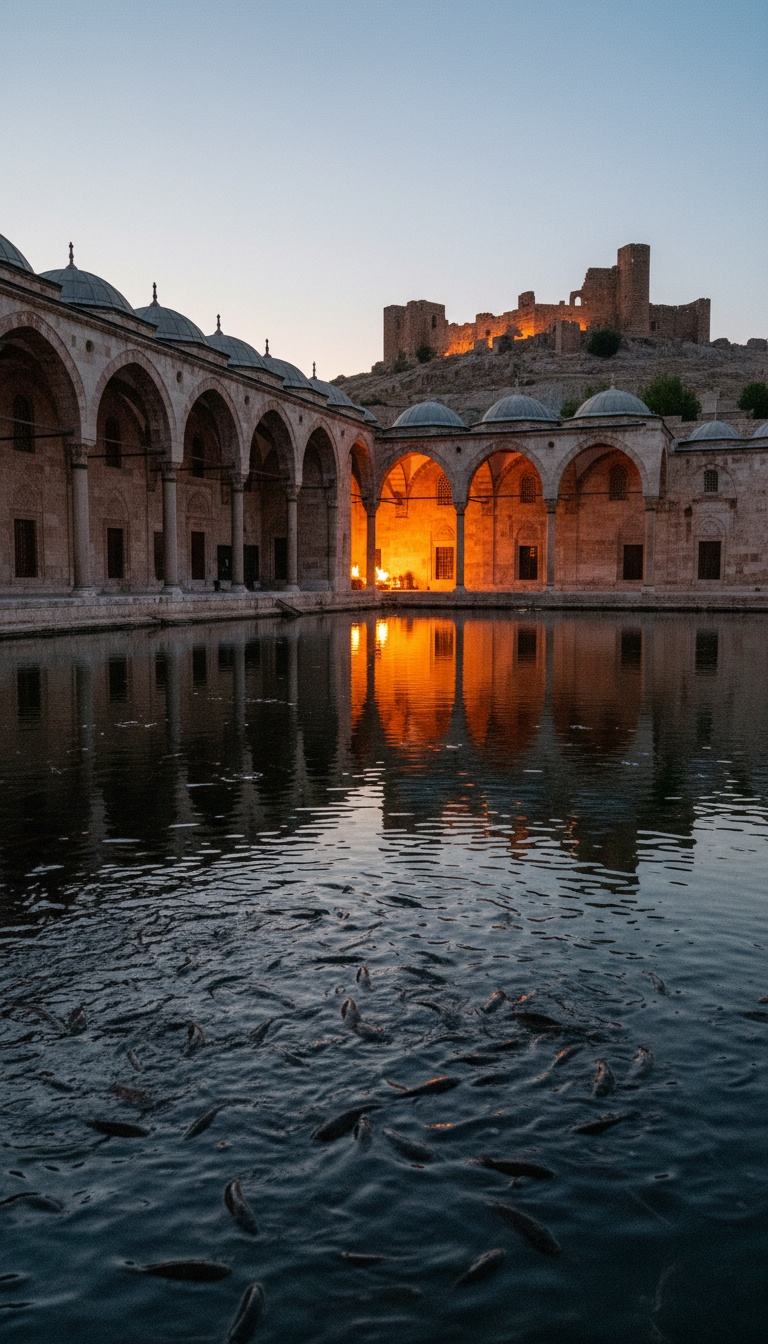
Where the fire landed, the story says, God turned the flames into water and the burning logs into fish. That water is Balıklıgöl, the Pool of Abraham, still full of sacred carp that no one is allowed to catch. Beside it stands the Halil-ür Rahman Mosque, and nearby is the Mevlid-i Halil cave, honored as the place Abraham was born.
The rival site sits a thousand kilometers south. Leonard Woolley dug Tell el-Muqayyar in southern Iraq from 1922 to 1934 for the British Museum and the Penn Museum in Philadelphia, and he labeled it Abraham's Ur. Genesis 11:31 breaks that label. It says Terah left Ur for Canaan and settled in Harran. Harran sits about 44 kilometers south of Şanlıurfa. The family that left Urfa reaches Harran in two days on foot. The family that left Woolley's Ur has to walk the length of Mesopotamia and then stop short of its destination.
| Question | Woolley's Ur (Tell el-Muqayyar, Iraq) | Şanlıurfa (Edessa, Turkey) |
|---|---|---|
| Distance to Harran, where Terah settled | Roughly 1,000 km | About 44 km |
| Furnace tradition on site | None recorded | Balıklıgöl, the citadel columns, the fish pool |
| Birth cave of Abraham | None | Mevlid-i Halil cave |
| Who named it Abraham's Ur | An excavator in the 1920s | Living local tradition, Jewish and Islamic |
| Deep-time neighbors | Sumerian ziggurat, c. 2100 BC | Göbekli Tepe, 15 km away, c. 9600 BC |
And the ground under Urfa runs deeper than any Sumerian brick. The Urfa Man, an 11,000-year-old limestone figure, the oldest life-size human statue ever found, was dug up beside Balıklıgöl in 1993. He stands today in the Şanlıurfa Archaeology Museum. Göbekli Tepe sits fifteen kilometers up the road. The city of the furnace sits on the oldest sacred ground on the planet. Our ancient maps show how tightly that cluster sits together.
Why Genesis Kills Haran in One Line
Genesis is a document that names fathers, sons, ages at death and years lived down to the decade. Genesis 11 lists every patriarch from Shem to Terah with numbers attached. Then it reaches Haran, a man whose son Lot carries half the plot of the next ten chapters, and it gives him one sentence with no cause of death.
The standard answer from the textual critics is that Jasher and the midrash invented the furnace to explain the gap. That answer has the timeline upside down. The Targum, Genesis Rabbah and the Talmud carry the furnace centuries before Jasher reached print, and the Quran carries it independently. A story that appears in Aramaic, Hebrew and Arabic, in rival faiths that agree on almost nothing, reads as an older memory surfacing through every crack it can find. Genesis is the text that edited it down to a single death notice.
Which leaves the question the editors left for us. You can follow the rest of the excluded record in the vault.
Fifteen hundred years after Abraham, the furnace comes back. Daniel chapter 3 puts Shadrach, Meshach and Abednego into the fiery furnace of Nebuchadnezzar, king of Babylon. They walk out unhurt. The men who threw them in burn. Same kingdom Nimrod founded. Same punishment. Same survivors walking out of the flames.
Genesis remembers Babylon as Nimrod's beginning and remembers nothing of his fire. Daniel remembers the fire and never mentions Nimrod. One text holds the king, the other holds the furnace, and the man who died between them gets one line. So who cut Haran's death out of Genesis, and what else burned with it?
Frequently Asked
Is Abraham being thrown into a furnace in the Bible?
Genesis records only that Abraham's brother Haran died in Ur of the Chaldeans, with no cause given. The furnace story lives in the Book of Jasher, chapter 12, which the Bible itself cites in Joshua 10:13 and 2 Samuel 1:18, and in the Targum, Genesis Rabbah, the Talmud and the Quran.
Who threw Abraham into the fire?
King Nimrod, the mighty hunter of Genesis 10 whose kingdom began at Babel. Jasher, Genesis Rabbah and the Talmud all name him as the king who lit the furnace.
Why does Ur mean fire?
In Hebrew, ur means fire or flame, as in Isaiah 31:9. The rabbis read Ur Kasdim as the fire of the Chaldeans, the furnace where Haran died and Abraham survived.
Where is the pool of Abraham?
Balıklıgöl in Şanlıurfa, Turkey. Local tradition says God turned Nimrod's fire into water and the burning logs into the sacred carp that still swim there.
Does the Quran mention Abraham in the fire?
Yes. Surah 21:68-69 has God command the fire to be coolness and safety upon Abraham, and Surah 37:97 describes the structure built to burn him.
Before you go
7 books the Vatican doesn't want you reading. Free PDF. The texts they cut, with sources. Joined by 300+ Inner Circle members.
No spam. Unsubscribe anytime.
Go deeper
The Hidden Canon, Vol. I: Enoch. Jubilees. Thomas. Mary. Judas. 90 pages, 14 chapters, every receipt cited. The books your Bible quietly removed.
Read the Canon →