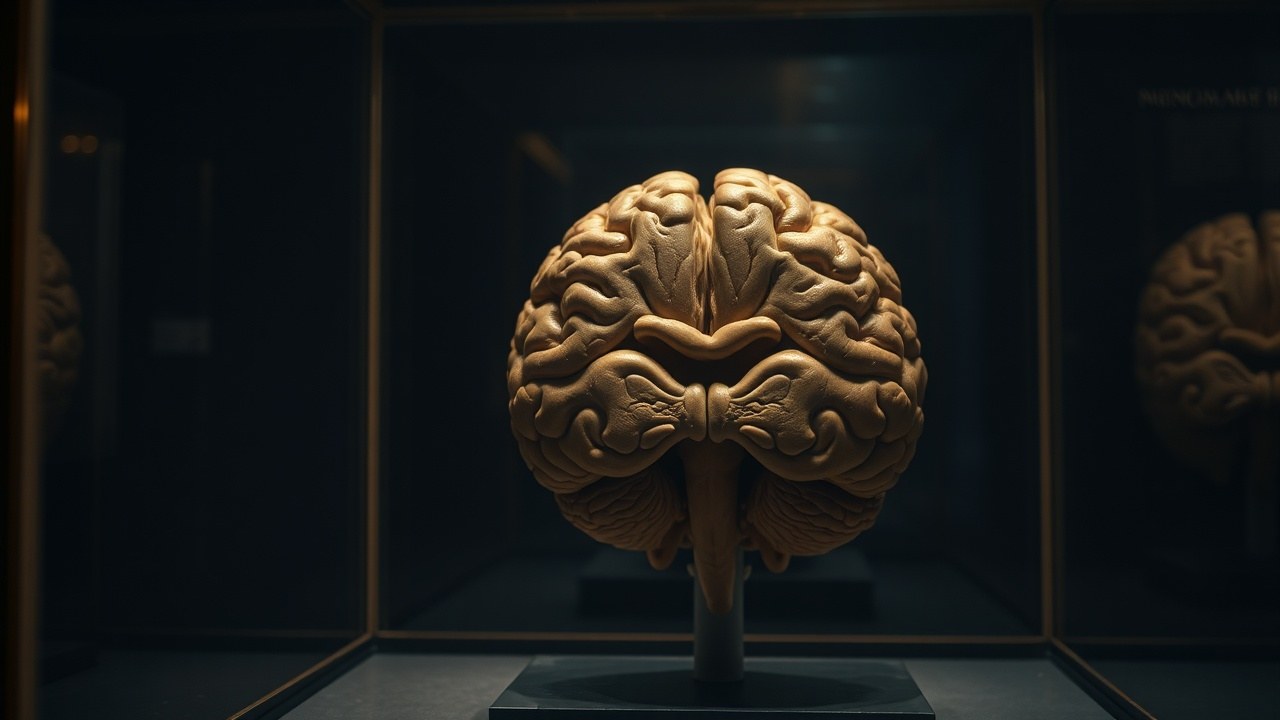
The Garden of Eden didn't disappear.
Human perception did.
That's the part they left out of Sunday school. The conventional reading of Genesis tells you Eden was a place, a location that was taken away as punishment for disobedience. Sin entered the world. The gates closed. Mankind was cast out.
But what if the exile wasn't geographic? What if something happened inside the human brain, a deliberate collapse of perceptual capacity, and the story of Eden is describing exactly that in the only language available to ancient writers?
The evidence, when you look at it directly, is difficult to explain away.
The Organ That Calcifies on a Schedule
The human body contains roughly 78 organs. Of those, exactly one calcifies on a fixed, synchronized schedule across the entire species regardless of health, geography, or genetics.
The pineal gland.
Located at the geometric center of the brain, the pineal gland begins calcifying at puberty, typically between ages 11 and 14, in virtually all humans. By adulthood, calcium deposits are so consistent and predictable that forensic scientists use pineal calcification as a reliable age marker in skeletal remains.
No other organ does this. The liver doesn't calcify on a schedule. The kidneys don't calcify on a schedule. The heart doesn't. The lungs don't. Organs calcify in response to damage, disease, aging, not on a biological clock that fires at the same developmental window across billions of human beings.
The calcification is systematic. It is synchronized. And it happens at the precise moment when a developing human's consciousness would be expanding most rapidly.
That detail has no satisfying biological explanation. And it isn't for lack of trying.
What Was There Before It Hardened
René Descartes called the pineal gland the "seat of the soul." He wasn't speaking metaphorically, he genuinely believed this small pine-cone-shaped structure at the brain's center was the primary interface between the physical body and consciousness itself.
He wasn't alone. Ancient traditions across cultures, none of them in contact with each other, converged on the same conclusion. The Hindu tradition called it the Ajna, the third eye, the seat of higher perception. The Egyptian Eye of Horus, anatomically, maps precisely onto a cross-section of the human brain with the pineal gland at its center. Ancient Sumerians depicted it as a pine cone, carried by their gods as a symbol of divine authority.
Every major ancient civilization pointed at the same structure and said: this is where you connect to something beyond the physical.
Then it hardens. And the connection, by all accounts, weakens.
The pineal gland produces DMT, dimethyltryptamine, a compound that exists naturally in nearly every living organism and produces, when isolated, the most intense visionary states ever documented by neuroscience. It also produces melatonin, regulating sleep cycles and circadian rhythms. But melatonin production doesn't require calcification. Whatever calcification is stopping, it isn't the sleep cycle.
The Nag Hammadi Discovery
In 1945, a farmer digging near the cliffs of Jabal al-Tarif in Upper Egypt unearthed a sealed jar containing 13 leather-bound papyrus codices. The texts inside dated to the 4th century AD, but the ideas they contained were older, far older. These were the Nag Hammadi texts, the most complete surviving collection of Gnostic writings ever found.
The Gnostics were early Christians who were systematically hunted, their libraries burned, their followers executed. The Nag Hammadi texts were hidden, buried in a sealed jar in the Egyptian desert, presumably to survive exactly that destruction. They did survive. For 1,600 years, they waited.
What they describe, in meticulous detail, is a cosmology the institutional church spent centuries trying to erase.
At the center of that cosmology: the Archons.
The Archons: Documented, Named, Purposeful
The Archons are not demons in the conventional sense. The Gnostic texts describe them as lower-dimensional administrators, entities created by a false god, a demiurge, whose function is the management and containment of human consciousness. They are not evil in the way a villain is evil. They are systematic. They are architectural. Their purpose is limitation.
The texts are specific. The Archons did not create humanity, they found it. What they did was introduce a perceptual cage. A severing of the human capacity for what the Gnostics called gnosis, direct, experiential knowledge of the divine, unmediated by any institution, doctrine, or external authority.
The Apocryphon of John, one of the most significant texts recovered at Nag Hammadi, describes this process explicitly: the Archons construct a physical body as a container, a limitation, a shell designed to prevent the soul inside from recognizing its own nature.
The language is technical. Almost anatomical.
The Gnostics wrote this between 100 and 400 AD, drawing on traditions that stretch back much further. They had no knowledge of neuroscience. They had no MRI machines. They had no way to examine the pineal gland under a microscope.
And yet they described, in symbolic terms, a deliberate biological intervention, a narrowing of human perception from multidimensional awareness to flat, linear, physical-only experience, that maps with uncomfortable precision onto what happens when calcification sets in.
The Tree of Knowledge Reconsidered
Genesis 3 tells you that eating from the Tree of Knowledge of Good and Evil brought death into the world. But the text also says something stranger: "your eyes will be opened, and you will be like God, knowing good and evil."
The serpent wasn't wrong. Their eyes were opened. They did gain knowledge.
What if the tree wasn't a moral test? What if it was a perceptual event, a moment when a particular capacity of human consciousness became available, and the response from whatever governed the garden was to shut it down?
The Gnostic reading of Genesis inverts the entire moral structure of the story. The serpent is not the villain. The serpent is the one trying to restore access. The demiurge, the false god who cast them out, is the one who imposed the limitation. The exile from Eden is not punishment for disobedience. It is the implementation of the cage.
The fruit wasn't sin. The fruit was perception. And whoever controlled the garden couldn't allow that to spread.

What It Means If It's True
If the Fall is a neurological event rather than a moral one, several things change immediately.
The restoration of "paradise" is not a theological question, it's a biological one. The path back to Eden is not repentance. It's decalcification. It's the restoration of a suppressed biological function. It's the reopening of a channel that was deliberately closed at the most critical window of human development.
It also means the entire framework of institutional religion, sin, guilt, the need for an external authority to mediate your relationship with the divine, is built on the architecture of the cage, not the key to escape it.
The Gnostics understood this. That's why they were exterminated.
The texts survived anyway. Buried in a jar. Waiting in the desert for 1,600 years until someone was ready to read them without the permission of the institution that buried them.
Before you go
7 books the Vatican doesn't want you reading. Free PDF, the texts they cut, with sources. Joined by 140+ Inner Circle members.
No spam. Unsubscribe anytime.
Go deeper
The Hidden Canon, Vol. I, Enoch. Jubilees. Thomas. Mary. Judas. 90 pages, 14 chapters, every receipt cited. The books your Bible quietly removed.
Read the Canon →, Go Deeper,
The Nag Hammadi texts and the Archon cosmology are documented in full. If you want to read the primary sources yourself, these are the essential starting points:
- The Book of Enoch , The pre-Flood account of the Watchers and their intervention in human biology. The text the church removed from canon. Essential companion reading to the Archon framework.
- The Bible Unearthed, Israel Finkelstein & Neil Asher Silberman , Archaeological evidence for what Genesis was actually describing. Required reading for anyone who wants the physical record, not just the theological interpretation.
affiliate links, same price for you, small commission supports Hidden Epoch