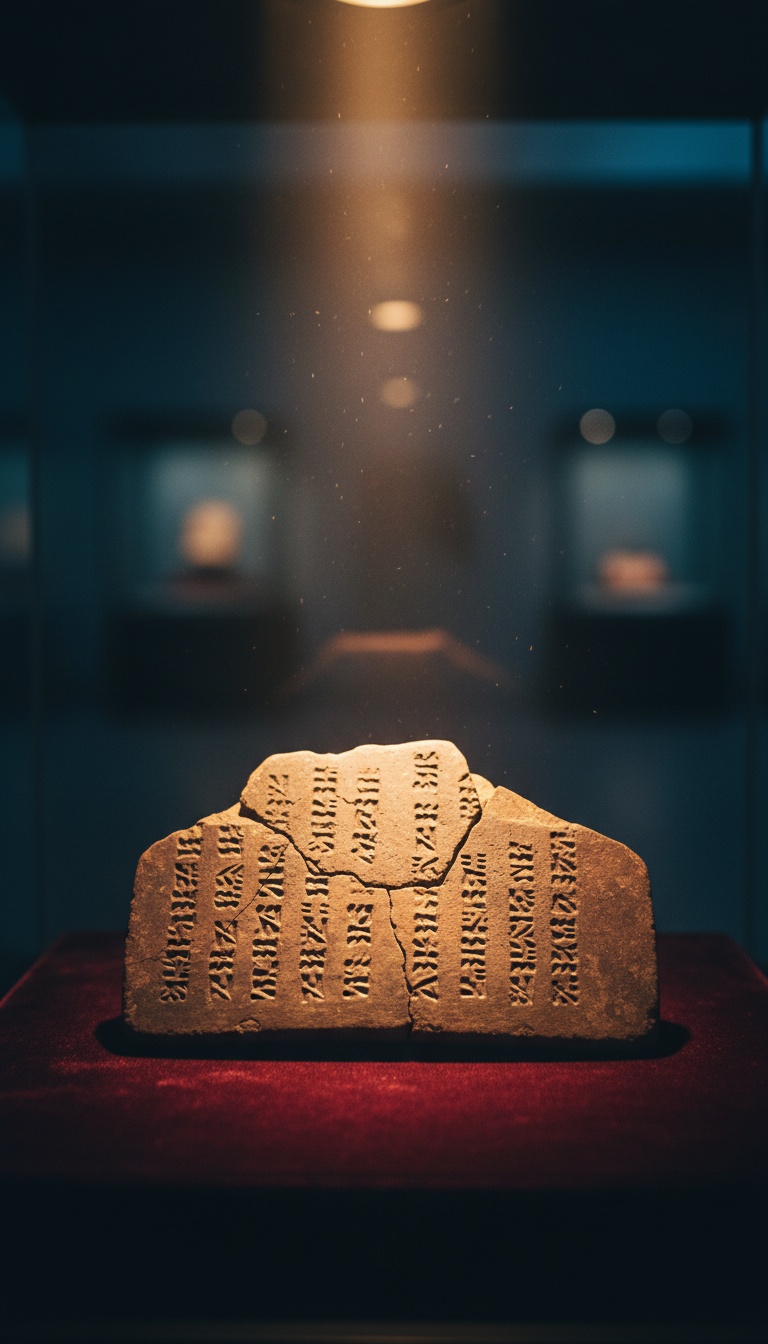
Seven cultures separated by oceans and eleven thousand miles wrote the same flood story, with the same boat, the same bird, and the same mountain landing. They never met. That is not folklore. That is testimony.
I have spent the last three years pulling the source tablets, the Sanskrit verses, and the Hopi oral records into one timeline. The overlap is not loose. It is forensic.
The Sumerian Original Sits In The British Museum
Tablet XI of the Epic of Gilgamesh, cataloged as K.3375 in the British Museum's Arched Room, records Utnapishtim building a sealed boat, sealing it with bitumen, loading pairs of animals, and releasing a dove, a swallow, and a raven after the waters receded. The tablet was excavated by Hormuzd Rassam at Nineveh in 1853 and translated by George Smith in 1872.
Smith reportedly tore off his clothes in the museum reading room when he realized he was looking at a flood account that predated Genesis by more than a thousand years. The tablet dates to the 7th century BCE. The story it copies dates to the third millennium BCE.
The Babylonian Atrahasis Epic, tablets housed at the British Museum under accession numbers 78941 and 78943, tells the same story with the same bitumen, the same animal pairs, and the same divine warning. Dated to roughly 1700 BCE under King Ammi-saduqa.
The Hebrew Account Is Not The Oldest. It Is The Youngest.
Genesis 6 through 9, redacted into its current form during the Babylonian exile in the 6th century BCE, gives Noah a boat sealed with pitch, pairs of animals, a dove, a raven, and a mountain landing on Ararat. The Dead Sea Scroll 4Q252, held at the Israel Museum's Shrine of the Book in Jerusalem, preserves a commentary on the flood narrative dating to roughly 50 BCE.
The Hebrew authors were in Babylon. They had access to the Atrahasis material. That part is not controversial. What is controversial is that the Vedic, Chinese, Greek, and Hopi versions cannot be explained by contact with Mesopotamia.
Manu, Yu, And Deucalion Tell The Same Story In Three Languages
The Shatapatha Brahmana 1.8.1, composed in Sanskrit around 700 BCE and preserved in manuscripts at the Bhandarkar Oriental Research Institute in Pune, describes Manu warned by a fish, building a boat, and landing on a northern mountain after a global deluge.
The Chinese account of Yu the Great taming the great flood appears in the Shujing and the Shiji of Sima Qian, completed around 94 BCE. Recent sediment analysis published in Science in August 2016 by Wu Qinglong of Peking University identified a catastrophic outburst flood on the Yellow River around 1920 BCE, but the mythic memory reaches further back into the Longshan culture layer.
Deucalion and Pyrrha appear in Pseudo-Apollodorus, Book 1.7.2, surviving in the Codex Parisinus Graecus 2722 at the Bibliothèque nationale de France. Deucalion builds a chest, floats nine days, and lands on Mount Parnassus. Same structure. Same survivors. Same mountain.
Sumer to the Hopi mesas is eleven thousand miles of ocean. No bronze-age ship made that crossing. Yet Spider Grandmother and Utnapishtim release the same bird.
The Hopi Version Should Not Exist
The Hopi emergence narrative, recorded by Frank Waters in Book of the Hopi in 1963 from elders at Oraibi and Hotevilla in Arizona, describes the destruction of the Third World by flood, the survivors sealed inside hollow reeds by Spider Grandmother, and the emergence onto a new land where a bird is sent to find dry ground.
The Hopi mesas sit at roughly 35 degrees north latitude in northern Arizona. Sumer sits at 31 degrees north in southern Iraq. The distance is approximately 11,200 miles by great circle. No pre-Columbian vessel is known to have crossed the Pacific in either direction during the Holocene.
The diffusionist explanation breaks. The Jungian collective unconscious explanation requires you to believe that seven cultures independently invented bitumen-sealed boats, paired animals, and post-storm bird releases. The third option is that something happened, and everyone who survived remembered it the same way because they were describing the same event.
The Younger Dryas Impact Hypothesis Fits The Date
In 2007, Richard Firestone and a team of 26 researchers published in PNAS evidence of a cosmic impact event at the onset of the Younger Dryas cold snap, dated to 12,800 years before present. The marker layer contains nanodiamonds, melt-glass, and platinum group metals across sites in North America, Europe, and the Middle East.
In 2018, Kjetil Kinzie and Christopher Moore published in the Journal of Geology evidence of a platinum spike at 28 sites across four continents, all dating to the same 12,800 BP horizon. The Hiawatha crater under the Greenland ice sheet, identified by Kurt Kjaer of the University of Copenhagen in November 2018, sits in the right size range for a fragment of that event.
An airburst or impact at the end of the last glacial period would have triggered massive ice-sheet collapse, sudden sea-level rise estimated at up to 60 meters in some models, and continent-scale flooding. The date matches the deepest archaeological layers at Gobekli Tepe in southeastern Turkey, excavated by Klaus Schmidt starting in 1994, where Pillar 43 of Enclosure D appears to depict a date stamp pointing to the same epoch according to the Sweatman and Tsikritsis paper in Mediterranean Archaeology and Archaeometry, 2017.
Why Mainstream Archaeology Will Not Connect The Dots
The careers of an entire generation of archaeologists were built on the assumption that civilization began around 4000 BCE in Sumer and nowhere earlier. Admitting that seven separate cultures preserved memory of an event 12,800 years ago means admitting that organized human culture, capable of transmitting complex narrative across eight millennia of oral tradition, predates the official start of civilization by eight thousand years.
The Comet Research Group continues to publish. The pushback from Mark Boslough at Sandia National Laboratories and others has been aggressive. The flood myth correlation is treated as folklore studies, not impact science, and the two fields do not share conferences.
Seven cultures. One story. One date. One impact layer found on four continents. The receipts are sitting in the British Museum, the Bhandarkar Institute, the Bibliothèque nationale, and the ice under Greenland. Nobody is hiding them. They are just refusing to put them on the same table.
I am pulling the Mesoamerican and Australian Aboriginal flood accounts next. The Popol Vuh has a bird. The Dreamtime has a rising sea. If the count goes from seven to nine, the coincidence argument is finished. Tell me in the comments which culture you want me to dig into first, because I am running out of reasons to believe this was an accident.
Before you go
7 books the Vatican doesn't want you reading. Free PDF, the texts they cut, with sources. Joined by 140+ Inner Circle members.
No spam. Unsubscribe anytime.
Go deeper
The Hidden Canon, Vol. I, Enoch. Jubilees. Thomas. Mary. Judas. 90 pages, 14 chapters, every receipt cited. The books your Bible quietly removed.
Read the Canon →Books that informed this investigation
As an Amazon Associate, Hidden Epoch earns from qualifying purchases. Cost to you: nothing.
Research safely
The VPN we use to research without being tracked. First 3 months free.
Get NordVPN →