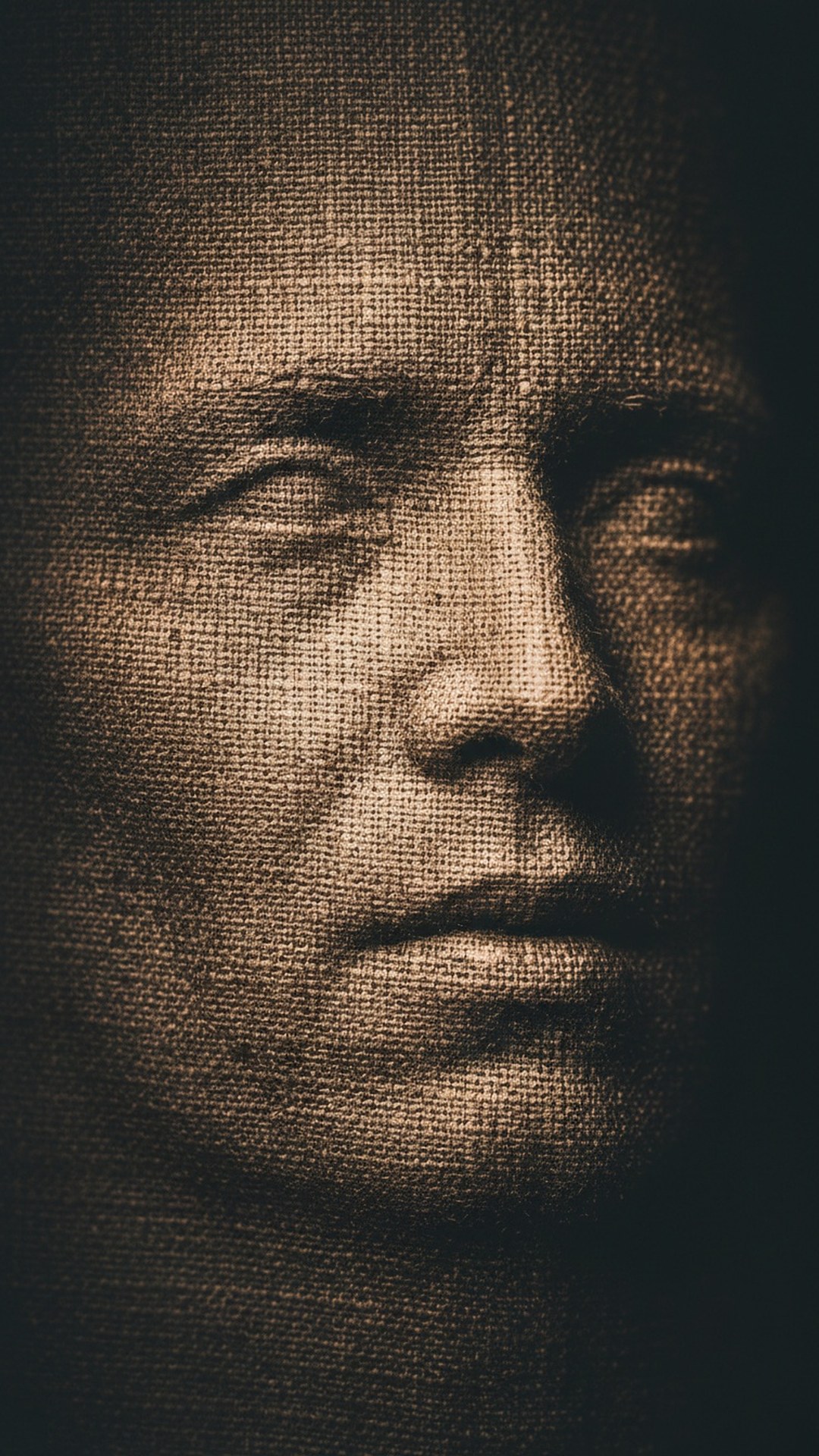
There is a linen cloth in Turin Cathedral that behaves like a photograph taken centuries before the camera existed.
It is 4.4 meters long. It bears the front and back imprint of a beaten, crucified man. And after 127 years of scientific scrutiny, no one has reproduced how the image got there.
May 28, 1898: The Night the Cloth Became a Photograph
On the evening of May 28, 1898, an amateur photographer named Secondo Pia was granted permission to take the first official photograph of the Shroud of Turin during a public exhibition inside Turin Cathedral.
He worked with a heavy glass-plate camera. When he returned to his darkroom and lowered the plate into the developing bath, he nearly dropped it. The negative was not a negative. It showed a clear, luminous, lifelike positive face of a bearded man.
That meant the image on the linen was itself a photographic negative. In 1898. On a cloth documented since 1354. Centuries before the invention of photography by Nicéphore Niépce in 1826.
The Wounds Match Roman Crucifixion, Not Medieval Art
Medieval European painters depicted Christ with nails driven through the palms of the hands. Every crucifix in every parish church across 14th-century France showed the same thing.
The man on the Shroud has nail wounds through the wrists. Modern forensic pathology, including studies by French surgeon Pierre Barbet at Saint-Joseph Hospital in Paris in the 1930s, confirms that a body nailed through the palms would tear free under its own weight. The wrist is the anatomically correct entry point. A medieval forger would not have known this.
The body also carries roughly 120 scourge marks consistent with a Roman flagrum, a lance wound to the right side between the fifth and sixth ribs, and puncture wounds across the scalp consistent with a cap of thorns rather than the ring-shaped crown of Western iconography.
The Image Sits on the Top of the Fibers. Only the Top.
In 1978, a team of 33 American scientists known as the Shroud of Turin Research Project, or STURP, was granted 120 continuous hours of access to the cloth inside the Royal Palace of Turin.
They ran X-ray fluorescence, infrared spectrometry, ultraviolet photography, and microchemical analysis. Their conclusion, published in the journal Applied Optics in 1980 and later in Accounts of Chemical Research in 1981, was that the image contained no pigment, no dye, no stain, no brush strokes, and no directionality.
The color exists only on the topmost microfibrils of each linen thread, at a depth of roughly 200 nanometers. Two ten-thousandths of a millimeter. It is not painted. It is not scorched. It is a discoloration of the linen itself.
The image lives on the top 200 nanometers of thread. No paint. No dye. No lab on Earth has reproduced it.
The Blood Is Real. And It Is Type AB.
The dark stains along the wrists, feet, side, and scalp were tested by Dr. Alan Adler of Western Connecticut State University and Dr. John Heller of the New England Institute in the early 1980s.
Their analysis identified hemoglobin, bilirubin, albumin, and human immunoglobulins. The blood group typing returned AB. The stains fluoresce in ultraviolet in a way consistent with blood serum halos around clotted wound sites, a detail invisible to the naked eye and unknown to medieval science.
The blood also sits under the image. The wounds were on the cloth first. The mysterious body image formed around them afterward.
The 1988 Carbon Date and the Rewoven Corner
In 1988, three laboratories at Oxford, Zurich, and the University of Arizona in Tucson independently carbon-dated a single postage-stamp-sized sample cut from one corner of the Shroud. Their result, published in Nature on February 16, 1989, dated the cloth to between 1260 and 1390.
The verdict seemed final. Then in 2005, chemist Raymond Rogers, a former STURP team member and Los Alamos National Laboratory researcher, published a paper in the journal Thermochimica Acta showing that the sample tested in 1988 contained cotton fibers and a spliced dye consistent with a medieval invisible repair.
The main body of the Shroud contains no cotton. Rogers concluded the 1988 sample came from a rewoven patch, likely stitched in after the 1532 fire that damaged the cloth inside the Sainte-Chapelle of Chambéry. In 2019, statistician Tristan Casabianca published raw data from the 1988 test in the journal Archaeometry showing internal inconsistencies the labs had never released.
Everyone Has Tried to Reproduce It. No One Has.
Italian chemist Luigi Garlaschelli of the University of Pavia announced a reproduction in 2009 using ochre pigment rubbed through a cloth over a volunteer. Under microscopy, his image sat on multiple fiber layers, contained pigment, and lacked the 3D distance-encoded information that NASA's VP-8 Image Analyzer detected in the real Shroud in 1976.
The VP-8 finding, made by Air Force scientists John Jackson and Eric Jumper, is the strangest detail of all. The Shroud image contains encoded depth information. Brightness on the cloth corresponds to distance from an underlying body. Ordinary photographs do not do this. Paintings do not do this.
Nothing else does this.
So we have a 14-foot linen with an anatomically accurate crucifixion, real human blood typed AB, a nanometer-thin image with encoded 3D data, a photographic negative predating photography, and a carbon date drawn from a patch that may not belong to the original cloth.
The Catholic Church has never officially declared the Shroud authentic. It has also never called it a forgery. It sits in a sealed reliquary behind bulletproof glass in Turin Cathedral, climate-controlled, argon-filled, waiting.
If a medieval forger made this in the 1300s, they used a technique no chemist in 2025 can duplicate, encoded depth data 600 years before computers, understood Roman crucifixion anatomy the entire art world got wrong, and painted with real human AB blood under an image that was not yet there. What do you think the Shroud actually is?
Before you go
7 books the Vatican doesn't want you reading. Free PDF, the texts they cut, with sources. Joined by 140+ Inner Circle members.
No spam. Unsubscribe anytime.
Go deeper
The Hidden Canon, Vol. I, Enoch. Jubilees. Thomas. Mary. Judas. 90 pages, 14 chapters, every receipt cited. The books your Bible quietly removed.
Read the Canon →Books that informed this investigation
As an Amazon Associate, Hidden Epoch earns from qualifying purchases. Cost to you: nothing.
Research safely
The VPN we use to research without being tracked. First 3 months free.
Get NordVPN →