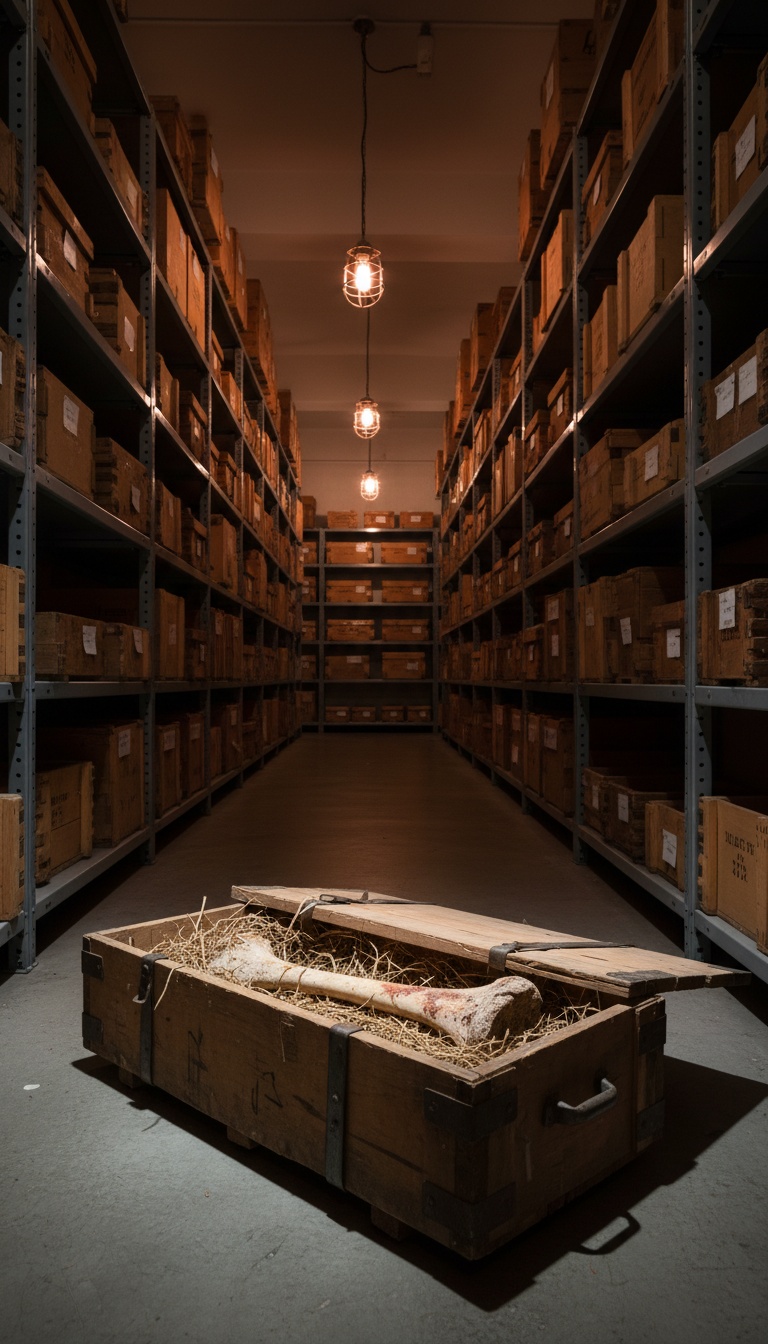
In 1909, the Smithsonian Institution received a shipment of oversized human remains pulled from a cave in western Nevada. The bones were catalogued. Then they disappeared from public view. Almost nobody knows this story survived at all.
What follows is not folklore. It is a paper trail. Dates, place names, storage counts, and cross-continental parallels that the mainstream archaeological establishment has quietly declined to explain for over a century.
Lovelock Cave, Nevada. 1911 to 1912.
Lovelock Cave sits roughly 22 miles southwest of the town of Lovelock, in Churchill County, Nevada. Guano miners David Pugh and James Hart began commercial extraction there in 1911, hauling out several feet of bat droppings before the artifacts underneath became impossible to ignore.
The University of California at Berkeley dispatched Llewellyn L. Loud in 1912 to excavate what the miners had disturbed. Loud recovered approximately 10,000 artifacts. A second campaign in 1924, led by Loud and Mark Raymond Harrington of the Museum of the American Indian, expanded the recovery further.
Local newspapers of the period, including the Nevada Review-Miner (June 19, 1931) and the Lovelock Review-Miner, reported the discovery of two skeletons at the site. One was described as measuring roughly 8 feet in length. Reddish hair still adhered to the remains.
The Smithsonian Paper Trail Goes Cold.
Portions of the Lovelock material were transferred east. The Smithsonian's National Museum of Natural History in Washington, D.C. is the institution that ended up holding a significant share of oversized skeletal material recovered from western sites during this era, alongside artifacts from cave excavations in Kentucky, West Virginia, and Ohio.
The Smithsonian currently stores an estimated 30,000 sets of human remains at its Museum Support Center in Suitland, Maryland. A ProPublica investigation published in January 2023 documented that the institution still holds the remains of more than 30,000 Native American and other individuals, with the majority never repatriated or publicly inventoried in detail.
The specific 1909 to 1931 window is where the anomaly lives. Newspaper reports name the finds. Field notes reference them. Then the trail thins to nothing verifiable in a public catalog.
Sardinia. The Same Signature.
Cross the Atlantic and the pattern repeats. The island of Sardinia contains a class of prehistoric rock-cut tombs called domus de janas, along with the larger hypogea associated with the Ozieri culture, roughly 3500 to 2700 BC.
Sardinian folklore records a race called the giganti, memorialized in the Giants' Tombs (tombe dei giganti). Over 800 of these megalithic gallery graves are documented across the island, several exceeding 20 meters in length. Excavated remains have periodically been reported as anomalously large, with red pigmentation noted on skeletal material at multiple sites.
The academic response has been to reclassify the anomalies as measurement error or ritual burial of extended limbs. The physical remains that would settle the question are, once again, not on public display.
Four continents. The same red pigmentation. The same 8-to-9-foot frames. The same institutional silence following the same institutional confirmation.
The Textual Record Nobody Wants to Touch.
The Hebrew Bible references a population called the Nephilim in Genesis 6:4 and again in Numbers 13:33. The latter passage describes the reconnaissance report of twelve scouts sent into Canaan, who return claiming the inhabitants made them feel like grasshoppers.
Deuteronomy 3:11 records the bed of Og, king of Bashan, as measuring nine cubits by four cubits. Converted at the standard 18-inch cubit, that is roughly 13.5 feet by 6 feet. The text specifies the bed was made of iron and preserved at Rabbah of the Ammonites.
1 Samuel 17:4 places Goliath's height at six cubits and a span. The Masoretic tradition renders this at approximately 9 feet 9 inches. The Dead Sea Scrolls fragment 4QSam-a and the Septuagint render it at four cubits and a span, roughly 6 feet 9 inches. Even the conservative reading exceeds the average Iron Age male height by more than two feet.
The Storage Problem.
Return to the physical evidence. The Smithsonian's collections are administered under the National Museum of Natural History's Department of Anthropology. Access requires institutional credentials, a stated research purpose, and approval from the department's collections management staff.
The Native American Graves Protection and Repatriation Act of 1990 required federal institutions to inventory human remains for repatriation. The Smithsonian, uniquely, was governed by the earlier National Museum of the American Indian Act of 1989. Neither statute produced a fully public, item-level inventory of anomalously proportioned remains.
Requests filed under the Freedom of Information Act for cave-recovery specimens from the 1909 to 1935 period have, per public records available through MuckRock and independent researcher filings, returned partial documentation and heavily redacted accession logs.
The receipts stack in the same direction every time. Newspaper reports name the finds. Field expeditions confirm the recoveries. Institutional storage absorbs the material. Public access closes.
If the 8-foot skeletons of Lovelock Cave were a measurement error, the correction would have been published in a journal by 1935 at the latest. If the Sardinian anomalies were folklore, the hypogea would be empty. If the Anakim and the Nephilim were literary invention, they would not have anatomical correlates on four continents.
The question is not whether the bones existed. The 1911 to 1931 Nevada newspaper record, the Berkeley excavation logs, and the Smithsonian's own accession history put that beyond dispute. The question is what an institution founded in 1846 with a Congressional charter to increase and diffuse knowledge is doing with 30,000 sets of remains it will not fully inventory. Drop your theory in the comments. I am reading every one.
Before you go
7 books the Vatican doesn't want you reading. Free PDF, the texts they cut, with sources. Joined by 140+ Inner Circle members.
No spam. Unsubscribe anytime.
Go deeper
The Hidden Canon, Vol. I, Enoch. Jubilees. Thomas. Mary. Judas. 90 pages, 14 chapters, every receipt cited. The books your Bible quietly removed.
Read the Canon →Books that informed this investigation
As an Amazon Associate, Hidden Epoch earns from qualifying purchases. Cost to you: nothing.
Research safely
The VPN we use to research without being tracked. First 3 months free.
Get NordVPN →