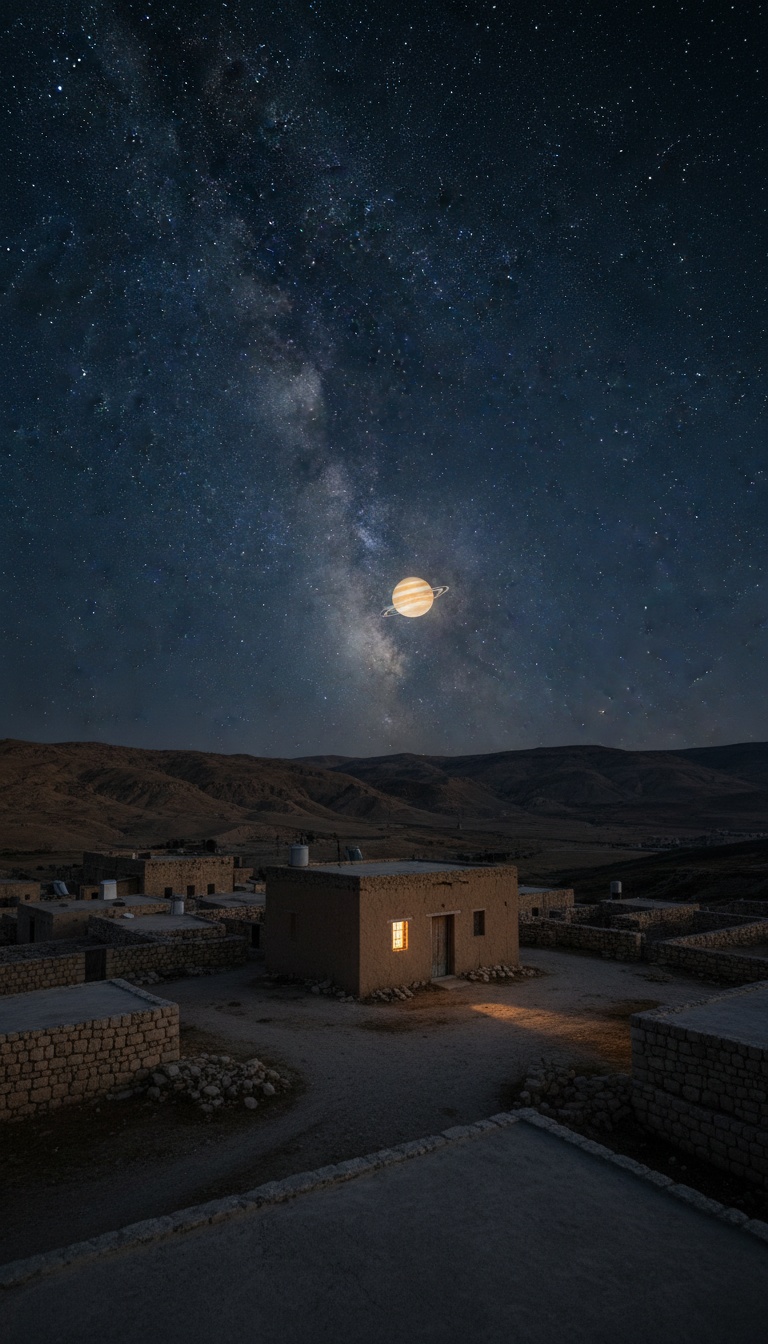
The Gospel of Matthew describes a star that moved ahead of travelers, led them to a single town, then stopped over one specific house. No star in the observable sky does that.
I am Jordan Vale, and this is the problem astronomers have been circling for four hundred years without landing.
What Matthew 2 Actually Says
The text in Matthew chapter 2 uses three verbs that break astronomy. The star goes before the magi (proegen), it comes and stands (estathe) over the location, and it does this after they leave Herod's court in Jerusalem and travel roughly six miles south to Bethlehem.
The Greek word for the magi is magoi, which the Wikipedia entry on the Star of Bethlehem (updated within the last 35 days) notes is more accurately rendered as astrologers than wise men. These were Persian or Babylonian sky-readers. They knew what stars did. They knew what stars did not do.
The child in the text is called paidion, not brephos. Paidion means young child, not newborn. Herod later orders the killing of boys up to age two in Bethlehem and its vicinity, which suggests the magi arrived months, possibly close to two years, after the birth itself.
The Comet Theory Falls Apart on Motive
Chinese and Korean court astronomers logged a comet around 5 BC in the records preserved in the Han shu and the Samguk Sagi tradition. The sighting is real. The interpretation is the problem.
In the first century Mediterranean and Near East, comets were read as omens of catastrophe. Josephus in The Jewish War book 6 describes a comet hanging over Jerusalem before its destruction in 70 AD. Suetonius records a comet at the death of Julius Caesar. Comets signaled the fall of kings, not the birth of them.
A Babylonian astrologer riding west because a comet appeared would have expected a war, a plague, or a dead emperor. Not an infant heir.
The Nova Theory Cannot Move
A nova is a star that suddenly flares in brightness, sometimes visible for weeks. Chinese records from 5 BC in the constellation Capricorn have been proposed as a candidate. Mark Kidger, an astronomer with the Instituto de Astrofisica de Canarias, published this argument in his 1999 book The Star of Bethlehem: An Astronomer's View.
A nova has one fatal flaw as a candidate. It does not move. It flares in a fixed position and slowly fades. It does not lead travelers south from Jerusalem to Bethlehem, and it does not stand over a house.
Every fixed star in the night sky rotates with the celestial sphere. It rises in the east, arcs across the sky, sets in the west. It does not stop.
The 7 BC Triple Conjunction in Pisces
This is the strongest astronomical candidate. In 7 BC, Jupiter and Saturn passed each other three times inside the constellation Pisces. The event is documented on a cuneiform tablet from Sippar held at the British Museum, cataloged as the Star Almanac for 7-6 BC.
Jupiter was read across the ancient Near East as the royal planet. Saturn was, in some Jewish astrological traditions, associated with the Sabbath and with Israel. Pisces was linked to Judea in the astrology of the period. Three signals pointing at one land.
Johannes Kepler worked this out first. In 1614, from Linz, he published De Stella Nova, arguing the conjunction of 7 BC was the trigger for the magi's journey. He was watching a similar conjunction in his own sky in 1603 when the idea hit him.
A planet that seems to halt, over the right land, at close to the right time. But the text says it stopped over a house.
Retrograde Motion Is the Only Real Halt
Planets appear to reverse direction against the stars because Earth overtakes them in its orbit. The planet slows, stops, moves backward for weeks, stops again, then resumes forward. Astronomers call the two pause points stationary points.
Jupiter went stationary during the 7 BC event. To an observer on the ground, the royal planet literally stopped moving in the sky. Michael Molnar, formerly of Rutgers University, argued in his 1999 book The Star of Bethlehem: The Legacy of the Magi that the key event was actually a different one, a lunar occultation of Jupiter in Aries on April 17, 6 BC, visible from the Near East at dawn.
Molnar found the argument on a Roman coin minted in Antioch in 13-14 AD, which shows Aries the ram looking back at a star. He argued Aries, not Pisces, was the sign the magi read as Judea.
The House Problem Nobody Solves
Every astronomical candidate stops at the same wall. A conjunction hangs high in the ecliptic. A retrograde pause happens across a wide arc of sky. A nova sits fixed among the stars. None of these can hover over a single address in a single village.
Bethlehem sits at 31.7 degrees north latitude. A star or planet directly overhead there would also be directly overhead every point on that same latitude, from Cairo to Kandahar. The geometry does not permit a sky object to single out one house on one street.
Matthew 2:9 is precise on this. The star came and stood over where the young child was. Not over the town. Over the location. The Greek reads epano hou en to paidion.
What Ancient Readers Would Have Heard
The story echoes Numbers 24:17, the oracle of Balaam, another eastern seer. A star shall come forth out of Jacob. First-century Jewish readers, including the community at Qumran whose Testimonia scroll (4Q175, held at the Israel Museum in Jerusalem) quotes this exact verse, treated it as messianic.
The Dead Sea Scrolls community was reading star language as king language decades before Matthew was written. The vocabulary of a star announcing a ruler was already in the air.
Which raises the harder question. Is Matthew describing an object in the sky, or a symbol borrowed from a prophecy his audience already knew by heart?
Every candidate explains part of the story. The 7 BC conjunction explains the timing and the royal signal. The retrograde motion explains a halt. The comet of 5 BC explains a moving light. None of them explains a light that hovers over one door.
Unless the object was not a star at all. Unless the magi were following something the text calls a star because they had no other word for it. Something that could descend low enough to mark a single roof in a village of a few hundred people.
Tell me in the comments. If it moved, stopped, and hung over one house, what were they actually looking at?
Before you go
7 books the Vatican doesn't want you reading. Free PDF, the texts they cut, with sources. Joined by 140+ Inner Circle members.
No spam. Unsubscribe anytime.
Go deeper
The Hidden Canon, Vol. I, Enoch. Jubilees. Thomas. Mary. Judas. 90 pages, 14 chapters, every receipt cited. The books your Bible quietly removed.
Read the Canon →Books that informed this investigation
As an Amazon Associate, Hidden Epoch earns from qualifying purchases. Cost to you: nothing.
Research safely
The VPN we use to research without being tracked. First 3 months free.
Get NordVPN →