Caltech announced Planet Nine in January 2016. A Sumerian artist carved it into stone around 2300 BCE. That stone is sitting in a glass case in Berlin right now.
Almost nobody knows this. The artifact is cataloged. The interpretation is published. The mainstream rebuttal exists. And yet the timeline keeps sliding into place every time astronomers point a new telescope at the outer solar system.
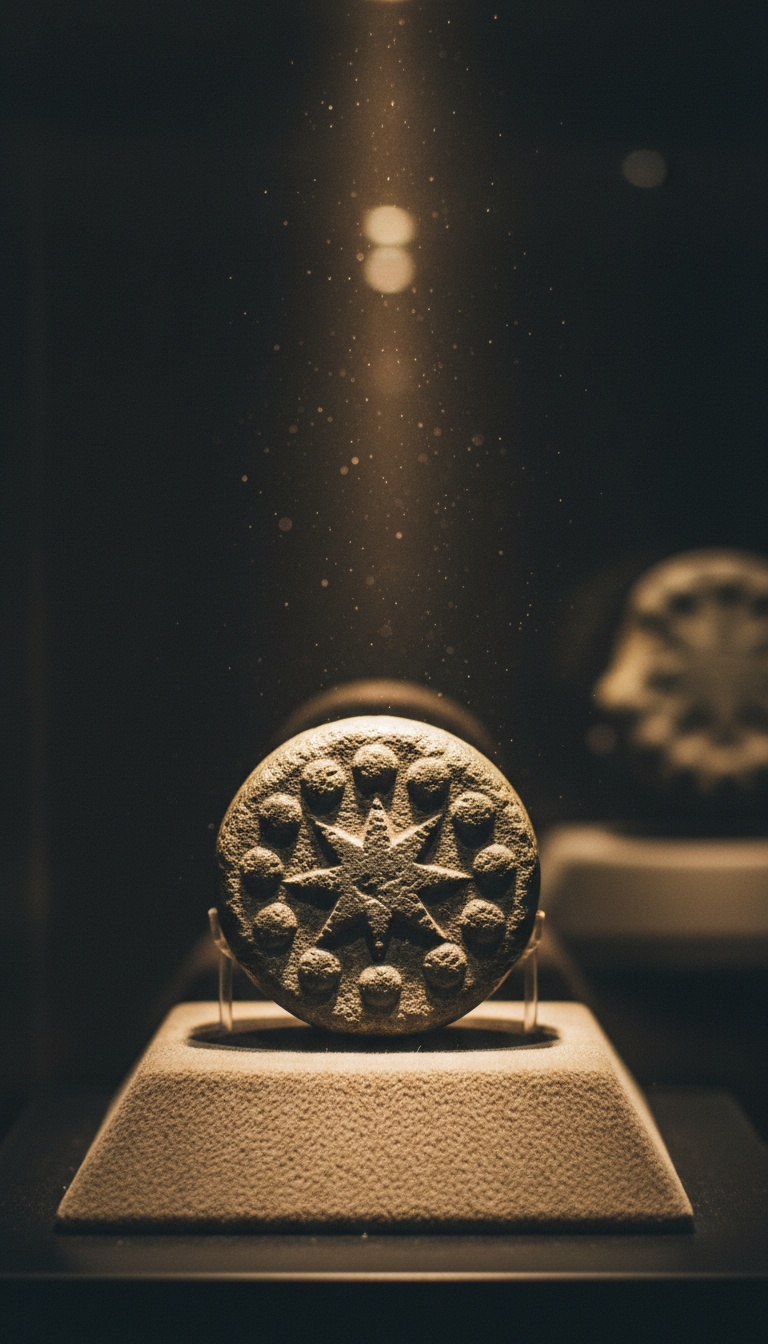
The Artifact: VA 243, Vorderasiatisches Museum Berlin
The object is called VA 243. It is a small Akkadian cylinder seal, carved from stone, dated to roughly 2300 BCE. It lives in the Vorderasiatisches Museum in Berlin, accession number VA/243, where you can walk up and look at it today.
The carving shows a central star surrounded by eleven smaller spheres arranged in a rough circle. Not stars. Not dots. Spheres of varying sizes clustered around a larger central body. The arrangement does not match any standard Mesopotamian deity-attendant motif in the geometry of size and placement.
Zecharia Sitchin, working from the Berlin collection, published his interpretation in 1976 in The 12th Planet. He counted the bodies. Sun plus Mercury, Venus, Earth, Moon, Mars, Jupiter, Saturn, Uranus, Neptune, Pluto. That is eleven. Then one more. He called the extra one Nibiru.
The Pluto Problem Nobody Wants to Discuss
Clyde Tombaugh discovered Pluto at Lowell Observatory in Flagstaff, Arizona, on February 18, 1930. Uranus was discovered by William Herschel in 1781. Neptune was discovered by Johann Galle in 1846.
The Sumerian seal predates all three discoveries by approximately 4,000 years. The mainstream counter is that the spheres are decorative. The counter to that counter is that the count is exact. Eleven bodies around a central star. Not ten. Not twelve. Eleven.
The mainstream position, articulated by Assyriologists including Michael Heiser, is that VA 243 depicts a star symbol with attendant dots and that Sitchin mistranslated the cuneiform inscription on the seal. That debate is real and ongoing. The geometry, however, is not in dispute. Eleven bodies are carved on that stone.
Sumerian Astronomy Was Not Primitive
The Sumerians compiled the Enuma Anu Enlil, a 70-tablet astronomical compendium (the 700 figure floats in popular sources, the academic count is around 70 tablets with thousands of omens) preserved in the library of Ashurbanipal at Nineveh, now held at the British Museum. It catalogs celestial omens, eclipse cycles, and planetary movements.
The Venus Tablet of Ammisaduqa, British Museum K.160, records 21 years of Venus observations from the reign of King Ammisaduqa around 1700 BCE. The tracking precision is hour-accurate over decades. That is not folk astronomy. That is institutional, multi-generational data collection.
The Babylonians, inheriting Sumerian methods, named Marduk in the Enuma Elish, Tablet VII, circa 1750 BCE. Marduk is described as a wandering body with a long orbital path. Sitchin and others have argued Marduk and Nibiru are the same body under different dynastic names.
A Sumerian scribe carved Planet Nine into stone in 2300 BCE. Caltech announced it in 2016. The gap is 4,316 years.
Caltech, 2016: The Math Catches Up
On January 20, 2016, Konstantin Batygin and Michael Brown of Caltech published in The Astronomical Journal their evidence for a ninth planet. The proposed body is roughly ten Earth masses. Its orbit is roughly 20 times farther from the Sun than Neptune. Its orbital period is estimated between 10,000 and 20,000 years.
Batygin and Brown did not see Planet Nine. They inferred it from orbital anomalies in six Kuiper Belt objects whose paths cluster in a way that suggests a massive unseen body shepherding them. In October 2016, the same team published a second paper arguing Planet Nine also explains the six-degree tilt of the Sun's rotational axis relative to the planetary plane.
The Sumerians described Nibiru as the planet of the crossing, a body on a long elliptical orbit that intersects the plane of the other planets. A long orbit. A crossing trajectory. A body that disturbs the others. The description is in cuneiform on tablets cataloged in the British Museum and the Iraq Museum in Baghdad.
The Anunnaki Origin Claim
The Sumerian King List, the best preserved copy of which is the Weld-Blundell Prism at the Ashmolean Museum in Oxford, dated to around 1800 BCE, opens with the line that kingship descended from heaven. The Anunnaki are described throughout Sumerian literature as beings who came down from the sky.
The Atrahasis epic, tablets held at the British Museum, describes the Anunnaki arriving, establishing cities, and assigning labor. The text is specific. It names locations. It dates events in regnal years.
Mainstream archaeology reads these texts as mythology. Sitchin and the researchers who followed him read them as redacted history. The texts themselves do not soften the claim. They say the gods came from a specific body in the sky and that the body is real.
What the Rubin Observatory Will Settle
The Vera C. Rubin Observatory in Cerro Pachon, Chile, begins full operations in 2025. Its 8.4-meter mirror and 3.2-gigapixel camera are designed to survey the entire visible southern sky every few nights. If Planet Nine exists within the predicted parameters, Rubin will find it within the first few years of operation.
In April 2025, a team led by Terry Long Phan published a candidate Planet Nine signal in the infrared archives of the IRAS and AKARI satellites, matching the Batygin-Brown predicted position. The candidate is unconfirmed. The search is narrowing.
If Rubin confirms a tenth body, the count of major solar system objects becomes Sun plus Mercury, Venus, Earth, Moon, Mars, Jupiter, Saturn, Uranus, Neptune, Pluto, Planet Nine. That is eleven bodies around a central star.
The Berlin seal shows eleven bodies. The 2016 Caltech math predicts eleven bodies. The 2025 infrared candidate may confirm eleven bodies. Three independent data sets, separated by 4,300 years, are converging on the same number.
One scenario: coincidence, decorative motif, post-hoc pattern matching by a 1976 author with an agenda. Another scenario: the Sumerians knew something. A third scenario: somebody told them.
VA 243 is sitting in Berlin. Rubin Observatory comes online this year. The next 24 months decide which scenario survives. Which one do you think the announcement will be.
Books that informed this investigation
- The Sumerians (Kramer)
- Babylon: Mesopotamia and the Birth of Civilization (Kriwaczek)
- The Ancient Near East (Hallo & Simpson)
As an Amazon Associate, Hidden Epoch earns from qualifying purchases. Cost to you: nothing.
Research safely
The VPN we use to research without being tracked. First 3 months free.
Get NordVPN →