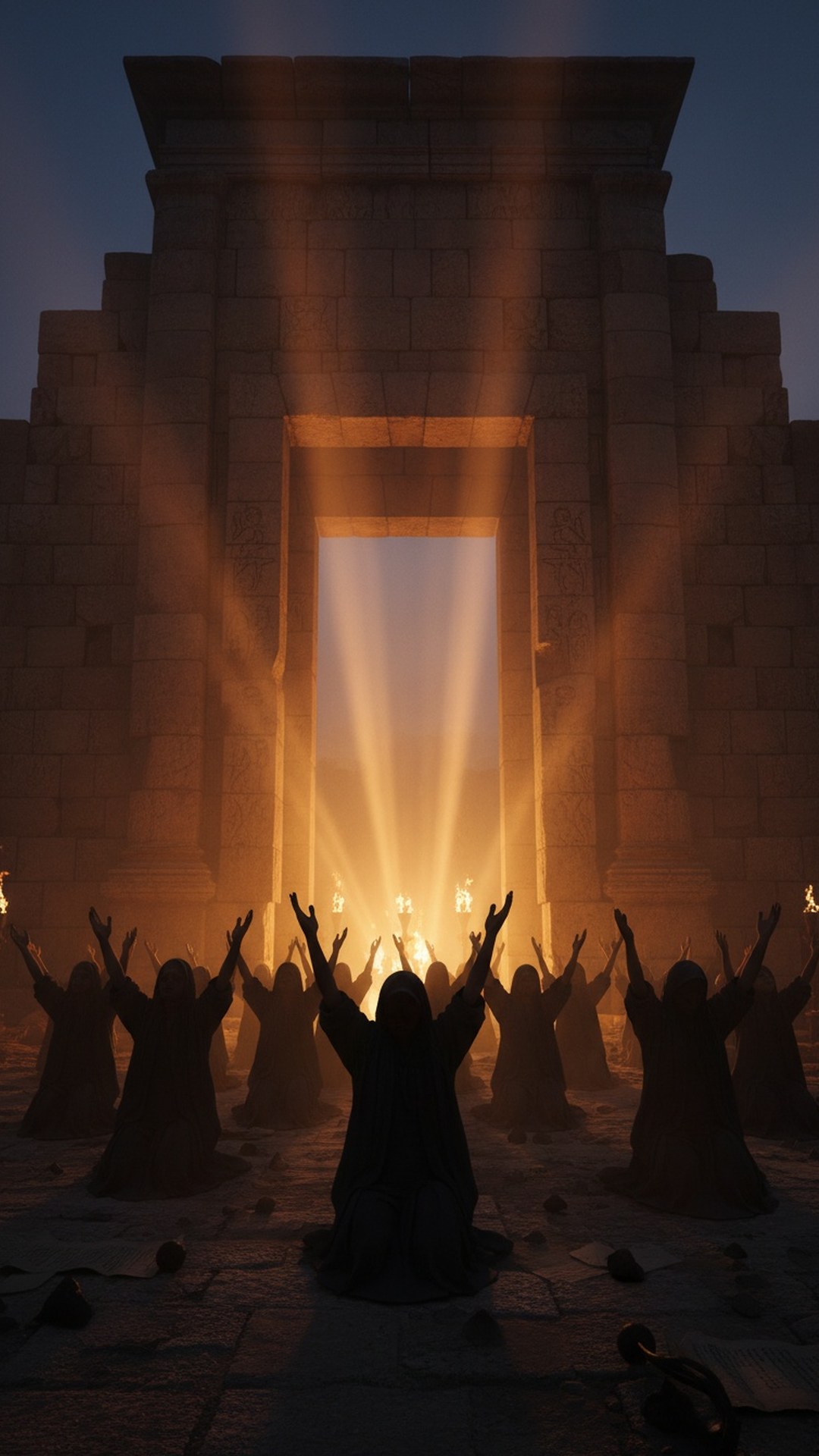
The strangest witness in this entire investigation is the Bible itself. Ezekiel chapter 8, verse 14: the prophet is carried in a vision to the north gate of the Temple of Yahweh in Jerusalem, and, in the text's own words, behold, there sat women weeping for Tammuz. Jewish women. Inside the Temple precincts. Performing the mourning ritual of a dying and rising pagan god, six hundred years before Jesus.
This is part 4 of THE BLUEPRINT, our 23-part investigation into the figures who carried pieces of the Jesus story before the story was told. And this chapter needs no lost tablets or disputed reconstructions. The receipt is printed in every Bible on earth.
The shepherd who died every year
Tammuz, called Dumuzid in the older Sumerian sources, was the shepherd god of Mesopotamia, worshipped from at least 2100 BC. Readers of part 3 have already met him: he is the substitute the underworld demanded when Inanna returned from the dead. Every year Tammuz died and was carried down to the world below. Every spring he returned, released through the intervention of the goddess, and the land turned green with him.
His death was not mourned quietly. Across Mesopotamia, in the fourth month of summer when the heat killed the pastures, women performed ritual lamentation for the dead shepherd: public, communal, calendared weeping. Cuneiform lamentation liturgies for Dumuzid survive in quantity. This was one of the most widespread ritual practices of the ancient Near East, sustained for well over a thousand years.
The witness inside the Temple
Then the Bible catches the ritual inside its own holiest precinct. Ezekiel, writing from the Babylonian exile around 592 BC, lists the abominations shown to him at the Jerusalem Temple, and the weeping women are the third of four. The prophet's outrage is precisely our evidence: nobody legislates against a practice nobody is doing. For Jewish women to sit mourning Tammuz at the north gate, the dying-god cult had to be domesticated deep inside Judahite religious life on the eve of the exile.
The fourth month of the Hebrew calendar is still called Tammuz today. The cult branded the calendar of the very people who condemned it.
And here is the detail almost nobody talks about. The Hebrew calendar month that falls in midsummer, the month of the mourning season, is named Tammuz. Not was named. Is named. Open a Jewish calendar this year and the dying god of Sumer is printed on it. The Babylonian month name came home with the exiles and never left. A ritual condemned by Ezekiel as an abomination ended up permanently stamped on the sacred calendar of Judaism.
The shape of the parallel
Line the two figures up. Tammuz was the divine shepherd; Jesus calls himself the good shepherd. Tammuz died and returned; so does Jesus. Tammuz was mourned by ritually weeping women; the Gospels place weeping women at the cross and at the tomb, and the daughters of Jerusalem weep along the route to Golgotha. Six hundred years after Ezekiel watched women weep for a dead shepherd god at the Temple gate, Jewish women wept at a tomb outside the same city, and this time the shepherd rose.
The honest differences
We keep this series honest, so state the gaps. Tammuz dies every year as a seasonal cycle, not once for all as a redemptive sacrifice. His return is secured by a goddess bargaining with the underworld, not by his own power, and scholars debate how fully the oldest sources describe a true rising rather than a half-year release. Nobody claims the evangelists copied a lamentation liturgy. The claim is narrower: the weeping-women, dying-shepherd pattern was practiced in Jerusalem itself, at the Temple itself, and the Bible says so.
Of every parallel in this series, Tammuz has the shortest chain of transmission to defend. The cult does not need to travel from Egypt or Greece to reach the Gospel writers. Ezekiel already found it standing at the north gate of the Temple, six centuries early, inside the tradition itself.
Same geography. Same ritual. Same archetype. Coincidence, or blueprint? The next chapter moves west, to a god whose initiates ate bread as flesh and drank wine as blood four hundred years before the Last Supper.
This is Part 4 of 23 in THE BLUEPRINT, an investigation into the pre-Christian figures who carried the pieces of the Jesus story. See every part of the series here.
Before you go
7 books the Vatican doesn't want you reading. Free PDF, the texts they cut, with sources. Joined by 140+ Inner Circle members.
No spam. Unsubscribe anytime.
Go deeper
The Hidden Canon, Vol. I, Enoch. Jubilees. Thomas. Mary. Judas. 90 pages, 14 chapters, every receipt cited. The books your Bible quietly removed.
Read the Canon →Books that informed this investigation
- The Sumerians (Kramer)
- Babylon: Mesopotamia and the Birth of Civilization (Kriwaczek)
- The Ancient Near East (Hallo & Simpson)
As an Amazon Associate, Hidden Epoch earns from qualifying purchases. Cost to you: nothing.
Research safely
The VPN we use to research without being tracked. First 3 months free.
Get NordVPN →