The Vatican sealed an archive in 1611, and every document that has ever come out of it has contradicted something the Church told the world for centuries.
That is not a coincidence. That is a pattern. And a pattern that consistent only runs one way.
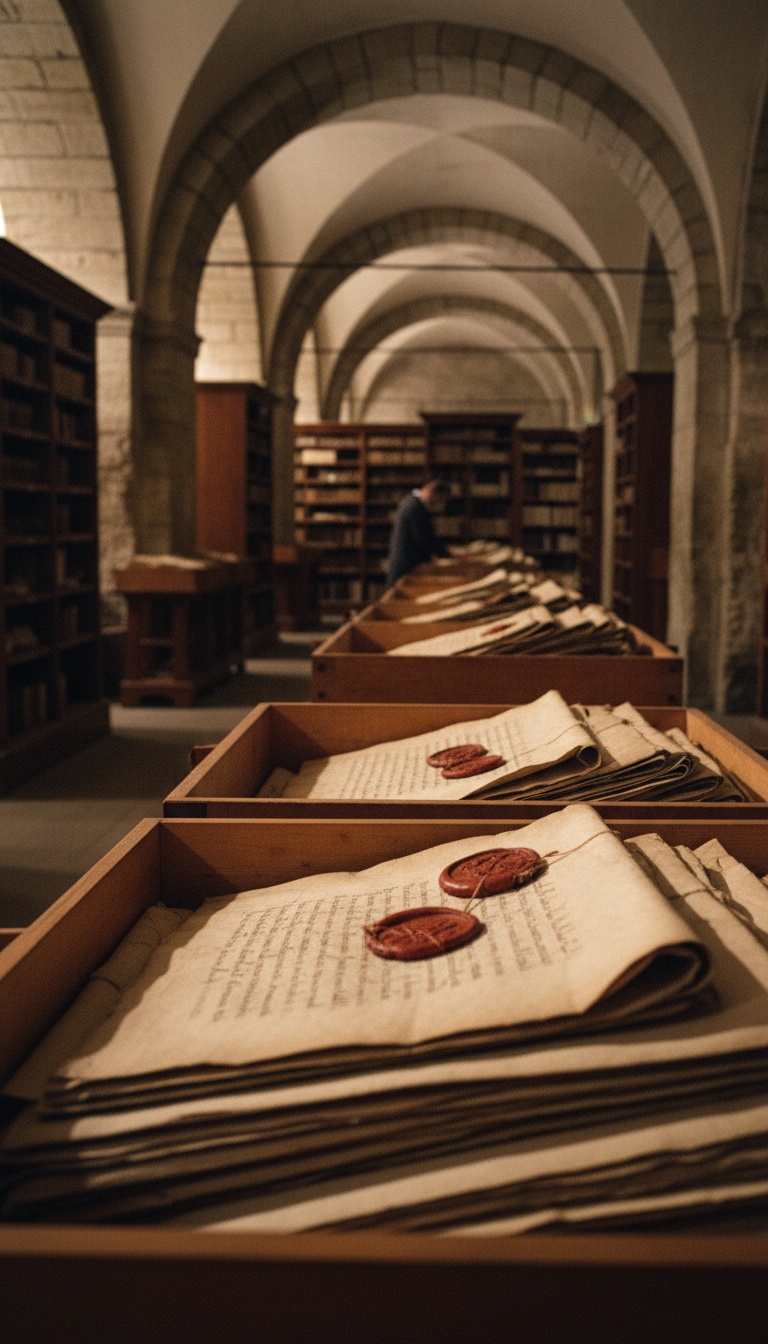
Two Miles of Shelving and No Public Catalogue
The Vatican Apostolic Archive sits inside Vatican City and holds approximately 85 kilometers of shelving. That is not a figure of speech. Eighty-five kilometers. The publicly accessible index covers a fraction of what is stored. Whole sections carry no description at all in the index that qualified researchers are permitted to consult. Access requires academic credentials, an institutional letter of introduction from a body the Vatican recognizes, and a specific research application naming each document requested in advance. Researchers must identify the documents before they can see them. The index is the only tool for identifying them. The Vatican controls the index.
The system is built so that what the Church does not want named cannot be found. A document without a name in the index has no request form. A request that cannot be filed cannot be denied. A denial that never happens leaves no record of a refusal.
The Chinon Parchment: 700 Years of Misfiling
In 2001, Vatican archivist Barbara Frale was searching the archive's holdings when she pulled a document from the wrong folder. The document was the Chinon Parchment, dated August 17 to 20, 1308. It recorded a private hearing in which Pope Clement V absolved the Knights Templar of heresy. The absolution was total. Unqualified. The Church's own internal record, written in the Pope's name, confirmed the Templars were innocent.
In 1314, the Church burned Jacques de Molay at the stake on the Ile de la Cite in Paris, convicted of the same heresy the Pope had privately cleared him of six years earlier. Philip IV of France pushed for the execution. Pope Clement V allowed it. The Chinon Parchment sat in the archive the entire time. It sat there through every subsequent century of official Church history that described the Templars as genuine heretics. It sat there through every academic history written on that authority. It sat misfiled for 700 years inside an institution whose central function, across those 700 years, was preserving and cataloguing its own records.
Documents do not end up in the wrong folder for seven centuries by carelessness inside an institution that size.
The Chinon Parchment proved the Pope privately cleared the Templars of heresy in 1308. Jacques de Molay burned for that same heresy in 1314. The document sat misfiled for 700 years.
The Galileo File and the Annulment That Built a Reformation
The Galileo trial file from 1633 was never released as a complete record. Researchers assembled it across multiple decades through separate, restricted access requests, each covering only a portion of the full proceedings. The inquisition convicted Galileo Galilei of heresy for teaching that the Earth orbits the Sun. The Church formally reversed that conviction in 1992. Three hundred and fifty-nine years after the verdict. The full deliberation behind the original conviction, the internal correspondence, what the Inquisition's leadership weighed at the time, is still inside the archive.
Henry VIII's 1527 petition to Pope Clement VII for annulment from Catherine of Aragon is in there. The refusal of that petition triggered the English Reformation and separated the Church of England from Rome permanently. The correspondence behind the refusal, the internal papal deliberation, what the Church privately assessed about the strength of Henry's canonical argument, has never been described publicly. A decision that altered the religious map of Europe permanently, and the full paper trail behind it, is in those 85 kilometers of shelving.
Napoleon Took 3,000 Cases. Not All of Them Came Back.
In 1810, Napoleon Bonaparte ordered the Vatican archive seized and transported to Paris. Three thousand wooden crates of documents made the journey. After Napoleon's defeat, the archive was returned to Rome in stages between 1815 and 1817. The return shipment was incomplete. Some documents were lost in transit. Some were damaged. Some were sold to cover transport costs and never recovered. The Vatican has never published a complete list of what was removed in 1810. The Vatican has never published a complete list of what was returned in 1817. The gap between those two lists, if it was ever formally accounted for, sits inside the archive. No external audit of the Napoleonic transfer has ever been permitted.
The 2020 Rename and What It Actually Changed
In October 2020, the Vatican announced it was renaming the Vatican Secret Archive to the Vatican Apostolic Archive. The official statement said the Latin word "secretum" had been misunderstood, that it historically meant private or reserved rather than hidden, and that "apostolic" better reflected the archive's purpose. The press release ran across major outlets in Europe and North America. The access rules did not change. The restricted sections remained restricted. The unnamed sections remained unnamed. The index did not expand. Researchers did not receive new credentials. The word "apostolic" does not open a filing cabinet.
The one concrete effect of the rename: searching "Vatican Secret Archive" in news databases now returns pre-2020 results. The term that generated decades of investigative journalism about sealed papal records no longer attaches cleanly to the institution that holds those records. Whatever was sealed in September 2020 was still sealed in November 2020. The name changed. The archive did not.
The Index Is the Lock
The Vatican Apostolic Archive does not turn qualified researchers away. It processes requests, reviews credentials, and grants access. The system looks like openness. The lock is in the index. Researchers who do not know which document to request cannot request it. The index provides the only list of requestable documents. Sections of the index carry no entries at all. Those sections correspond to physical shelving that exists inside the archive. The Church has confirmed the collection contains records from every pontificate since the eighth century, materials seized from dissolved religious orders, correspondence from medieval Church councils, and Inquisition records that have never been fully described. None of the unnamed sections have been described either. A document without a name in the index cannot be requested. A request that cannot be formed cannot be refused. A refusal that never happens generates no record of denial.
The Chinon Parchment proves the Church has burned people for positions it privately recorded as not heretical. The Galileo file documents a conviction it took 359 years to reverse. The Henry VIII correspondence covers a refusal that rewired European Christianity permanently. Every document that has come out of those 85 kilometers of shelving has revised history in a direction that makes the Church's public record look worse. Every single time.
The unnamed sections have been unnamed since at least 1611. The institution that sealed them has outlasted every empire that ever demanded transparency from it. It will outlast this news cycle. The only question is what changes when what is still in there finally comes out. Because something is in there. An institution does not leave sections of a 700-year archive without a name by accident. It leaves them unnamed because naming them is the beginning of the question. Whatever question that is, the Church has been answering it with silence for four centuries. That is not patience. That is a decision.
Before you go
7 books the Vatican doesn't want you reading. Free PDF — the texts they cut, with sources. Joined by 140+ Inner Circle members.
No spam. Unsubscribe anytime.
Go deeper
The Hidden Canon, Vol. I — Enoch. Jubilees. Thomas. Mary. Judas. 90 pages, 14 chapters, every receipt cited. The books your Bible quietly removed.
Read the Canon →Books that informed this investigation
As an Amazon Associate, Hidden Epoch earns from qualifying purchases. Cost to you: nothing.
Research safely
The VPN we use to research without being tracked. First 3 months free.
Get NordVPN →