A 240-page book has existed for over six hundred years. Every code-breaker who has ever touched it left empty-handed. Not one word, not one letter, not one identifiable symbol has been decoded. The Vatican held it for two centuries and said nothing about what was inside.
In 1912, rare book dealer Wilfrid Voynich purchased a manuscript from Villa Mondragone, a Jesuit college near Frascati outside Rome. The Jesuits were liquidating assets from their library. Voynich had spent his career hunting suppressed texts across European archives. He recognized within hours that the script matched nothing in any language catalogue he had ever studied. No Phoenician. No Aramaic. No cipher variant of any known European language. An entirely unidentified writing system, spanning 240 vellum pages, bound and complete, written by someone who knew exactly what they were doing.
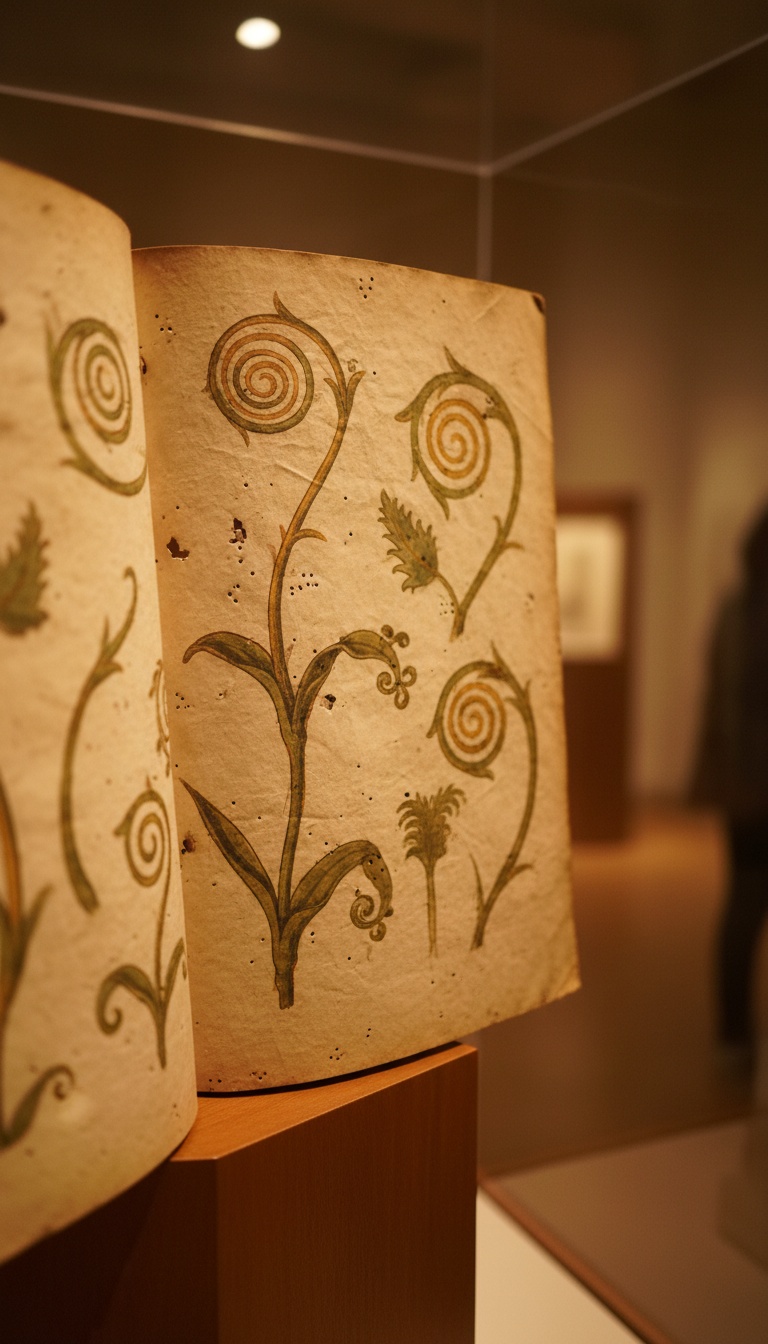
Two Hundred Years Inside the Collegium Romanum
The manuscript's earliest traceable ownership runs to Rudolf II, Holy Roman Emperor, around 1600 CE. Rudolf paid 600 gold ducats for it. That translates to roughly one hundred thousand dollars in current purchasing power. Rudolf did not spend that kind of money on novelty items. He built the largest curiosity cabinet in sixteenth-century Europe, filling Prague Castle with verified scientific instruments, authenticated maps, and documented texts from every corner of the known world. He identified this manuscript as worth acquiring at a significant price.
After Rudolf's death in 1612, the manuscript passed through the hands of two documented owners before arriving at the Collegium Romanum in Rome in 1666. The Collegium Romanum is a Jesuit institution operating under direct Vatican authority. It housed some of the most sophisticated scholarly minds in seventeenth-century Europe. The manuscript remained inside that library for 246 years, until Voynich bought it in 1912. No Jesuit scholar, no Vatican Cardinal, no papal authority published a single word of translation or explanation in any of those 246 years.
Athanasius Kircher Received It and Said Nothing
Athanasius Kircher was the most prolific and celebrated Jesuit scholar of the seventeenth century. He published more than forty books covering Egyptian hieroglyphics, Chinese language, geology, magnetism, acoustics, and subterranean geography. His 1652 work Oedipus Aegyptiacus attempted the first systematic decipherment of Egyptian hieroglyphs. He analyzed obscure texts sent to him from across Europe and corresponded with scholars in dozens of countries. Decipherment was the work he was known for.
In 1666, Johannes Marcus Marci shipped the Voynich Manuscript to Kircher in Rome. The cover letter explicitly asked Kircher to decode it, stating Marci's belief that Kircher was the only scholar in Europe capable of doing so. Kircher received the manuscript. He never published a translation. He never published a partial reading. He never wrote a letter to any correspondent describing what he found. His published correspondence for the following decade contains no reference to the manuscript at all. It entered the Collegium's library and fell silent.
The Code-Breakers Who Walked Away
William Friedman cracked JN-25, the primary Japanese naval cipher, during World War II. The intelligence produced by that decryption destroyed Japan's carrier fleet at the Battle of Midway in June 1942, a turning point that altered the entire Pacific war. Friedman spent years on the Voynich Manuscript after the war ended. He produced nothing.
The cryptanalysts at Bletchley Park who broke Germany's Enigma cipher examined the manuscript. They produced nothing. The United States National Security Agency has internal classified documents relating to their attempts to decode the Voynich text. The NSA. Not a university library. The NSA, which breaks the communications encryption of foreign governments and has done so since the 1950s, found this medieval manuscript significant enough to classify their work on it and still produced nothing they were willing to publish.
Four Sections. Four Impossibilities.
The botanical section contains 113 plant illustrations. Botanists at Kew Gardens in London and the Royal Botanic Garden Edinburgh have examined every drawing against the complete catalogue of known plant species. None of the 113 illustrations match any catalogued plant on Earth. Several drawings resemble real plants in isolated features, a leaf margin here, a root form there, but no single illustration has produced a positive identification against any known species.
The astronomical section shows at least four circular diagrams depicting star arrangements. Astronomers have compared these against Babylonian catalogues, Greek celestial maps, Arabic star charts from the ninth century, and every Renaissance-era celestial atlas in documented existence. No match has been identified for any diagram.
The biological section shows human figures immersed in pools connected by networks of tubes. Anatomists cannot identify the body systems the tubes represent. The pharmaceutical section lists substances drawn from the same unidentifiable plants in the botanical section. Four complete domains of human knowledge. Four total failures to connect any content to anything catalogued in human scientific history.
The team that cracked the Enigma machine walked away from this book with nothing. The NSA classified their attempt. Neither institution has ever explained why.
The Hoax Defense Does Not Survive the Statistics
In 2004, Gordon Rugg at Keele University argued in the journal Cryptologia that a forger could have generated the Voynich text using a Cardan grille. A Cardan grille is a card with cut-out holes placed over a syllable table. Slide it, copy the visible syllables, advance, repeat. Rugg demonstrated the method could produce text with surface similarities to the manuscript script. He called this evidence of possible forgery.
In 2013, Marcelo Montemurro at the University of Manchester published an information-theoretic analysis of the Voynich text in PLOS ONE. Montemurro found that the manuscript follows genuine linguistic entropy patterns. The statistical structure of word distribution, positional frequency, and syntactic clustering matches the patterns found in real human languages. Random generation and Cardan grille output both produce noise. The Voynich Manuscript produces something structurally different from noise.
A successful hoax across 240 pages requires maintaining internally consistent grammatical structure in an invented alphabet, referencing an invented botanical catalogue and an invented stellar cartography, without a single structural break, over a production period that manuscript quire analysis places at multiple months. No historical forger has been documented accomplishing anything close to this. The hoax theory requires a forger more skilled at consistent invented linguistics than anyone in the historical record who actually existed.
The randomness defense requires believing that someone in 1420 spent months producing 240 pages of grammatically consistent text depicting plants that do not grow on this planet and stars that do not map this sky. The Vatican received that text. Held it for 246 years. Never explained it. The NSA investigated it. Classified the investigation. Never explained that either. Every institution that has touched this manuscript has left without a public answer and without an explanation for why they left without one.
Six hundred years. Zero decoded words. Zero identified letters. Montemurro's 2013 analysis confirmed it carries genuine linguistic structure. The question is not why nobody can read it. The question is who decided that structure would stay unread, and what it says that every institution with the resources to find out has chosen not to tell you.
Before you go
7 books the Vatican doesn't want you reading. Free PDF. The texts they cut, with sources. Joined by 300+ Inner Circle members.
No spam. Unsubscribe anytime.
Go deeper
The Hidden Canon, Vol. I: Enoch. Jubilees. Thomas. Mary. Judas. 90 pages, 14 chapters, every receipt cited. The books your Bible quietly removed.
Read the Canon →Books that informed this investigation
As an Amazon Associate, Hidden Epoch earns from qualifying purchases. Cost to you: nothing.
Research safely
The VPN we use to research without being tracked. First 3 months free.
Get NordVPN →