A woman who ran a forbidden ritual for a living saw it work exactly once. That was the night a disguised King Saul knocked on her door, and the thing that rose out of the ground knew who he was and named the day he would die.
The account is in 1 Samuel 28, and it is the strangest chapter in the Hebrew Bible. For three thousand years rabbis, church fathers and translators have tried to explain it away. The text keeps refusing to cooperate.
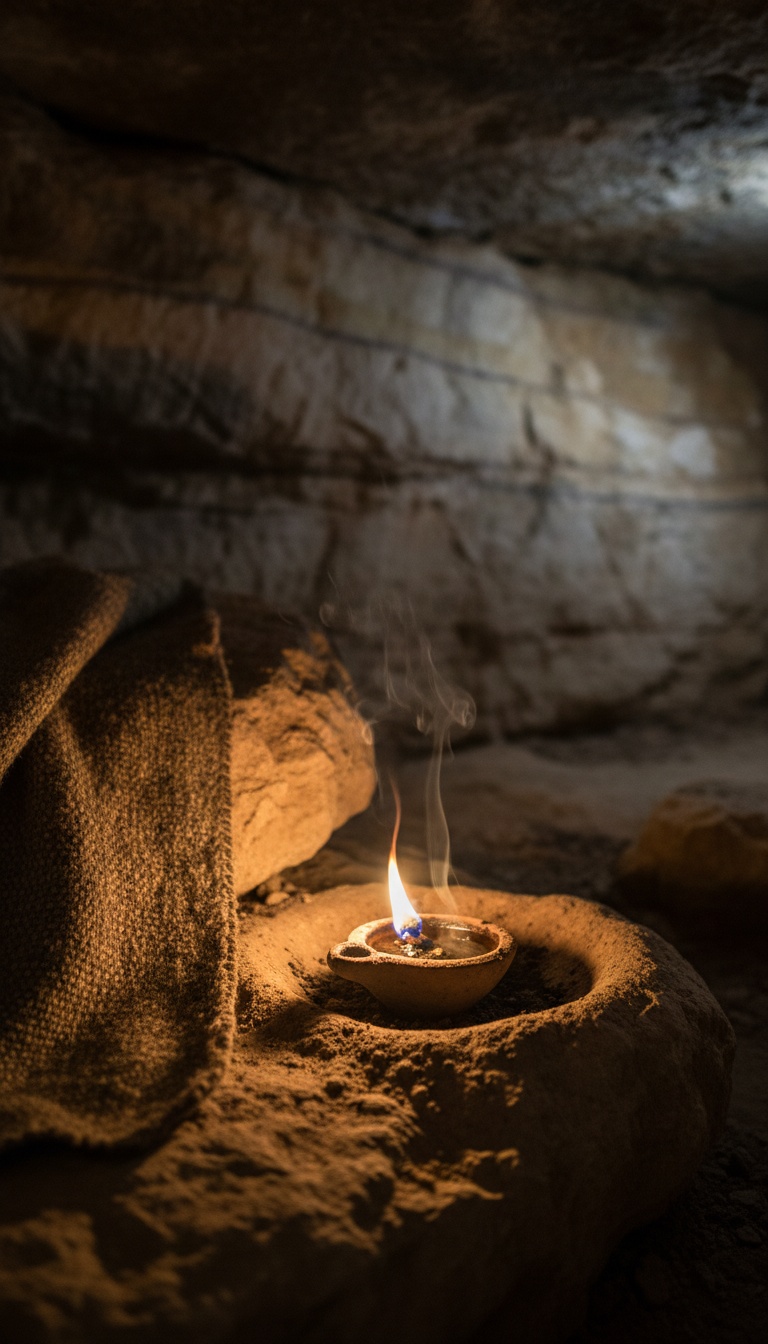
The King Who Banned the Dead
1 Samuel 28:3 sets the trap in one line. Samuel was dead and buried in Ramah, and Saul had driven the mediums and spiritists out of the land. The king himself had enforced Leviticus 19:31 and Deuteronomy 18:11. In his Israel, calling up the dead was a capital crime.
Then the Philistines massed at Shunem in the Jezreel Valley, and Saul camped on Mount Gilboa across the plain. 1 Samuel 28:5 says his heart trembled greatly. He asked God for an answer three ways: by dreams, by the Urim, and by the prophets. Verse 6 records silence on all three.
So the man who had outlawed the dead went looking for them. He told his servants to find him a baalat ob, a mistress of the ob, and they already knew where one lived. She was in Endor, on the far side of the Hill of Moreh. To reach her, Saul had to slip past the Philistine camp in the dark.
What an Ob Actually Was
The Hebrew word ob is older than Israel. In 1967 the Hittitologist Harry Hoffner Jr. traced it in the Journal of Biblical Literature to the Hittite a-a-bi, a ritual pit dug into the earth to call up beings from the underworld. Ritual tablets from Hattusa, now split between the Museum of Anatolian Civilizations in Ankara and the Istanbul Archaeology Museums, describe priests opening these pits and pouring offerings down to draw the dead upward.
That was her equipment: a hole in the ground, a summoning formula, and a practitioner listening at its edge. The Greek translators of the Septuagint, working in Alexandria in the third and second centuries BCE, gave her a blunter title. They called her an engastrimythos, a belly-talker. A ventriloquist.
Ancient readers had already filed her as a performer who threw her voice up out of the pit. Keep that label in mind, because it is the key to the whole chapter.
The Scream
Saul disguised himself, changed his clothes, and went by night with two men (1 Samuel 28:8). He asked her to bring up whoever he named. She told him to his face that Saul had cut the mediums off from the land, so she was describing the king's law to the king. He swore by the LORD that no punishment would touch her. She asked who to bring up. He said Samuel.
Her career breaks at verse 12. When the woman saw Samuel, she cried out with a loud voice. In Hebrew it is vattiz'aq beqol gadol, the shriek of someone in mortal terror. In the same breath she turned on her client: "Why have you deceived me? For you are Saul."
Nobody had told her. Saul came in costume, at night, with a borrowed escort, and the only name he gave her belonged to a dead man. She learned who the king was at the moment the thing came out of the ground.
A woman who faked the dead for a living screamed on the one night the dead actually came.
The Ventriloquist Theory Breaks on Verse 12
The strongest case against the chapter comes from the fourth century. Eustathius of Antioch wrote a whole treatise, On the Belly-Myther, attacking Origen and arguing that the scene was a demon's theater staged for a desperate king.
That theory fails by its own logic. A ventriloquist controls the voice, so she has no reason to scream at her own act. She has no reason to stop mid-session and accuse a paying customer of fraud. And Saul has to ask her what she sees, which means she was reporting something she had not scripted.
Her answer in verse 13 makes it worse: "I see elohim coming up out of the earth." Elohim is the word Genesis uses for God, and the verb attached to it, olim, is plural. She saw a divine being, plural in the grammar, rising out of the ground. Then she saw an old man wrapped in a robe, a me'il. That is the same garment Saul tore from Samuel's back in 1 Samuel 15:27, and the same kind his mother sewed for him as a boy in 1 Samuel 2:19. The robe identified him, and Saul bowed with his face to the floor.
Origen of Alexandria preached on these verses in the third century and read them straight: the text says Samuel, so it means Samuel. The Wisdom of Ben Sira, written around 180 BCE, said it first. After Samuel fell asleep, he prophesied and showed the king his end (Sirach 46:20).
Tomorrow
What rose did not comfort him. It asked why Saul had disturbed it, then gave the verdict in 1 Samuel 28:19. The LORD would hand Israel to the Philistines. "Tomorrow you and your sons will be with me."
Saul fell full length on the floor. He had eaten nothing all day and all night. The medium he had outlawed killed a fattened calf, baked unleavened bread, and fed the king before he walked back out into the dark.
1 Samuel 31 closes the loop. The Philistines killed Jonathan, Abinadab and Malchishua, three sons of Saul, on Mount Gilboa. Archers hit Saul. When his armor bearer refused to finish him, he fell on his own sword. The next day the Philistines found the bodies, cut off his head, and fastened his corpse to the wall of Beth-shan.
A second objection says Saul went into battle already broken, so the prophecy fulfilled itself. That can account for one man's nerve. It cannot arrange for three princes to die on the same slope on the same day. 1 Chronicles 10:13 gives the cause outright: Saul died because he consulted a medium. The Chronicler treated the séance as real enough to kill a king.
The Wall Is Still Standing
Beth-shan is Tel Beit She'an, a short march down the valley from Gilboa. The University of Pennsylvania excavated it from 1921 to 1933. Alan Rowe's team identified temple levels there with the house of Ashtaroth where the Philistines hung Saul's armor (1 Samuel 31:10). The finds are now divided between the Penn Museum in Philadelphia and the Rockefeller Archaeological Museum in Jerusalem, including the basalt steles of Seti I that guarded the garrison town.
Endor is still on the map. The Arab village of Indur stood on that hillside until 1948, the year Kibbutz Ein Dor took the ancient name. The hill is full of caves, and local tradition has pointed to one of them as hers for centuries. Gilboa, Shunem, Endor and Beth-shan sit inside a single day's walk, and every place in the chapter can still be stood on.
Count the receipts. A disguised king was named on sight. A robe identified a man across his own death. A father and three sons died on Gilboa within a single day, exactly as the voice from the ground had said.
One line has never been explained. When Saul asked what she saw, her first answer was elohim, plural, coming up out of the earth. Samuel came up as one old man in a robe. So who came up with him? Tell me in the comments what you think she saw first.
Before you go
7 books the Vatican doesn't want you reading. Free PDF — the texts they cut, with sources. Joined by 140+ Inner Circle members.
No spam. Unsubscribe anytime.
Go deeper
The Hidden Canon, Vol. I — Enoch. Jubilees. Thomas. Mary. Judas. 90 pages, 14 chapters, every receipt cited. The books your Bible quietly removed.
Read the Canon →Books that informed this investigation
As an Amazon Associate, Hidden Epoch earns from qualifying purchases. Cost to you: nothing.
Research safely
The VPN we use to research without being tracked. First 3 months free.
Get NordVPN →