The woman Jesus met at the well has no name in the Bible, yet the early church gave her one, and that name has outlived every empire that tried to bury her: Photina.
John chapter four spends forty two verses on one conversation at one well outside a Samaritan town called Sychar. It is the longest one-on-one conversation Jesus has with anyone in the four Gospels. In it he says plainly who he is, and he says it to her. The writer never records her name. The church kept it alive for two thousand years anyway.
Forty Two Verses, One Missing Name
Open John 4 and count. Verses 1 through 42 belong to her, to a single meeting at noon beside a well that was already ancient when Jesus sat down on its rim.
One chapter earlier, John gives Nicodemus his full credentials. "There was a man of the Pharisees, named Nicodemus, a ruler of the Jews" (John 3:1). Name, sect and rank, all in one line. The woman at the well gets this in the King James: "There cometh a woman of Samaria to draw water" (John 4:7). Her people, her chore, and a blank where her name should be.
Then the scene does something no other scene in John has done yet. In John 4:26 Jesus says, "I that speak unto thee am he." It is the first time in John's Gospel that he claims the title of Messiah out loud, in his own voice. He says it to a Samaritan woman with no name before he has said it that plainly to the twelve.
She Was The First Evangelist In John
She leaves her water jar at the well (John 4:28) and runs into the town. "Come, see a man, which told me all things that ever I did: is not this the Christ?" (John 4:29).
John 4:39 records what happened next: "many of the Samaritans of that city believed on him for the saying of the woman." The first mass conversion in John's Gospel comes out of her mouth. A whole town believed, before any apostle had preached a single sermon.
Then verse 42 writes her out. The townspeople tell her, "Now we believe, not because of thy saying." John gives her the credit in verse 39 and takes it back three verses later. She walks off the page and never comes back.
Three Manuscripts, The Same Blank
Papyrus 66, copied around 200 AD, is one of the oldest near-complete copies of John on earth. It sits in the Fondation Martin Bodmer in Cologny, outside Geneva. Her name is absent.
Codex Sinaiticus, copied in the mid fourth century, is held mostly at the British Library in London. Codex Vaticanus, from the same century, is kept in the Vatican Apostolic Library in Rome. Both carry John 4. Both leave her blank.
That is three manuscripts in three countries, and seventeen centuries of scribes copying the same silence letter for letter. The church that owned those books knew her name the whole time.
The Church Called Her Photina
Eastern Orthodox tradition names her Photini, from the Greek phos, meaning light. She is the enlightened one. The name answers the chapter itself, where Jesus offers her "living water" (John 4:10) and she carries the light back into the town.
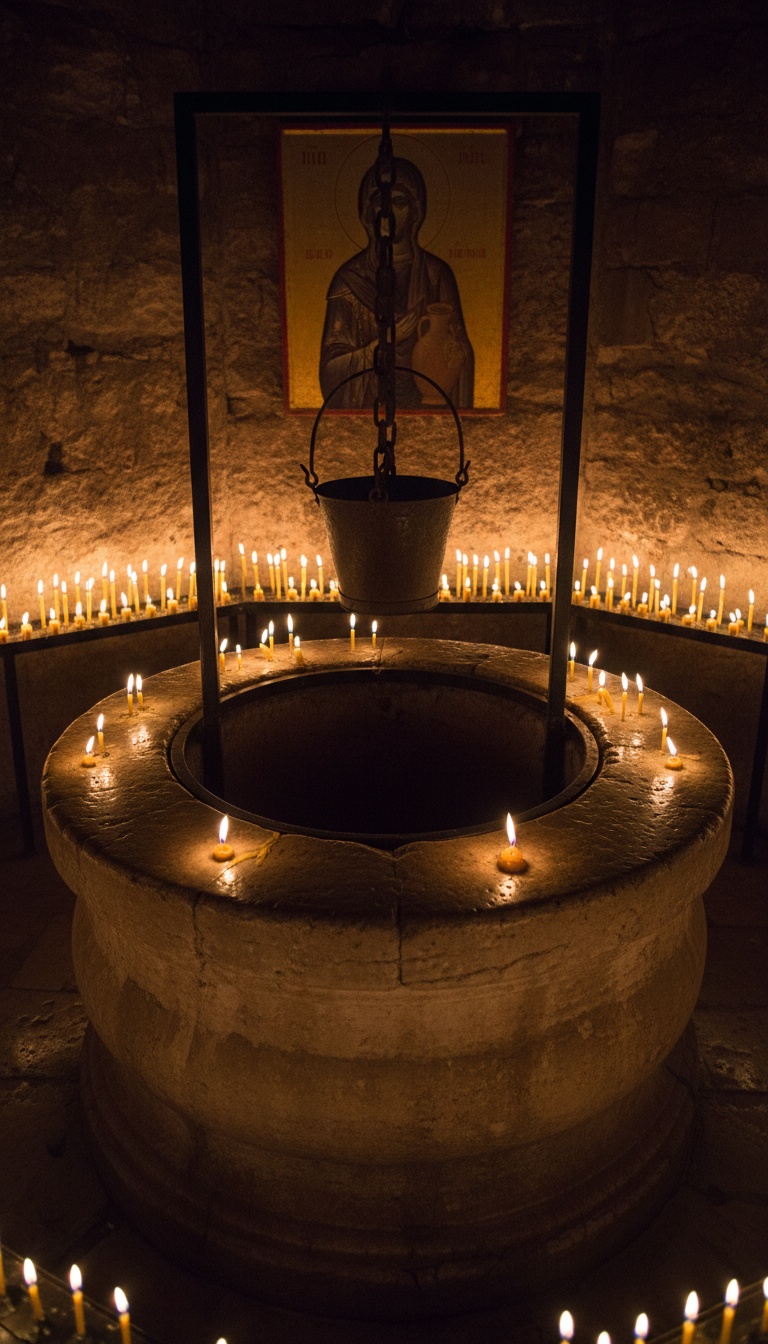
The Orthodox Church gives her the title Isapostolos, Equal to the Apostles. That is the same rank it gives Mary Magdalene and the emperor Constantine. She has a feast day on February 26, and the whole fifth Sunday after Pascha carries her story as the Sunday of the Samaritan Woman. Her icon shows her holding a clay water jar, and it hangs in Orthodox churches from Athens to Moscow.
Rome kept her too. The Roman Martyrology lists Saint Photina on March 20. Skeptics call the name a late legend. Then explain how a late legend ends up in both the Greek and the Latin calendars, on both sides of the Great Schism of 1054, when those two churches agreed on almost nothing. A name that both sides kept is older than the split.
She met the Messiah at a well. Nero killed her in one.
She Kept Preaching, And Nero Answered
The Orthodox accounts of her life pick up where John drops her. After Pentecost, Photini preached alongside her five sisters, Anatole, Phota, Photis, Paraskeve and Kyriake, and her two sons, Victor and Joses. Her road ran through Carthage in North Africa and ended in Rome.
Victor served as a Roman officer. In Rome the whole family was brought before Nero himself. Tradition records that Nero's own daughter, Domnina, converted through Photini's preaching and took the baptismal name Anthousa. The woman John never named reached the household of the emperor.
Nero had them tortured. The others were beheaded. Photini was thrown down a dry well, and she died there. The woman who met the Messiah at a well was executed in one. Her story closes the circle that John left open.
The Well Outside Nablus Still Draws Blood
Jacob's Well sits on the eastern edge of Nablus in the West Bank, a short walk from Tell Balata, the mound of ancient Shechem, at the foot of Mount Gerizim. The Bordeaux Pilgrim logged it in 333 AD. Jerome, writing in 404 AD about the pilgrim Paula, describes a church already standing over the well.
The Byzantines built over it. The Crusaders rebuilt it. Today the Greek Orthodox Church of Saint Photini stands on the site. It was finished in 2007, and the well in the crypt still gives water.
On November 29, 1979, the priest who guarded that well, Archimandrite Philoumenos, was attacked inside the crypt and killed with an axe. The Patriarchate of Jerusalem declared him a saint in 2009. Two thousand years after Photini, the well is still collecting martyrs.
Why The Page Stays Blank
In 367 AD, Athanasius of Alexandria sent out his 39th Festal Letter listing the 27 books of the New Testament. The Council of Carthage confirmed the list in 397. Everything outside it fell away.
Look at what fell away. The Gospel of Mary, preserved in the Berlin Codex at the Egyptian Museum in Berlin, gives Mary Magdalene a voice and a fight with Peter. The Pistis Sophia, in the Askew Codex at the British Library, has Mary questioning Jesus more than any male disciple. The texts that named the women were left out. The texts that left them blank went in.
Photina survived in hymns, icons and martyrologies, everywhere a priest could keep her. She never made it back onto the page you were handed.
The early church had her name, her sons, her sisters, her trial before Nero and the well she died in. It wrote every detail into its liturgy and none of it into scripture. Someone decided which of those records you would get to read.
The books that fell out of your Bible are free to read right now as a full PDF at hiddenepoch.com/lost-books. Read them and count how many women get their names back.
So ask it out loud. If the church knew her name, her feast day and her martyrdom for two thousand years, who decided your Bible should leave her blank, and what else did they cut out with her? Put your answer in the comments.
Before you go
7 books the Vatican doesn't want you reading. Free PDF — the texts they cut, with sources. Joined by 300+ Inner Circle members.
No spam. Unsubscribe anytime.
Go deeper
The Hidden Canon, Vol. I — Enoch. Jubilees. Thomas. Mary. Judas. 90 pages, 14 chapters, every receipt cited. The books your Bible quietly removed.
Read the Canon →Books that informed this investigation
As an Amazon Associate, Hidden Epoch earns from qualifying purchases. Cost to you: nothing.
Research safely
The VPN we use to research without being tracked. First 3 months free.
Get NordVPN →