The Acts of Andrew, a second-century book the Church later condemned by name, says the apostle Andrew was tied to a cross at Patras in Greece and preached from it for three days to a crowd of about twenty thousand people. When that crowd forced the Roman governor Aegeates to cut him down, Andrew prayed that nobody would touch the ropes. He died on the cross by his own choice.
That is the death the Church spent centuries trying to bury. A Roman governor tried to silence Andrew with rope. The bishops finished the job with a list.
The Book Rome's Bishops Put on a Blacklist
The Acts of Andrew was condemned three separate times. In 405 AD Pope Innocent I wrote to Exsuperius, bishop of Toulouse, and named the writings under Andrew's name as books to be rejected, blaming two men he called the philosophers Xenocharides and Leonidas. Around 325 AD Eusebius of Caesarea, in Book 3 of his Church History, put the Acts of Andrew on his list of books no true churchman would ever quote. Then the Decretum Gelasianum, issued under the name of Pope Gelasius I, listed the "Acts in the name of the apostle Andrew" among the apocrypha the faithful had to avoid.
Nobody condemns a book three times unless people keep reading it. You can trace the rest of the banned shelf in our lost books archive.
Tied With Rope So He Would Die Slowly
In the Acts, the proconsul of Achaea is a man named Aegeates, ruling from Patras on the Gulf of Corinth. He orders his soldiers to bind Andrew to the cross by his hands and feet with ropes. The text gives the reason. Nails would kill him too fast. Rope meant days of hanging, thirst and exposure in front of the whole city.
The sentence was personal. Aegeates' wife, Maximilla, had heard Andrew preach and believed him. She stopped sharing her husband's bed. The governor's own brother, Stratocles, followed Andrew too. Rome ran Patras, and a Roman governor whose household had walked out on him to follow a wandering Galilean had one tool left. He made an example of the man in public.
Three Days, Twenty Thousand Witnesses
The plan failed on the first morning. Andrew did not die. He preached from the cross, and the text says he kept preaching for three days and three nights without stopping. The crowd under him kept growing. Gregory of Tours puts it at nearly twenty thousand people.
That crowd turned on the governor. They marched on Aegeates and demanded the release of the righteous man he was killing in the open. A Roman proconsul, backed by the full weight of the empire, gave in to a mob in his own provincial capital. He came to the cross himself to untie Andrew.
They tied him up to silence him. He talked for three days. The Church cut the book, not the rope.
The Prayer That Kept Him on the Wood
This is the scene the bishops could not live with. Andrew looks down at the governor coming to free him and refuses. He prays out loud that nobody be allowed to untie him. In the text, the soldiers reach for the ropes and their hands go numb. A blinding light wraps around the cross for about half an hour, and when it fades, Andrew is dead.
He chose the hour of his own death in front of twenty thousand witnesses and a humiliated Roman governor. Maximilla took the body down and buried it. Aegeates, the Acts says, threw himself from a height and died before his brother could take him to trial. An apostle who beats Rome, outlives his own execution and then walks into death on his own terms is a dangerous story to hand a congregation. That danger is what got the book banned.
The "Late Romance" Label Breaks on Its Own Receipts
Critics call the Acts of Andrew a late Greek romance, a novel dressed up as history. The paper trail breaks that label three ways. Eusebius was already condemning it by 325 AD, so the book was old, circulating and influential before the first Christian emperor finished building his churches. A Coptic copy, Papyrus Utrecht 1, survives from the fourth century and sits today in the Utrecht University Library in the Netherlands, proof that the story had crossed from Greece into Egypt and been translated. And Gregory of Tours, a Frankish bishop writing in the 590s, copied it into his own Latin book of Andrew's miracles.
Gregory is the giveaway. He kept the cross, the crowd and the three days. He cut the teaching that made Maximilla leave her husband. The Church believed the story enough to edit it.
| Detail | Acts of Andrew (2nd century) | The Church-approved retelling |
|---|---|---|
| How he was fixed to the cross | Bound with ropes so he would die slowly | Kept, because nobody could deny it |
| Days on the cross | Three days and nights, preaching the whole time | Kept by Gregory of Tours |
| The crowd | About 20,000 who forced the governor to back down | Kept as a miracle story |
| Why Maximilla followed him | She left her husband's bed for Andrew's teaching | Teaching cut, only the miracles left |
| Shape of the cross | The text never names one | The X-shaped saltire, added in medieval art |
| Status of the full book | Read from Greece to Egypt | Banned by name in the Decretum Gelasianum |
The Church Kept the Bones and Banned the Book
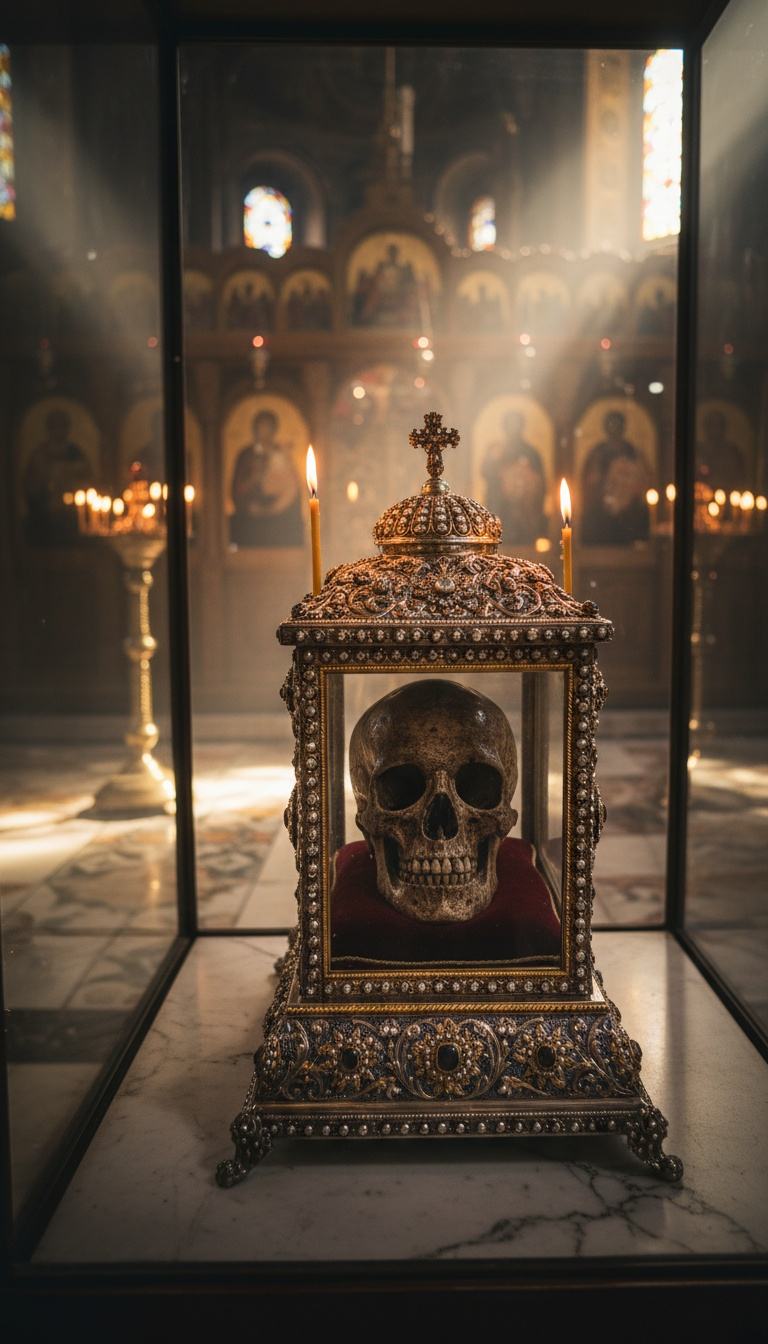
Andrew's body never stayed buried either. In 357 AD Emperor Constantius II moved his relics from Patras to Constantinople, to the Church of the Holy Apostles. After the Crusaders sacked Constantinople in 1204, the bones went to Italy, and since 1208 they have rested in the crypt of Amalfi Cathedral. His head went to Rome in 1462, handed to Pope Pius II. In 1964 Pope Paul VI sent it back to Patras, where it sits today in the Basilica of Saint Andrew, a few streets from where the Acts says he hung.
Rome guarded the skull for five hundred years and kept the only full account of how that skull's owner died off the reading list. More of these relic trails live in the Vault and our case files.
So put the pieces side by side. The bishops venerated the skull, kept the cross, adopted the X as a national flag for Scotland, and built a basilica over the execution site. The one thing they threw out was the book where a man tied up to be silenced out-talked Rome for three days and then refused to be saved.
You do not ban a story nobody believed. The question nobody in Rome has ever answered is what else was in the full text of the Acts of Andrew, because the copies that survive are pieces, and someone decided which pieces. What do you think they cut first?
Frequently Asked
What is the Acts of Andrew?
The Acts of Andrew is a second-century account of the apostle Andrew's preaching and death at Patras in Greece. It was read from Greece to Egypt before the Church banned it by name in the Decretum Gelasianum.
How long was Andrew on the cross?
The Acts of Andrew says he hung for three days and three nights, preaching the entire time. He was tied with ropes instead of nailed, so he would die slowly.
Why did Andrew refuse to come down from the cross?
When a crowd of about twenty thousand forced the governor Aegeates to free him, Andrew prayed that no one be allowed to untie him. He chose to die on the cross on his own terms, in front of the city that had come to save him.
Why was the Acts of Andrew banned?
It taught that Maximilla, wife of a Roman governor, was right to leave her husband's bed for Andrew's message, and it showed an apostle defeating Rome and choosing his own death. Pope Innocent I condemned it in 405 AD, Eusebius had already rejected it around 325 AD, and the Decretum Gelasianum listed it by name.
Where are Saint Andrew's remains today?
Most of his relics rest in the crypt of Amalfi Cathedral in Italy, where they have been since 1208. His head was returned from Rome to the Basilica of Saint Andrew in Patras in 1964.
Before you go
7 books the Vatican doesn't want you reading. Free PDF. The texts they cut, with sources. Joined by 300+ Inner Circle members.
No spam. Unsubscribe anytime.
Go deeper
The Hidden Canon, Vol. I: Enoch. Jubilees. Thomas. Mary. Judas. 90 pages, 14 chapters, every receipt cited. The books your Bible quietly removed.
Read the Canon →