
In 1901, Greek sponge divers off the island of Antikythera pulled a corroded lump of bronze out of a Roman-era shipwreck. It sat in an Athens museum drawer for years before anyone realized what it was. When they finally opened it, they found a machine that should not exist.
Thirty-seven meshing bronze gears in a wooden box, roughly the size of a shoebox. Built in the second century BC. It calculated the positions of the sun, the moon, and the five planets known to the Greeks. It predicted eclipses. The precision of the gear-cutting sits comfortably in the Renaissance, 1,400 years too early.
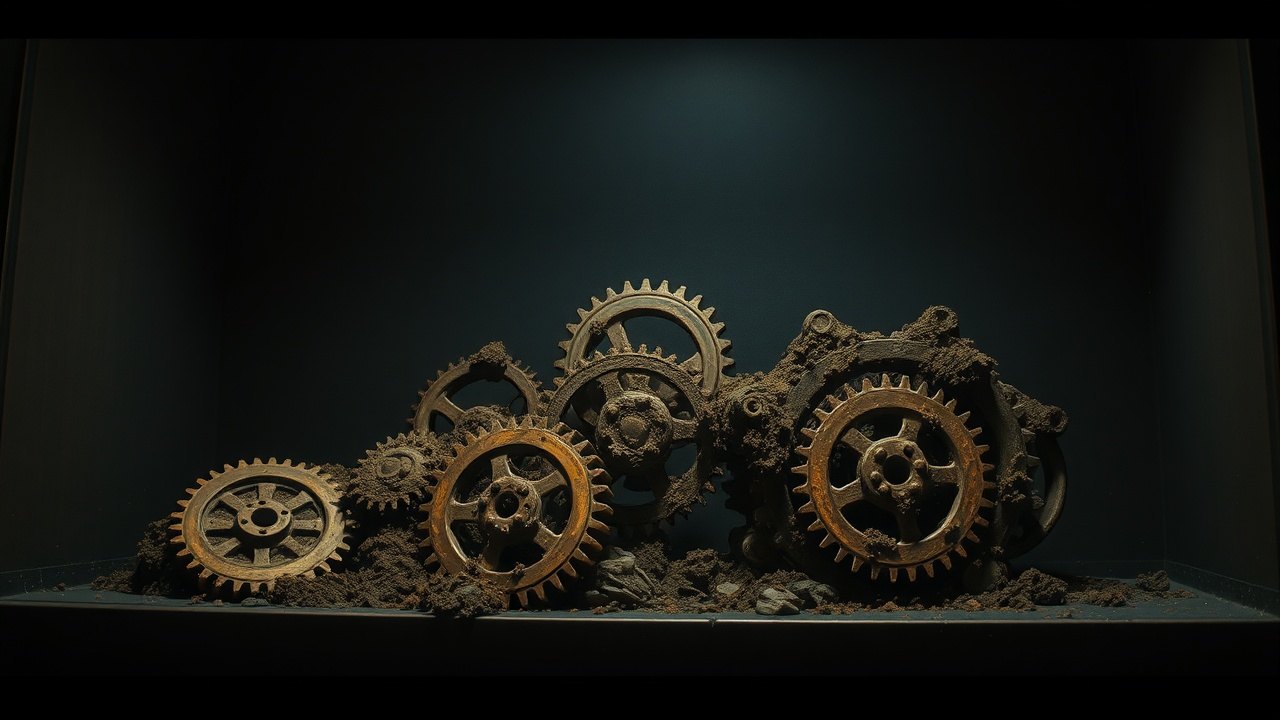
The lump nobody noticed
The wreck was found by sponge divers sheltering from a storm in April 1900. They came back the following summer to salvage what they could: marble statues, bronze figures, jars, coins. Somewhere in the debris pile was a lump of bronze the size of a small book, so encrusted with sediment that it looked like a rock. It was labeled and shelved.
Two years later, in 1902, an archaeologist named Valerios Stais noticed a gear wheel peeking out of a crack in the corrosion. Then another. Then Greek letters etched into a flat surface. What had been catalogued as a formless lump turned out to be a mechanism, and the mechanism turned out to be doing something specific.
The machine, in detail
Modern imaging, especially the high resolution X-ray tomography scans published by Tony Freeth and the Antikythera Mechanism Research Project in 2006 and again in 2021, revealed the internal structure. Thirty-seven bronze gears remain from an original count near 40. The largest is 13 centimeters across and carries 223 individually cut teeth. Each tooth is filed to sub-millimeter tolerance.
The gears model the motion of the sun and moon, and on the back face they predict solar and lunar eclipses on a Saros cycle of 223 lunar months. A separate dial tracks the four-year cycle of the Panhellenic Games. A pin-and-slot mechanism reproduces the slightly elliptical, non-uniform speed of the moon around the earth, an effect the Greeks had noticed but had no equations for. The device was solving the astronomy geometrically, with bronze.
The differential gear inside this device would not appear again in the historical record for 1,400 years.
Why this is the problem
Textbook history of technology places the differential gear in medieval Islamic and later European astronomical instruments, and mass-produced precision gearing in the clockmaking workshops of 14th century Europe. The Antikythera Mechanism sits centuries before either. And it is not a rough approximation of the idea. It is a fluent, mature application of it. Someone built and used mechanisms like this until they were good enough to survive underwater for two thousand years.
Which means the historical record is missing everything before it, and everything after it up to the Middle Ages. There is no prior prototype in any museum, and no continuous tradition afterwards. It appears once, in a shipwreck, and vanishes.
Where did the knowledge go
The tidy explanation, argued by Freeth and others, is that the mechanism belongs to a Hellenistic astronomical tradition centered on figures like Hipparchus of Rhodes, whose lunar theory shows up directly in the gearing. That accounts for the astronomy. It does not account for the machining, and the machining is the part that should not exist. Cicero, writing about 60 years after the shipwreck sank, describes a similar device built by Archimedes and later owned by the Roman general Marcellus. He mentions another built by Posidonius. So there were at least three of these that classical authors thought worth naming.
None survived except the one on the seafloor. Bronze corrodes in air within centuries. It survives underwater in specific conditions. Every land copy would have been recycled, melted, lost. The only reason we know Greek mechanical astronomy reached this level is that a ship went down in the right depth of water.
The uncomfortable question
If the entire surviving evidence of a technology is one corroded lump, dredged up by accident, what is the base rate for other technologies we cannot see? There are Byzantine geared calendars from the 5th and 6th centuries. There are early medieval Islamic astrolabes with reduction gearing. The transmission never broke. It ran underground through workshops that left no museum pieces, because bronze gets melted and reused and only the seafloor keeps what it is given. The Renaissance clockmakers were not inventing anything. They were recovering a technology that was already fourteen centuries old when they picked it up, and the lump from Antikythera is the receipt.
The objection is that all of this is an argument from silence, that missing evidence proves nothing. Turn it around. The second-century BC Mediterranean was running precision engineering our history books had no category for until 1902, and could not read until high resolution tomography in the 2000s. A hundred and twenty years passed between physically owning the artifact and comprehending it. The silence was never in the past. It was in us. We held the proof in a drawer in Athens and could not see it, and nothing about the way we catalogue the ancient world has changed since.
The mechanism is now in Athens, in the National Archaeological Museum, displayed in fragments behind glass. Visitors walk past it in seconds. Most museums put a caption next to something like this. This one has a full research team, a peer-reviewed decade of publications, and a growing list of questions its own excavators cannot answer.
The Antikythera wreck is being re-excavated. Sonar has mapped debris fields the 1901 divers never touched. If there is another mechanism down there, or an earlier prototype, or a manual, the Aegean is where it will surface. Meanwhile the piece already on land does one job: it tells us the historical record is not the whole story, and that the ocean has been keeping a better archive than the museums.
Before you go
7 books the Vatican doesn't want you reading. Free PDF, the texts they cut, with sources. Joined by 140+ Inner Circle members.
No spam. Unsubscribe anytime.
Go deeper
The Hidden Canon, Vol. I, Enoch. Jubilees. Thomas. Mary. Judas. 90 pages, 14 chapters, every receipt cited. The books your Bible quietly removed.
Read the Canon →Books that informed this investigation
As an Amazon Associate, Hidden Epoch earns from qualifying purchases. Cost to you: nothing.
Research safely
The VPN we use to research without being tracked. First 3 months free.
Get NordVPN →