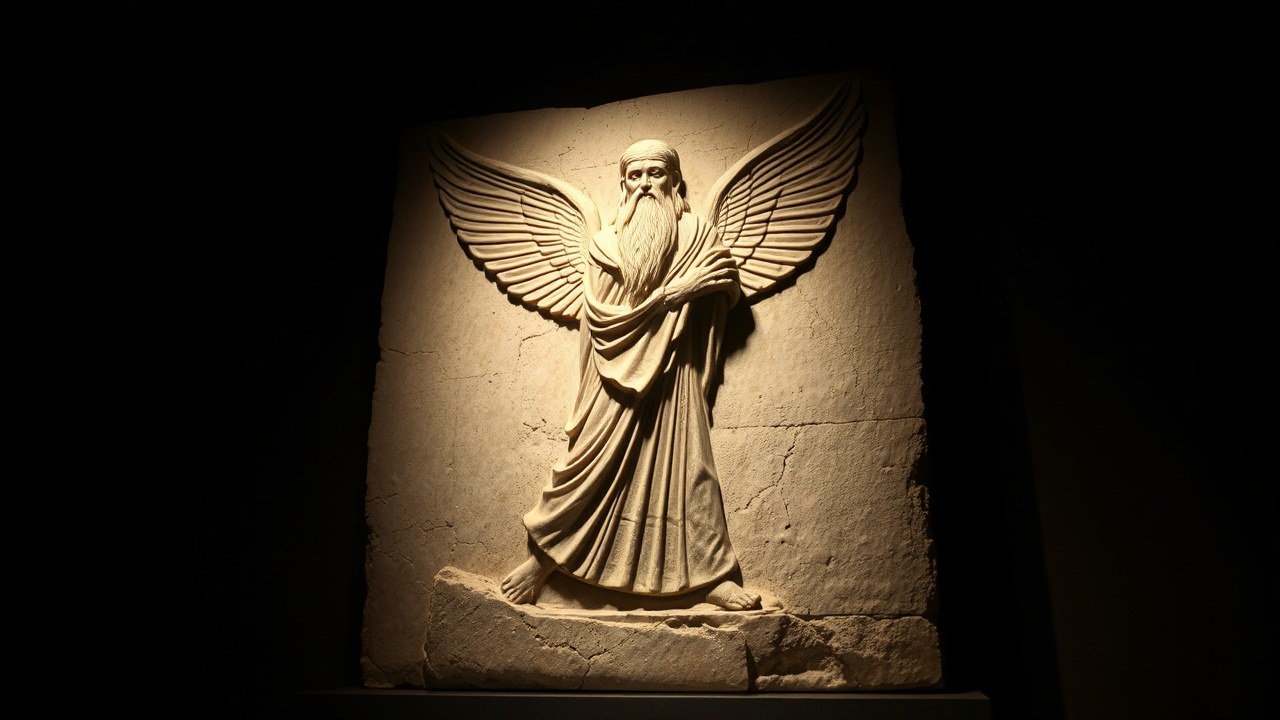
Walk into the Assyrian galleries at the British Museum, the Louvre, or the Pergamon. Look at the palace reliefs from Nimrud and Khorsabad. The Neo-Assyrian kings, Ashurnasirpal II, Sargon II, Sennacherib, covered their throne rooms with carved limestone panels showing rituals, hunts, processions.
And in nearly every panel, in front of every king, you will see a figure that is not entirely human.
It is humanoid. It stands upright. It carries a small bucket in one hand and what looks like a pine cone in the other. Sometimes it has wings. Sometimes its head is the head of an eagle. Sometimes, and these are the strangest, it is wearing what is unmistakably a fish, draped over its head and shoulders so that the head of the fish forms a hood over its own head and the body of the fish hangs down its back like a robe.
The Assyrians called these figures apkallu. The kings carved them at the gateways of palaces because, according to Mesopotamian belief, the apkallu were the figures who taught humanity what it knows.
The Babylonian Priest Who Wrote It Down
Around 300 BCE, a Babylonian priest of the god Marduk named Berossus wrote a three-volume history of his people for a Greek-speaking world that had just been conquered by Alexander. Most of Babyloniaca, Berossus's masterwork, is lost. What survives is preserved in fragments by later writers, primarily Eusebius and Polyhistor, who quoted Berossus extensively.
Berossus is the source for the most detailed surviving account of the apkallu. He describes the first one in such detail that the description has been quoted intact for two thousand years:
"His body was that of a fish, but under the fish's head he had another head, and feet like those of a man. His voice and language too were articulate and human; and a representation of him is preserved even to this day. He gave them an insight into letters and sciences, and arts of every kind. He taught them to construct cities, to found temples, to compile laws, and explained to them the principles of geometrical knowledge. After this, the rest of the apkallu came at intervals."
The first one, in Berossus's telling, was named Oannes. He emerged from the Erythraean Sea, a Greek term for what we now call the Persian Gulf, by day, taught humanity, and returned to the water by night. He did not eat. He did not stay among men.
Berossus says seven apkallu came before the flood. They taught civilization to humanity over generations, each adding to what the last had given.
Then the flood came.
Then, Berossus tells us, four more came.
The Four Post-Flood Sages
The four post-flood apkallu are named in surviving Sumerian and Akkadian texts. They are not Berossus's invention. They appear in cuneiform scribal lists and in the so-called Catalogue of Sages, a Mesopotamian text that pairs each sage with a specific king and a specific dynasty. The pre-flood seven taught antediluvian humanity. The post-flood four taught the kings of the early dynastic period.
Their names are:
- Nungalpiriggaldim, sage of king Enmerkar of Uruk
- Piriggalnungal, sage of king Gilgamesh's lineage
- Piriggalabsu, sage of king Shulgi (or Hammurabi, depending on the recension)
- Lu-Nanna, sage of the late dynastic period
Of these four, Lu-Nanna is described in one of the most striking ways. He is two-thirds apkallu, one-third human. The text is explicit. The post-flood sages, the Mesopotamians believed, were no longer purely the divine fish-men of the antediluvian age. They were diluted. Mixed. Two-thirds of what they had been before the flood.
This is the same fraction Gilgamesh is given in the Epic of Gilgamesh: two parts god, one part man. The Mesopotamians had a precise vocabulary for hybrid beings, and they used it consistently across centuries of texts.
Genesis 6:4, The Verse the Translators Tried to Soften
Open Genesis 6 in any modern Bible. Verse 4 says, in some translations:
"The Nephilim were on the earth in those days, and also afterward, when the sons of God came in to the daughters of men and they bore children to them. These were the mighty men who were of old, the men of renown."
Most readers focus on the first part. Sons of God came in to the daughters of men, the angelic-human hybrids that the Book of Enoch develops at length. The mighty men, the giants, the heroes of old.
The four words that almost nobody preaches on are "and also afterward."
The Hebrew is unambiguous on this point. v'gam acharei-chen, "and also after that." The text is not saying the Nephilim existed only before the flood. It is saying they existed before, and they existed afterward as well.
Numbers 13:33, written centuries later, has the Israelite spies returning from Canaan terrified because they saw Nephilim, the sons of Anak who come from the Nephilim. The Nephilim were back. Or they had never gone.
Then the question becomes: how did they come back? The flood, by Genesis's own account, killed everyone except Noah's family. The Nephilim line, if it was tied to the antediluvian sons-of-God incursion, should have ended in the flood.
Genesis 6:4's "and also afterward" says it didn't. Mesopotamian texts, written centuries earlier, said the same thing, that four sages came back after the flood, no longer purely divine, but two-thirds something other than human.
Same timeline. Same fraction. Same return.
The Pattern That Doesn't Stay in Mesopotamia
If this were only a Mesopotamian story, it would be remarkable enough, a 1,500-year-old text that anticipates the most theologically loaded verse in Genesis 6. But it isn't only Mesopotamian.
Every major flood-surviving civilization on Earth has the same beat in its founding mythology. A figure rises from the sea after a catastrophic flood. He teaches writing, mathematics, agriculture, calendar. He stays for a time. Then he disappears.
- Aztec / Mesoamerican: Quetzalcoatl, bearded, white-robed, came from the sea, taught the calendar, sailed back east, promised to return.
- Maya: Kukulkan, the feathered serpent, same figure, same beat. Arrived from the water, taught civilization, departed.
- Inca: Viracocha, emerged from Lake Titicaca after the flood, taught the people of the Andes how to plant, how to weave, how to organize, then walked west across the Pacific Ocean and vanished.
- Muisca (Colombia): Bochica, bearded, came from the east, taught writing and law, then disappeared into the cliffs.
- Vedic India: Matsya, the fish avatar of Vishnu, warned Manu of the coming flood, saved him in a boat, and afterward taught him the Vedas. The fish form is critical. It is not a coincidence.
- Easter Island: Hotu Matua, arrived from the sea after the sinking of the homeland Hiva, established civilization on the island.
Different oceans. Different continents. Cultures with no plausible contact in the relevant time window. The same narrative engine: civilization came from the water, after the flood, in the form of a teacher who taught and then left.
What Mainstream Scholarship Says, And What It Doesn't
The mainstream academic position on the apkallu is that they were mythological. The Mesopotamian texts are read as religious literature, not as historical record. The cross-cultural parallels are explained as either independent emergence (the human imagination, faced with similar challenges, generating similar stories) or as diffusion (one culture's myth traveling along trade routes and being adopted elsewhere).
Both explanations are reasonable for some of the parallels.
Neither explanation comfortably accounts for the full pattern. Independent emergence does not predict the consistent specificity, fish-form, water-emergence, post-flood timing, teaching of writing and mathematics, voluntary departure. Diffusion does not work for cultures separated by oceans before any plausible contact period.
The honest position is that the global pattern of post-flood teacher-from-the-water mythology is not fully explained by any current academic framework, and that the simplest explanation, that something close to a real event embedded itself in the cultural memory of every major flood-surviving civilization, is the one that academics are most reluctant to entertain.
The Question That Doesn't Get Asked
If the Sumerian tablets, written more than a thousand years before Genesis, describe four post-flood beings who taught civilization back to humanity, and Genesis 6:4 also describes a post-flood return of those beings, in language so specific that the rabbinic tradition spent centuries trying to soften it, then the conversation we are not having is whether the two traditions are talking about the same thing.
The mainstream position is that they are independent myths. That is a defensible academic stance. It is also, in any honest reading, a stance that requires the academic to ignore the timing, the structural parallels, the linguistic precision, and the cross-cultural pattern, all simultaneously.
The Sumerian record is the older one. The biblical record is the later one. And both records say the same thing: after the flood, something came out of the water, and civilization did not restart on its own.
Mainstream scholarship calls them apkallu. The Bible calls them Nephilim.
Whatever they were, every flood-surviving culture remembered them.