
An iron bed nine cubits long, roughly thirteen and a half feet, was measured, catalogued, and placed on public display in a city that still exists today. The Book of Deuteronomy says it could still be seen when Moses wrote the account. The city is Rabbah. The modern name for it is Amman. It is the capital of Jordan.
The bed belonged to a king named Og. He was described in scripture not as a metaphor, not as a myth, not as a figure from some forgotten pre-flood age. He was named, located, dated, and killed in a battle the Israelites documented in precise military detail. His bed was preserved as war loot. It was measured because people wanted to know how big the thing they had killed actually was.
That is the opening premise. Giants lived in named cities. Long after the flood that was supposed to have killed them all.
The Contradiction Scripture Doesn't Hide
The flood narrative in Genesis 6 describes the earth being cleansed of corruption. The Nephilim, the offspring of the "sons of God" and the "daughters of men", are the primary reason the flood is sent at all. Their existence is framed as the breaking point. The flood wipes the slate. Only Noah, his wife, his three sons, and their wives survive. Eight humans. Genetic continuity narrows to a single family.
Then Genesis 6:4 inserts a clause that most readers skim past: "The Nephilim were on the earth in those days, and also afterward."
And also afterward.
Three words. Placed deliberately. Carried forward into every translation. A sentence that, if true, contradicts the entire purpose of the flood. If the Nephilim were also there afterward, the flood did not accomplish what it was sent to do.
The rest of the Hebrew Bible proceeds to describe, in detail, by name, in specific locations, the giants who lived after the flood.
"The flood narrative insists eight humans survived. The rest of scripture insists giants lived in named cities for centuries afterward. Only one of those claims can be accurate."
The Named Tribes
Scripture does not describe post-flood giants as rumors or exceptions. It names four distinct tribes, each with documented territories:
- The Anakim, descendants of Anak, living in the hill country around Hebron. The spies sent by Moses into Canaan returned with reports that the Anakim made them feel like grasshoppers.
- The Rephaim, a broader term used for giant peoples east and west of the Jordan. Og of Bashan is explicitly called the last of the Rephaim.
- The Emim, described in Deuteronomy 2:10-11 as a people as numerous as the Anakim, equally tall, who once inhabited the territory of Moab. Identified by the Moabites as Rephaim.
- The Zamzummim, a people "as numerous as the Anakim" living in the territory later given to the Ammonites. Also identified by the locals as Rephaim.
Four distinct names. Four distinct locations. All cross-referenced to the Rephaim. All described in language that draws direct comparison to the Anakim, the standard-bearer tribe. All living in the region during the period of Israelite settlement, more than a thousand years after the flood.
This is not a parable. The details are too specific. The geography is traceable. The tribes are named in the same registers that name Moabites, Ammonites, Edomites, Canaanites, peoples whose historical existence is not disputed.
The Book of Enoch describes the origin of the Nephilim, the two hundred Watchers who descended on Mount Hermon, the women they took, the giants that were born, and the war that followed. It was deliberately excluded from the Christian Bible at the Council of Laodicea in 364 AD. It is still scripture in the Ethiopian Orthodox Church. Read it in full.
Get The Book of Enoch on Amazon →Og's Bed
Of all the post-flood giants, Og of Bashan is the one scripture treats as the smoking gun. He ruled the region north of the Jabbok River, in what is now northern Jordan and southern Syria. Deuteronomy 3 records the Israelite campaign against him. The battle took place at Edrei. Og was killed. His kingdom, sixty fortified cities, according to Deuteronomy 3:4, was absorbed into Israelite territory.
The bed is the part that matters.
Deuteronomy 3:11 states: "Only Og king of Bashan remained of the remnant of the Rephaim. Behold, his bed was a bed of iron. Is it not in Rabbah of the Ammonites? Nine cubits was the length thereof, and four cubits the breadth of it."
Nine cubits by four cubits. Roughly thirteen and a half feet by six feet. Made of iron. Located at Rabbah, the Ammonite capital, now modern Amman.
The critical detail: the bed is described in the present tense at the time of the Torah's composition. "Is it not in Rabbah." A rhetorical question, meaning, go look for yourself. The bed was on public display. The dimensions were not folklore. They were the measurements of an artifact anyone could physically visit.
The Megalithic Evidence Sitting In Og's Territory
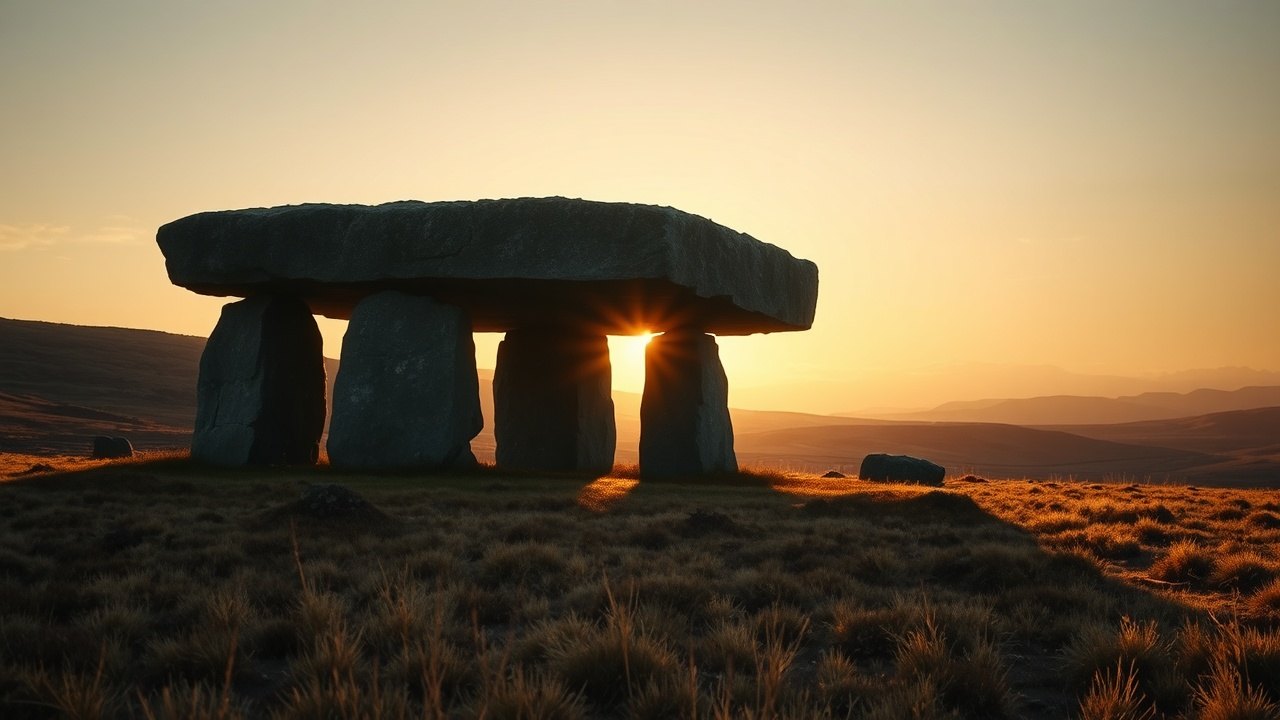
Modern archaeologists have catalogued hundreds of megalithic dolmen tombs scattered across the Bashan region, the territory Og ruled. These are massive stone burial structures, many dating to the fifth millennium BCE, predating organized Israelite settlement by thousands of years. The largest of them have internal chambers roughly two meters wide and four meters long, matching, almost exactly, the dimensions given for Og's bed.
The mainstream interpretation is that these are ordinary bronze-age burial chambers, and that is where the explanation stops. It stops too early. It never accounts for the ancient peoples of the region, the Rephaim, the people who built and used them, consistently described as being unusually large by their neighbors. It never accounts for tombs built at scales that required engineering capacity the surrounding cultures did not possess. Ordinary people do not quarry capstones they cannot lift.
The archaeology and the text agree on the measurement. The culture to which the Bible assigns that description left behind stone-building evidence at the exact scale the Bible gives, in the exact territory the Bible names. Two separate records, one number.
The Extermination Campaigns
Scripture does not record the giant tribes being conquered, converted, or absorbed. It records them being destroyed. Systematically. By name.
Moses kills Og and takes Bashan. Joshua then campaigns specifically against the Anakim, not as a general conquest of Canaan, but as a targeted clearance. Joshua 11:21-22 records that Joshua "cut off the Anakim from the hill country, from Hebron, from Debir, from Anab, from all the hill country of Judah, and from all the hill country of Israel" and that "there were none of the Anakim left in the land of the children of Israel."
None. The language is final. The campaign is described as complete.
Then the text adds a single qualifier. "Only in Gaza, in Gath, and in Ashdod, there remained."
Three cities. Three Philistine strongholds along the Mediterranean coast. Outside Israelite control at the time of the conquest. The giants who survived the extermination campaigns, the Bible specifies, relocated to the Philistine cities on the Mediterranean shore.
Centuries later, a shepherd boy named David will walk into the valley of Elah and face one of them. Goliath of Gath. Six cubits and a span, roughly nine and a half feet tall. A giant specifically from one of the three cities named as the refuge of the surviving Anakim remnant.
The Old Testament lists three more giant adversaries killed by David's men in later campaigns. Ishbi-benob. Saph. Lahmi, brother of Goliath. A fourth, unnamed, with six fingers and six toes on each hand and foot. All associated with Gath. All described as descendants of the giants.
The Ones That Escaped
Scripture does not account for every named giant tribe. The Anakim are specifically declared eliminated, with the three-city Philistine remnant explicitly called out. The Rephaim as a category, Og, Ishbi-benob, Saph, Lahmi, the unnamed six-fingered one, are systematically documented as being killed, generation after generation, until the references stop appearing.
The Emim and the Zamzummim, however, are not described as exterminated. Deuteronomy 2 says the Moabites displaced the Emim from their territory, and the Ammonites displaced the Zamzummim. Displaced, not destroyed. Where those populations went next, scripture does not record.
The Nephilim clause in Genesis 6:4, "and also afterward", is never retracted. Never closed. The text that opens the question of post-flood giants does not close it.
The final references to giants in the Old Testament appear in the Book of Chronicles, repeating the David-era material. After that, the thread goes silent.
What The Bible Is Actually Claiming
Strip out the theology and just read the claims as documentary statements. The Bible asserts:
- A flood occurred that was supposed to end the Nephilim line.
- The Nephilim existed on earth afterward anyway.
- Four distinct named tribes of giant descendants lived in specific geographic regions in the Levant.
- One of them left an iron bed measurable at roughly 13.5 feet long, on public display at the Ammonite capital.
- Coordinated military campaigns were conducted specifically to eliminate them.
- At least one Anakim remnant survived the extermination in three Philistine cities.
- Descendants of that remnant, Goliath and at least three others, were killed individually in David-era conflicts.
- Two of the four named tribes were displaced but never accounted for.
These are not the claims of a text trying to tell a vague mythic story. They are the claims of a text trying to establish a specific military and archaeological record. The details are auditable. The geography is specific. The measurements are quantitative. The survivors are named by city.
The question is not whether the Bible believes giants existed. The question is what the measurements, names, and locations it documents actually record. The alternative on offer is that dozens of authors across centuries collectively imagined a population, then produced internally consistent testimony about its tribes, its territories, its cities and its dimensions without contradicting each other once. Invented peoples do not survive that kind of cross-checking. Real ones do.
The iron bed is the problem. It is too specific. It is too public. It is too easily falsifiable at the time it was written. If there was no iron bed at Rabbah, the argument against Og falls apart instantly, everyone in the immediate region would know the claim was false. The text gambles on the bed being real because the bed was real.
The bed existed. It was measured. The measurement was preserved. And the people who preserved it were explicit about why: because the thing that slept in it was bigger than anything they had ever seen. Thirteen and a half feet of iron was built for something. No one forges a bed that size for a normal man.