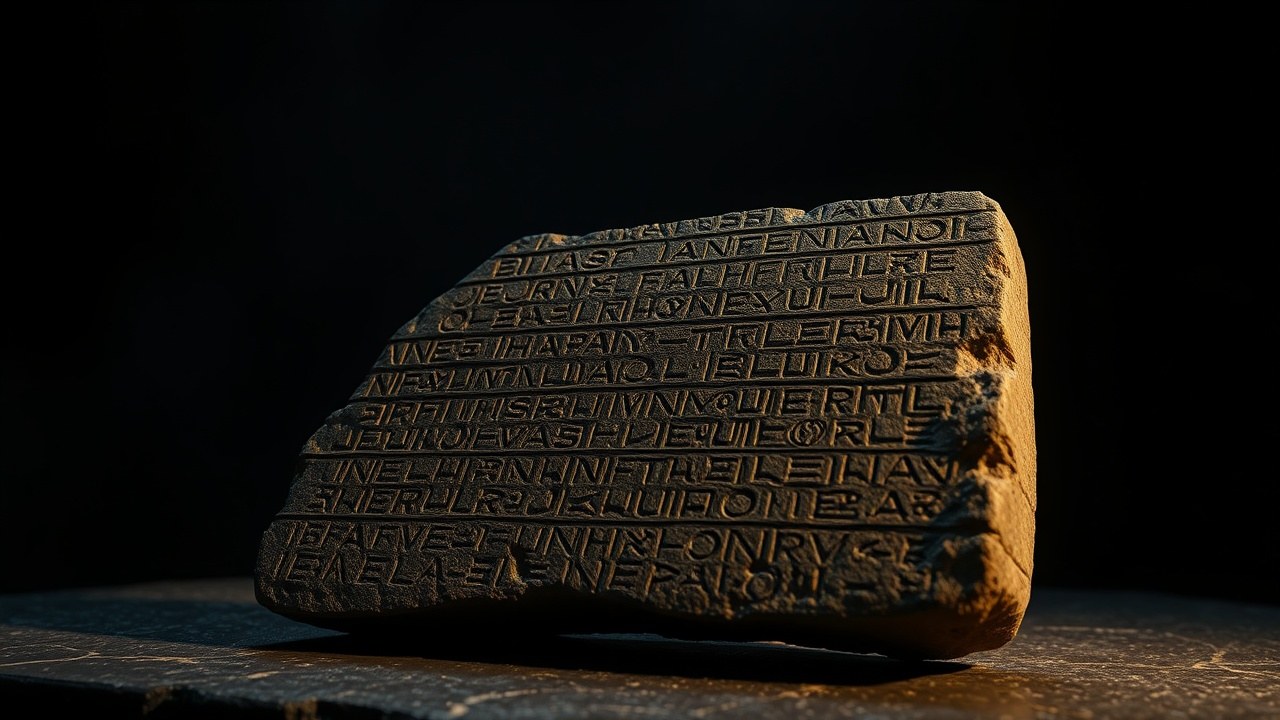
In 1853, a British archaeologist excavating the ruins of the ancient city of Nineveh, buried beneath a mound outside modern-day Mosul, Iraq, uncovered something that would quietly rewrite the history of religion.
Not a scroll. Not a relic. A library.
40,000 clay tablets, stacked and catalogued, belonging to the Assyrian king Ashurbanipal. They had been buried for over two thousand years. The excavation team spent years translating them. Most were administrative records, astronomical observations, medicinal texts.
Then they got to Tablet XI of the Epic of Gilgamesh.
Every scholar in the room went silent.
The Tablet That Stopped the Room
Tablet XI described a catastrophic flood sent by the gods to destroy humanity.
A single righteous man was warned in advance by a deity. He was given precise instructions: build a large vessel. He was told the dimensions. He was told to seal it with pitch. He was told to bring his family aboard. He was told to bring animals, pairs of every living creature.
The flood came. It raged for days. Everything outside the vessel died. When the waters began to recede, the man released three birds to test for dry land, first a dove, which returned. Then a swallow, which returned. Then a raven, which did not return, signaling that land had appeared.
The vessel came to rest on a mountain. The man disembarked. He performed a sacrifice on the mountaintop. The gods smelled the offering and were pleased.
The man's name was Utnapishtim.
The text was dated to approximately 2100 BCE.
"One civilization documented this first. The other adapted it. The question historians rarely ask publicly: which culture preserved the original account?"
The Timeline Problem
Genesis, the Biblical account of Noah and the flood, was not written in 2100 BCE.
The scholarly and archaeological consensus places the written composition of Genesis between approximately 700 and 400 BCE. The Documentary Hypothesis, the most widely accepted framework for understanding the origins of the Hebrew Bible, dates the flood narrative to sources written no earlier than the 10th century BCE, with final compilation during or after the Babylonian exile in the 6th century BCE.
The most generous dating of Genesis in written form places it approximately 1,000 years after the Epic of Gilgamesh.
The Atrahasis Epic, a separate Mesopotamian flood narrative that predates even the Gilgamesh version, was dated to approximately 1750 BCE. It too describes a chosen man, a divine warning, a vessel, a flood that destroys humanity, and a sacrifice after the waters recede.
The Sumerian Flood Story, yet another independent variant from the same tradition, was recorded around 1600 BCE.
Every major version of the flood story in the ancient Near East predates the Biblical account. By centuries. By more than a millennium in some cases.
The Parallels Are Not Approximate
Biblical scholars and comparative religion researchers have catalogued the parallels between the Epic of Gilgamesh and Genesis in exhaustive detail. They are not vague thematic similarities, the kind that might emerge independently from two cultures processing a universal human fear of catastrophic flooding.
The structural and narrative parallels are precise:
- A global flood sent as divine punishment
- A single righteous man chosen and warned in advance
- Divine instructions to construct a large vessel to exact specifications
- The man brings his family and pairs of animals
- Three birds released sequentially, dove, swallow, raven, to locate dry land
- The vessel lands on a specific mountain
- The man performs a sacrifice immediately after disembarking
- The divine being(s) smell the sacrifice and respond favorably
The sequence of three birds, in the same order, for the same purpose, is particularly striking. The dove, the swallow, and the raven appear in both texts, released in the same sequence, serving the same narrative function. This is not a coincidence of theme. The details are too specific, too ordered, too identical to have emerged independently.
These are not two civilizations arriving at similar conclusions. One of them read the other's story.
The Cultural Connection
The academic consensus on this point is not particularly controversial among historians and biblical scholars. Most accept that the Genesis flood narrative draws directly or indirectly from earlier Mesopotamian sources.
The connection was not accidental. Ancient Israel and Mesopotamia were not isolated from each other. Abraham, the patriarch of the Abrahamic faiths, is described in Genesis itself as originating from Ur of the Chaldeans, a Sumerian city in southern Iraq, the heartland of the very civilization that wrote the Gilgamesh epic.
The cultural exchange between ancient Israel and Mesopotamia spanned centuries. When the Israelites were taken into Babylonian captivity in the 6th century BCE, they lived inside the civilization that maintained, copied, and revered the Epic of Gilgamesh. Babylon was not a place where you would have been ignorant of Utnapishtim's story.
The flood narrative the Israelites brought back from exile, or that was formalized during exile, reflects a tradition that was already old when they arrived.
What the Sumerians Were
It is worth pausing to understand who wrote this story first.
The Sumerians built the first cities. They developed cuneiform, the first writing system. They constructed ziggurat temples that predated the pyramids. They established legal codes, developed astronomy, recorded mathematics, and maintained detailed historical chronicles.
They also documented a catastrophic flood. In meticulous detail. With a chosen survivor, a vessel, animals, birds, a mountain, and a sacrifice, and they wrote it down in 2100 BCE.
Flood narratives appear across ancient cultures worldwide: Sumerian, Babylonian, Egyptian, Hindu, Greek, Mesoamerican, Chinese. The structural similarities across cultures that never made contact with each other suggests that somewhere in human prehistory, a catastrophic flood event occurred that was significant enough to embed itself permanently in cultural memory across the globe.
The geological record supports this. The end of the last Ice Age, approximately 12,000 years ago, produced dramatic sea level rises worldwide. The Black Sea basin flooded catastrophically. The Persian Gulf filled. Coastal civilizations were drowned. A global civilization-ending flood, not a supernatural one, but a geological one, may have actually happened.
If it did, the Sumerians were closer to it in time than the Israelites were. Their account may be the older memory.

The Question That Doesn't Get Asked
Mainstream scholarship accepts that Genesis borrowed from Mesopotamian sources. This is not hidden, it appears in academic journals, university curricula, and comparative religion textbooks.
What mainstream scholarship tends not to press is the implication: if the Sumerians wrote it first, and the Biblical version came later, then the question is not whether the stories match. The question is which account preserved the original memory.
One civilization documented this event first. The other adapted it.
The Church has always known this. Biblical scholars have known it since 1853, when the tablet was first translated.
It was never hidden. It was just never taught.