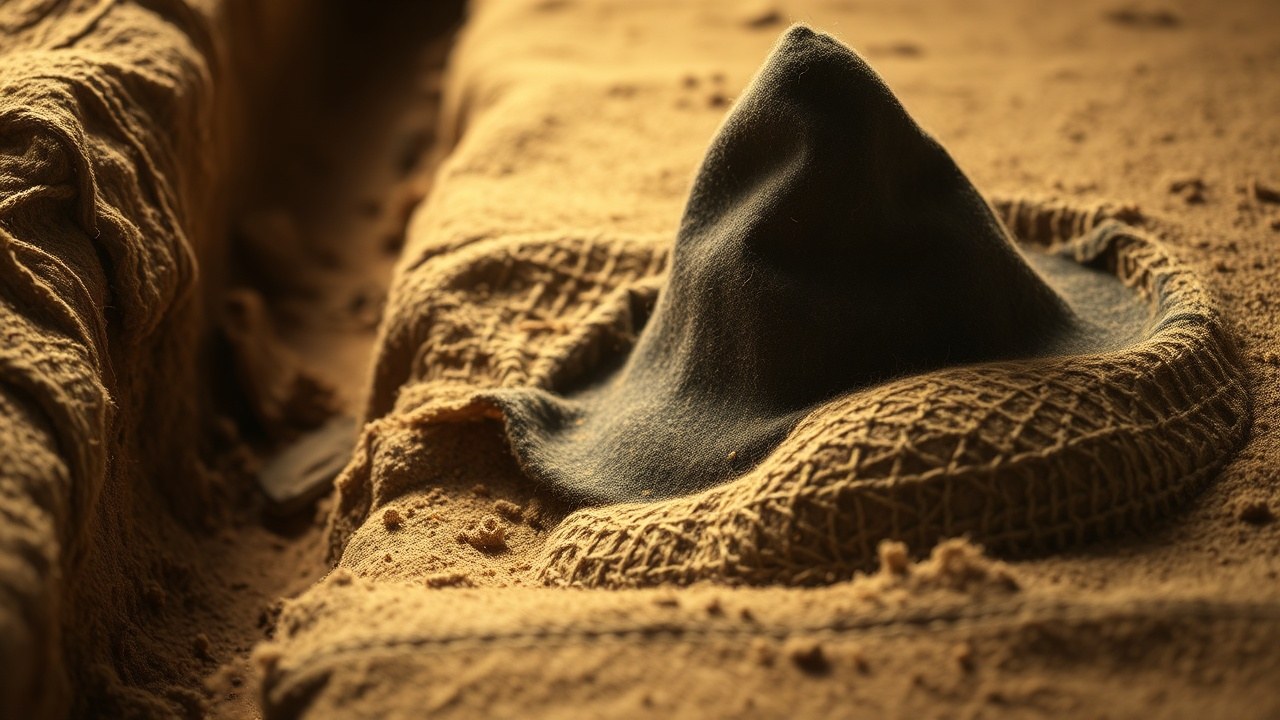
Everyone knows Egyptian mummies. They are the default cultural image, bandaged figures in limestone tombs, pharaohs preserved for eternity under the desert sun.
Egypt did not invent mummification.
Not even close.
The oldest deliberately mummified human remains ever discovered are not in Egypt. They are in the Atacama Desert of South America, and they predate Egyptian mummies by over 2,000 years. A civilization no one talks about was performing surgical preservation while Egypt was still a collection of tribal villages along the Nile.
And that is not even the strangest part of the story.
The Chinchorro: Mummifying the Dead 7,000 Years Ago
The Chinchorro people lived along the Pacific coast of what is now northern Chile and southern Peru. Between approximately 5000 and 3000 BCE, seven thousand years ago, they developed a sophisticated practice of preserving their dead.
Not just wrapping them. Surgically preserving them.
The Chinchorro mummification process was more technically complex than anything Egypt would develop for another two millennia. They removed internal organs through careful incisions. They reinforced skeletal structures with wooden poles and reeds. They packed the body cavity with plant fibers and ash. They covered the skin in a paste of clay and manganese, hardened into a shell. Some mummies show evidence of skin removal and replacement.
When Egypt was still tribal, a civilization in the Atacama was practicing anatomy with a precision that implies generations of accumulated knowledge, a school, a tradition, a culture sophisticated enough to understand what happened to a body after death and how to stop it.
The Chinchorro mummies predate the earliest known Egyptian mummies by over two thousand years. History does not teach this. It is not in school curricula. The cultural conversation about ancient mummification begins and ends with Egypt.
The Chinchorro did it first.
The Tarim Basin Problem
The Chinchorro anomaly is significant. The Tarim Basin mummies are something else entirely.
In the Tarim Basin of western China, modern-day Xinjiang province, one of the most remote and arid regions on Earth, archaeologists discovered mummies dating from approximately 2,000 to 4,000 years old.
The physical description of these mummies caused immediate confusion among researchers when they first came to international attention in the 1990s.
They were tall. Significantly taller than surrounding populations. Their facial structure was distinctly Caucasian, high cheekbones, deep-set eyes, prominent noses. Their hair was blonde and red.
They were buried in western China, in a basin surrounded by Central Asian steppe and desert, thousands of miles from any population where these physical characteristics should have existed.
They were not buried as foreigners or invaders. The evidence indicated they had lived in the Tarim Basin for generations. They had developed a material culture, plaid textiles, felt hats, wooden artifacts, that showed sophistication and continuity. They were not passing through. They were from there.
"They simply appeared in the middle of China. Built a civilization. And vanished."
The 2021 DNA Study
For decades, the Tarim Basin mummies generated competing theories. Were they migrants from the Pontic-Caspian Steppe, the grasslands north of the Black Sea that produced many ancient migrations? From Siberia? From somewhere in Central Asia or South Asia?
In 2021, a landmark genetic analysis of 13 Tarim Basin individuals from the Bronze Age was published in the journal Nature. It was the most comprehensive DNA study of these remains ever conducted.
The results were not what anyone expected.
The Tarim Basin people were not migrants from the Steppe. They were not related to any known neighboring population. Their genome showed no significant genetic contribution from the Yamnaya people, the Steppe herders whose DNA appears across Eurasia during the same period. They were not connected to populations in South Asia, East Asia, or the ancient Near East.
They were genetically isolated. A population with no traceable ancestor group on Earth. No migration path. No point of origin. The researchers concluded they were most likely a relict population, a group that had been genetically isolated from all other human populations for an extraordinarily long period of time.
A civilization appeared in one of the most remote regions of Central Asia. Built a culture sophisticated enough to produce complex woven textiles and preserved remains. Had physical features found nowhere nearby. And left no genetic trail connecting them to anyone else on the planet.
What China Did Next
When international researchers attempted to study the Tarim Basin mummies independently, they encountered sustained resistance.
Chinese authorities restricted access to the mummies for years. International research teams seeking permission to conduct independent analysis were denied. The genetic dataset from the 2021 study was not fully released to the public, only summary findings were published, while the raw genomic data remained under controlled access.
The mummies themselves have largely been moved into controlled museum settings in Xinjiang with restricted access for foreign researchers.
The official Chinese scientific position is that the Tarim Basin people were an indigenous East Asian population native to the region, a conclusion the 2021 DNA study does not fully support. The study confirmed they had no significant genetic relationship to Western or Indo-European populations, which contradicts earlier theories placing their origins in Europe or the Steppe. But it also confirms they had no significant genetic relationship to East Asian populations either.
They do not belong to any known branch of the human family tree as currently understood.

The Question No One Answers
Every human population on Earth has a genetic lineage. Every group connects, through the global database of ancient and modern DNA, to something, a migration, an ancestral population, a shared branch of the human story going back to Africa.
The Tarim Basin people's lineage is a dead end. The researchers describe them as a relict population of the Ancient North Eurasians, a ghost population that contributed DNA to many modern groups but itself left almost no direct descendants. A people who existed, and then were absorbed or eliminated, leaving almost no trace.
Except in the Tarim Basin, where they apparently survived in isolation long enough to mummify their dead, weave elaborate cloth, and build a civilization in a desert that no one was supposed to be able to live in.
The Chinchorro mummies are in South America, 7,000 years old, made by people who understood surgical anatomy two millennia before Egypt. The Tarim Basin mummies are in western China, made by people with no known genetic origin who looked nothing like anyone around them.
Neither story is in the history books.
Where did they come from?
The 2021 study does not say. The Chinese government will not let anyone look further.
The case is officially closed. Nothing has been explained.