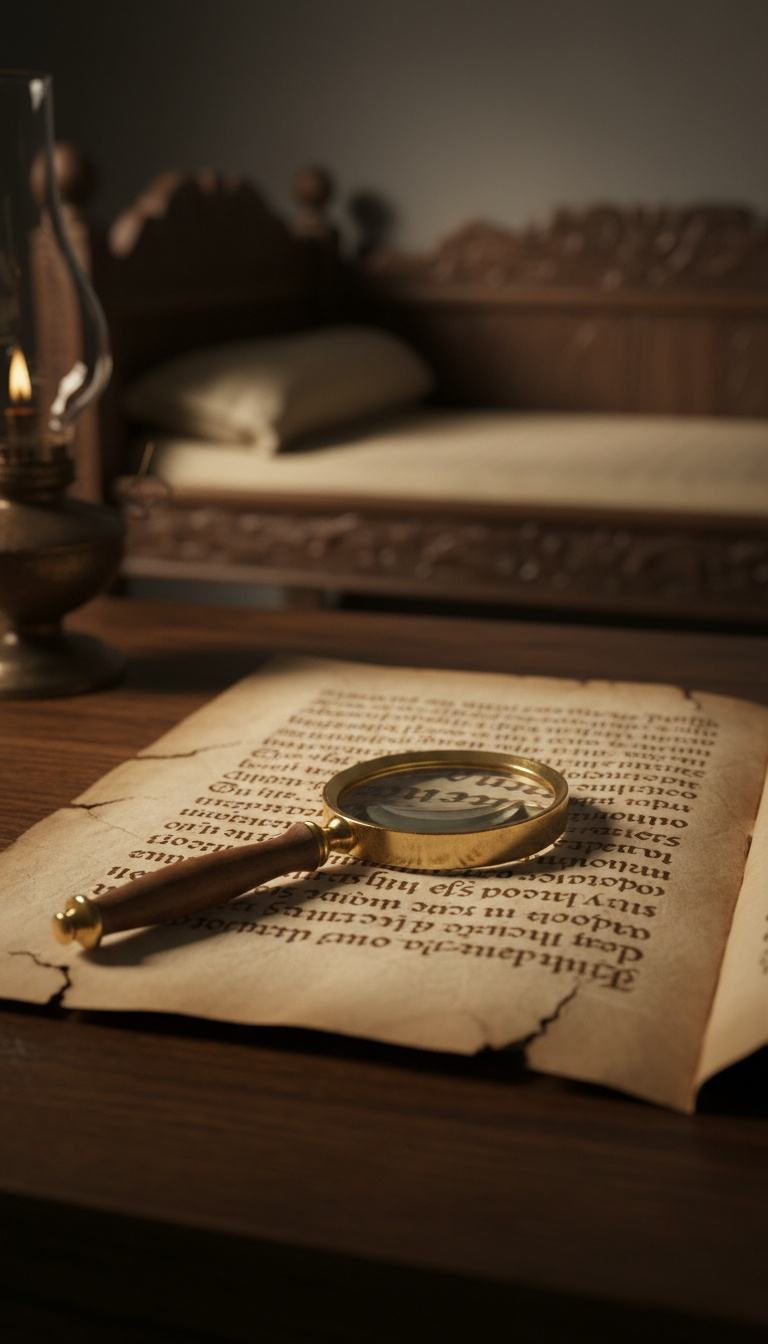
The Acts of John, a second-century book about the apostle John, records that John ordered the bedbugs in his bed at a deserted roadside inn to leave for the night, and at dawn his disciples opened the door and found a vast crowd of them waiting at the threshold until John called them back. The Church that kept the Gospel of John condemned this book as heretical at the Second Council of Nicaea in 787.
The bedbugs are only the start. The same book gave the Church its most famous image of John, the chalice with a serpent rising out of it. They kept the miracle they could paint on altars. The bedbugs went into the fire with the rest of the book, and so did what John said the bedbugs proved.
The Book That Tells It
The Acts of John was written in the second century, in the generation after the apostles died. Church writers tied it to a man named Leucius Charinus, who presents himself as one of John's traveling companions. It is one of the oldest stories about John outside the New Testament, and it reads like an eyewitness diary.
The book was still being read hundreds of years later. Around 447, Pope Leo I wrote against the apocryphal acts that circulated under the apostles' names. In the ninth century, Photius, Patriarch of Constantinople, read the Leucian Acts and summarized them in his Bibliotheca, codex 114. Three centuries of Church leaders knew this book by name. It kept moving through the hands of believers anyway.
The text survived in scattered Greek manuscripts, and the bedbug chapter came through intact. Scholars number it chapters 60 and 61. You can read more of what was cut from the canon in our lost books collection.
Midnight at the Empty Inn
John is traveling back to Ephesus with his disciples. On the first day of the journey they stop at a deserted inn. The innkeeper is gone. There is one bed in the place.
The disciples spread their cloaks on the bed for John and take the floor themselves. Around midnight, John cannot sleep. The bed is crawling with bedbugs, and they will not let him rest.
So John speaks to them, in front of everyone. His words, as the book records them: "I say to you, O bugs, behave yourselves, one and all, and leave your home for this night and remain quiet in one place, and keep your distance from the servants of God."
The disciples laugh. John says nothing more. He rolls over and sleeps through the rest of the night undisturbed.
The Crowd at the Threshold
At dawn, three men wake before John. The reel names them as Byrrhus and Andronicus, plus the narrator himself, the man writing it all down. They get up and go to the door of the room.
They open it. Standing at the threshold is a vast crowd of bedbugs, gathered in one place, exactly where John told them to wait. They had held that position all night.
The disciples wake John so he can see it. John sits up, looks at the bugs, and gives a second command: "Since you have behaved yourselves and obeyed my rebuke, go back to your place." The bugs move. They climb the frame of the bed, cross into the wood and disappear.
A man speaks, an insect swarm listens, and it obeys him twice. That is the miracle exactly as the book records it.
What John Said It Meant
John does not leave it there. He turns to his disciples and tells them what they have just seen, and this is the line that matters.
"This creature heard the voice of a man and kept to itself and was quiet and did not trespass. But we, who hear the voice and commandments of God, disobey and are light-minded. And for how long?"
Read that again. John is saying that obedience to a spoken word is built into creation, and that bedbugs are better at it than believers. He is saying the voice of a man who walks with God carries real authority over the natural world, available right now, at an inn, at midnight, over something as small as an insect.
That is a dangerous teaching for an institution. A believer who takes it seriously has no need for a mediator to make the world obey. The voice itself does the work.
Burned at Nicaea, Mined for Miracles
In 787, the bishops gathered at the Second Council of Nicaea read passages from the Acts of John aloud, condemned the book as heretical and ruled that it was fit for the fire. Nobody was to copy it again. Their official target was the book's portrait of Jesus, a Christ who changes shape and whose body is sometimes solid and sometimes immaterial.
Yet the Church never let go of the John these stories built. The most famous John miracle in Christian art is the poisoned cup. A pagan priest of Ephesus named Aristodemus hands John a cup of poison, John blesses it, the poison leaves the cup as a serpent, and John drinks it unharmed. That is why statues and paintings across Europe show John holding a chalice with a snake rising from it.
That poison story comes out of the same Leucian tradition the council burned. It passed into the Latin collections of apostle legends and onto altarpieces and cathedral walls. The council condemned the source and kept the image.
| Story from the Acts of John tradition | What it teaches | What the Church did with it |
|---|---|---|
| The poisoned cup at Ephesus | God protects John from harm | Kept. Became John's official symbol, the chalice and serpent, painted across Europe. |
| The bedbugs at the inn | A man's spoken word commands creation | Buried. Condemned with the whole book in 787. |
| The shape-shifting Christ | Jesus appears in many forms to different disciples | Burned. Named by the council as the reason for the ban. |
| John's own death in a grave he ordered dug | John chooses the hour he leaves | Absorbed. Became the tomb tradition at Ephesus. |
Look at the pattern in that table. Stories that make John a protected saint were kept. Stories that hand ordinary believers power were cut.
The Tomb at Ephesus
The Acts of John ends with John at Ephesus. He tells his disciples to dig a trench, lies down in it, prays and gives up his spirit. The Church kept that ending too. A shrine grew over the spot, and in the sixth century the emperor Justinian built the great Basilica of St. John over it, on Ayasuluk Hill in what is now Selçuk, Turkey. Its ruins still stand there today, with John's tomb marked at the center.
Pilgrims came to that tomb for centuries. Medieval travelers wrote that a fine dust rose from the grave every year on his feast day, and that it healed the sick. The same Church that burned the book built a basilica over its final chapter and sent pilgrims to collect dust from the floor.
Three receipts, one direction. The council of 787 condemned the text. The chalice and serpent made its poison story the face of John. The basilica at Selçuk stands over the grave its last chapter describes. They took what they could use. Find the rest of what they cut in the Vault.
Go back to the inn. A swarm of insects waited all night at a door because a man told them to. When it was over, John asked his disciples one question: why does a bedbug obey the voice of a man faster than believers obey the voice of God?
That question was in the book the bishops burned in 787. The cup stayed. The tomb stayed. The question went into the fire. So here it is again, after twelve hundred years: if bugs obeyed John, what were we supposed to be able to do, and who decided we should never find out?
Frequently Asked
Did the apostle John really command bedbugs?
The Acts of John, a second-century account written by one of John's traveling companions, records it in chapters 60 and 61. John ordered the bugs out of his bed at a deserted inn, and his disciples found them waiting at the door at dawn.
Why was the Acts of John banned?
The Second Council of Nicaea condemned it as heretical in 787 and ruled it fit for the fire. The bishops objected to its shape-shifting portrait of Jesus, and its teaching that a believer's spoken word commands creation went into the fire with it.
Who wrote the Acts of John?
Church writers tied the book to Leucius Charinus, who presents himself as John's companion and narrates the bedbug miracle as an eyewitness. Photius, Patriarch of Constantinople, still had the Leucian Acts on his desk in the ninth century.
Where does the story of John drinking poison come from?
From the same Acts of John tradition the Church condemned. The poisoned cup at Ephesus became John's official symbol, the chalice with a serpent, while the bedbug miracle was buried.
What did John say the bedbugs proved?
He said the bugs heard the voice of a man and obeyed it, while believers who hear the voice of God disobey. He asked his disciples how long that would go on.
Before you go
7 books the Vatican doesn't want you reading. Free PDF. The texts they cut, with sources. Joined by 300+ Inner Circle members.
No spam. Unsubscribe anytime.
Go deeper
The Hidden Canon, Vol. I: Enoch. Jubilees. Thomas. Mary. Judas. 90 pages, 14 chapters, every receipt cited. The books your Bible quietly removed.
Read the Canon →