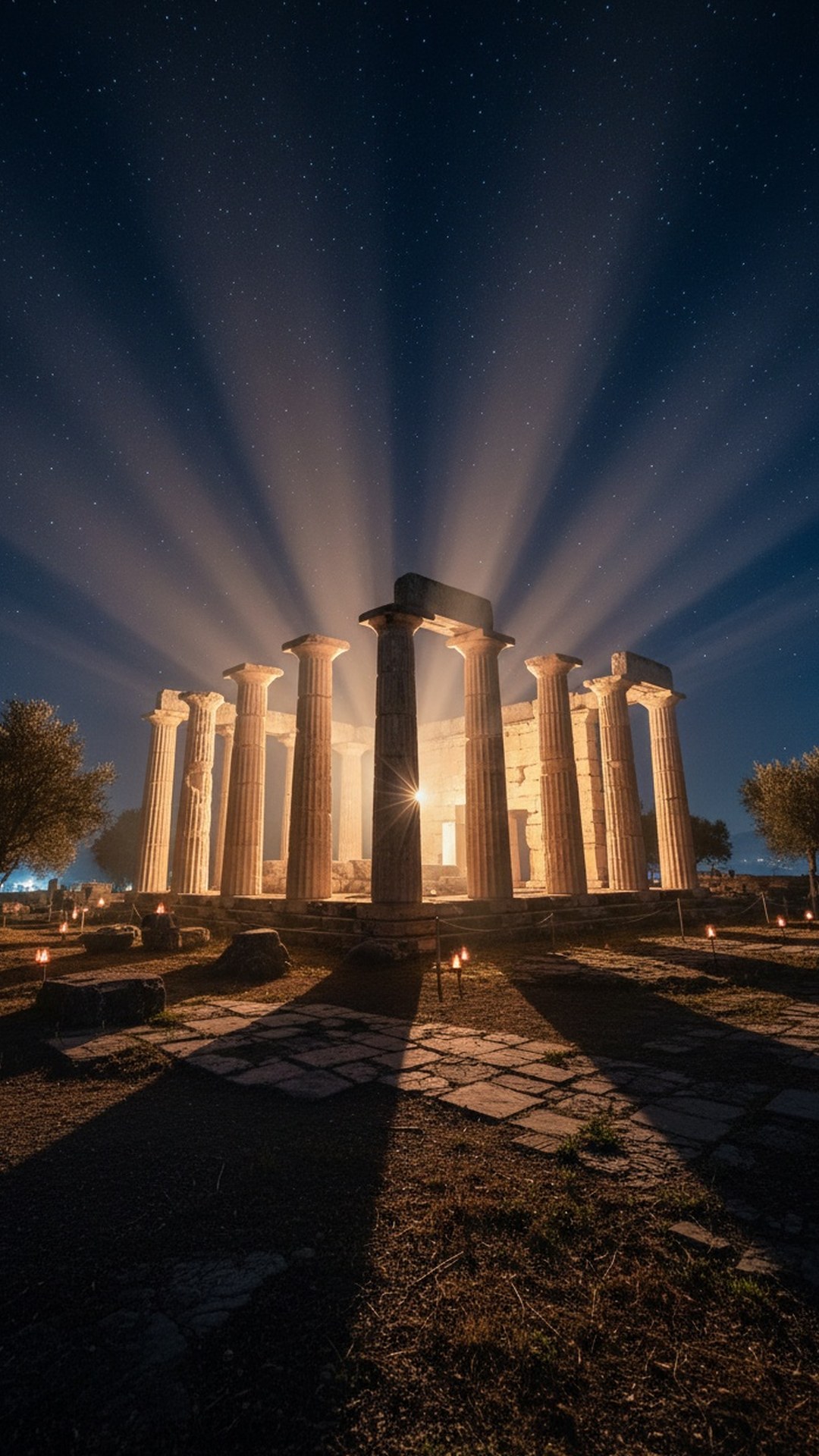
The blind see. The lame walk. The mute speak. The dead are raised. His followers called him Savior. And the receipts are not in a book that was copied for centuries. They are carved in stone, on temple tablets you can stand in front of today, dated around 350 BC.
His name was Asclepius, son of the god Apollo and a mortal woman, and his healing sanctuaries were still in full operation while Paul preached in Corinth. This is part 13 of THE BLUEPRINT. As always: primary sources on the table, fake parallels killed on sight.
Son of a god, pulled from the fire
The birth story is old and it is dated. Pindar's third Pythian Ode, composed in 474 BC, names Apollo as the father and a mortal woman, Coronis, as the mother. She died before delivering, and Apollo pulled the unborn child from her body as the funeral pyre burned: the original miraculous birth by extraction, four and a half centuries before Bethlehem. The objection arrives on cue: Coronis was no virgin, she was Apollo's lover, killed for taking a second man. The objection misses what it is looking at. The structure is a god for a father, a mortal woman for a mother, and a child delivered by a divine hand out of a dead woman's body while the pyre burns. That architecture is standing here in 474 BC, and no virginity clause is load-bearing in it. The clause is a later refinement bolted onto a frame that was already built.
The cures are carved in stone
Here is what separates Asclepius from almost every figure in this series. At his great sanctuary at Epidaurus, the temple kept official records of its healings, carved on stone stelae around 350 BC. Archaeologists dug them up. They sit in the Epidaurus museum, catalogued as Inscriptiones Graecae IV squared 1, numbers 121 to 124, roughly seventy case records with names and home cities.
Read one. Stele A, case four: Ambrosia of Athens, blind in one eye, came to the god as a suppliant. Walking the sanctuary, she laughed at the cures, saying it was impossible that the lame and the blind could be made whole by a dream. She slept in the shrine. The god came to her, cut the diseased eye, and poured in a drug. When day came she walked out seeing. A mocker converted by a healing miracle, recorded by name, in stone, three and a half centuries before the Gospels describe the blind receiving sight. The mute spoke there too: case five is a voiceless boy who left speaking. These are the same categories of miracle, in a temple's own official archive.
He raised the dead, and heaven killed him for it
Pindar again, 474 BC: Asclepius went too far. He raised a man from the dead, and Zeus destroyed him with a thunderbolt for it. Later sources, collected in Apollodorus, name the dead he restored: Hippolytus son of Theseus, Glaucus son of Minos, Tyndareus, and more. The underworld complained it was losing its dead. The order of life and death was breaking. So heaven executed the healer.
Then heaven promoted him. The sources record that after the thunderbolt, Asclepius was made immortal and set among the stars: the serpent-bearer constellation, Ophiuchus. A divine-born healer who raises the dead, is killed by the will of heaven, and is then elevated to godhood. That sequence was already ancient when the Gospels were written.
A god called Savior, healing the blind and raising the dead, with his miracles carved in temple stone 350 years before the Gospels.
They called him Savior
The title is not a detail. Greek votive inscriptions from the fourth century BC onward call Asclepius Soter: Savior. It was the standard Greek word for a god who steps in and saves a human life, from disease, from disaster, from death. When the New Testament calls Jesus Soter, it is using a word that had been a healing god's cult title for centuries. The vocabulary of salvation was already on the temple walls.
A church father admits it, in writing, to the emperor
You do not have to take a skeptic's word for the parallel. Around 150 AD, the Christian apologist Justin Martyr wrote his First Apology, addressed to the Roman emperor himself. Chapter 22: 'When we say that he healed the lame, the paralytic, and those born blind, and raised the dead, we seem to be talking about things like those said to have been done by Asclepius.' That is a devout defender of Christianity conceding, on the record, that the miracle list of Jesus matched the miracle list of Asclepius. One chapter earlier he names Asclepius among the sons of god who were 'struck by a thunderbolt and ascended to heaven.' His argument to the emperor was simple: you already believe this story, so do not mock ours. The parallel is not an internet meme. It is a second-century church document.
The rival across the street
This cult was not a museum piece in Paul's day. It was the competition. Paul spent eighteen months preaching in Corinth, and Corinth had its own Asclepius sanctuary inside the city: excavators found it, along with the clay votive offerings the healed left behind, shaped as the body parts the god had cured. Legs. Arms. Eyes. The great mother sanctuary at Epidaurus was about forty miles down the road. The church historian Adolf von Harnack judged Asclepius, not Mithras, the most serious rival Christianity faced, because the offer was the same: a divine physician for body and soul. The church fathers agreed with their behavior, attacking Asclepius by name for generations. And in the fourth century, the emperor Julian tried to revive paganism by holding up one god as the answer to Christ: Asclepius. Both sides could see the match.
The differences that change nothing
Now the counter-argument, so we can break it. The defenders lead with a list: Asclepius was not virgin-born, and he was not resurrected. He was killed and then deified, apotheosis, elevation to godhood, not a body walking out of a tomb three days after death. There is no tomb, no third day, no passion, and his death atones for nothing. He was executed for breaking cosmic law, not sacrificed for anyone's sins. He had no disciples, no mission, no church. And his healing ran on pilgrimage, ritual, and payment at a sanctuary, where the Gospel healings run on a word and cost nothing. Every item on that list is a change of furniture inside a room that was already standing. Nobody needs the stories to be identical. A template is not a photocopy. Add a tomb, add a third day, move the atonement onto the death, move the healing from the sanctuary floor to the roadside, and you have edited a structure you did not build. The structure is the divine father and mortal mother, the blind seeing and the mute speaking and the dead rising, the execution by heaven's own hand, the elevation into the sky afterward, and the title Savior cut into the temple wall. All of it documented in 350 BC stone, with the sanctuary doors still open when Paul walked past them.
Strip it down to the load-bearing beams and this remains: when the Gospels told a Greek-speaking world about a Savior who healed the blind, the lame, and the mute and raised the dead, that world already had a god with exactly that resume, his cures carved in temple stone since 350 BC, his sanctuaries still open for business. The first Christians were not preaching into a vacuum. They were preaching against an incumbent.
So the question writes itself. When a sick Corinthian heard Paul describe a healing Savior, was he hearing something new, or a rebuilt version of the god across the street? Template or takeover. Coincidence does not carve itself into stone three centuries early. Follow THE BLUEPRINT as the investigation continues.
This is Part 13 of 23 in THE BLUEPRINT, an investigation into the pre-Christian figures who carried the pieces of the Jesus story. See every part of the series here.
Before you go
7 books the Vatican doesn't want you reading. Free PDF, the texts they cut, with sources. Joined by 140+ Inner Circle members.
No spam. Unsubscribe anytime.
Go deeper
The Hidden Canon, Vol. I, Enoch. Jubilees. Thomas. Mary. Judas. 90 pages, 14 chapters, every receipt cited. The books your Bible quietly removed.
Read the Canon →Books that informed this investigation
As an Amazon Associate, Hidden Epoch earns from qualifying purchases. Cost to you: nothing.
Research safely
The VPN we use to research without being tracked. First 3 months free.
Get NordVPN →