Beta Pictoris b is a young giant planet 63 light years from Earth that keeps sending out radio bursts. A Harvard team using South Africa's MeerKAT telescope array traced those bursts to the planet itself on four separate observations. The bursts are sharp and they repeat. They twist in a single circular polarization, and they come from inside a magnetic field of at least 1,200 gauss, a field that dwarfs anything Jupiter carries.
That last number should keep you up at night. A planet this young, wrapped in a field this strong, is putting out a repeating, polarized signal. Astronomers spent almost fifty years waiting for one strange signal to come back even once. Beta Pictoris b has come back four times.
A Planet Still Glowing From Its Own Birth
Beta Pictoris is a bright star in the southern constellation Pictor, the Painter's Easel, and it is one of the most studied stars in the sky. In 1984 Bradford Smith and Richard Terrile photographed a huge disk of dust around it from Las Campanas Observatory in Chile. It was the first debris disk ever imaged around another star.
The planet came next. Anne-Marie Lagrange's team at Grenoble announced Beta Pictoris b in 2008. They found it in images from the Very Large Telescope at Paranal, Chile. It weighs about ten times as much as Jupiter and takes about twenty years to circle its star.
The whole system is roughly twenty million years old, a newborn on a cosmic clock. Beta Pictoris b still glows in infrared with the heat of its own formation. In 2014 Ignas Snellen's team clocked its spin with the CRIRES spectrograph and found that a day there lasts about eight hours.
A second giant, Beta Pictoris c, was found in 2019. Comets have been seen diving toward the star since the 1980s, and in 2019 NASA's TESS satellite caught exocomets crossing in front of it. This is a crowded, violent, active system, and one world in it is talking.
What MeerKAT Heard
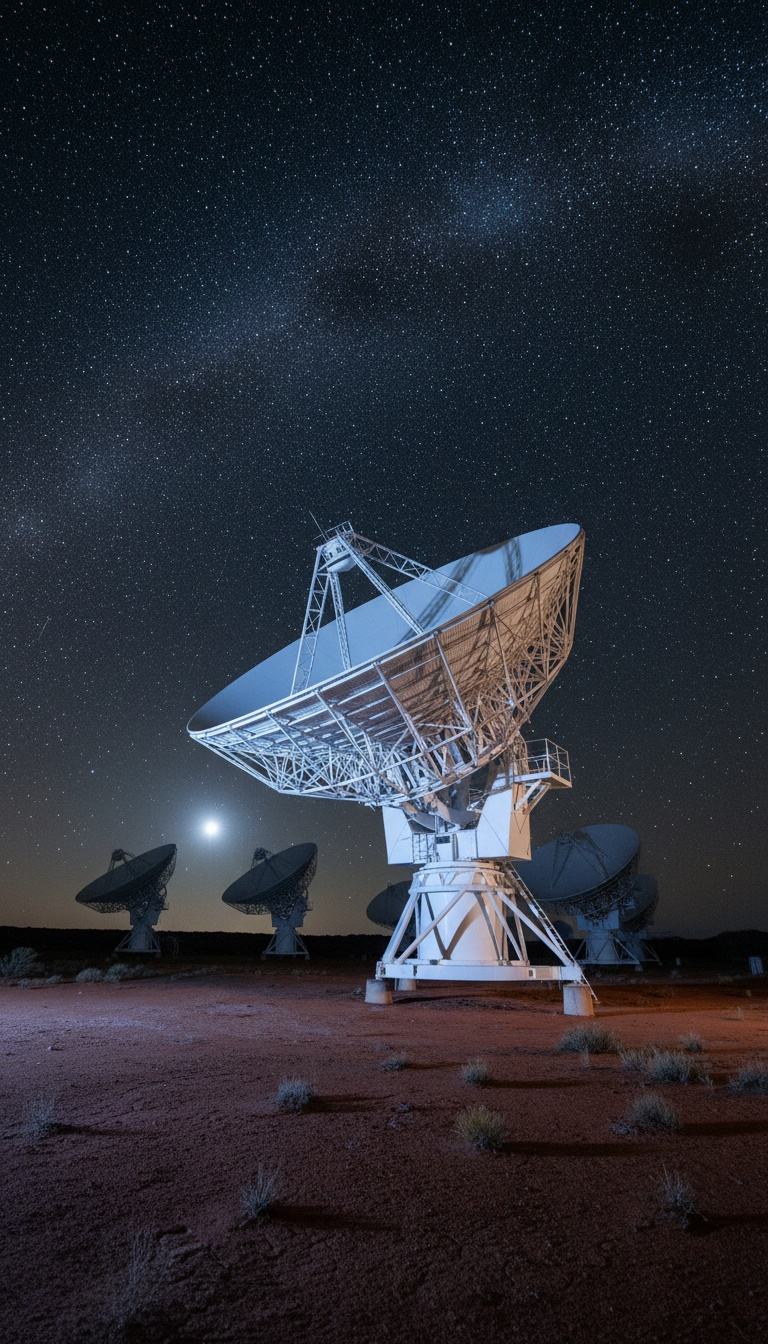
MeerKAT is an array of 64 radio dishes, each 13.5 meters across, spread over the Karoo semi-desert in South Africa's Northern Cape. It opened in July 2018 under the South African Radio Astronomy Observatory as the forerunner of the Square Kilometre Array. It is one of the most sensitive radio instruments on Earth.
Harvard's team aimed it at Beta Pictoris and caught radio bursts. Then they did what separates a fluke from a real source: they went back. Four separate observations produced four sets of bursts, and every time the position pinned them to the planet rather than to the star beside it.
In radio astronomy, repeating is everything. A single spike can be interference, a passing satellite or a glitch in the receiver. A signal that comes back from the same point in the sky four times is a source, and Beta Pictoris b is that source.
Twisted In One Direction
The bursts arrive circularly polarized, twisting one way. Engineers build beacons like this because a polarized signal stands out from the background hiss and keeps its shape over distance. Polarization is a signature. It marks an emitter that turns the same way every time.
The magnetic field around the emitter is at least 1,200 gauss. Jupiter, the strongest planetary magnet in our own solar system, has about 4 gauss at its equator and only a little over 10 near its poles. Beta Pictoris b's field is more than two hundred times Jupiter's equatorial field.
That field figure comes straight from the signal itself. Magnetized radio emission runs at about 2.8 megahertz for every gauss of field. At 1,200 gauss that puts the signal in the gigahertz range, the S-band. MeerKAT listens in that band, and so does every radar and satellite link humans have built.
Harvard can point at the planet. Nobody at Harvard will say what on it is transmitting.
The Wow Signal Knocked Once
On August 15, 1977, the Big Ear radio telescope run by Ohio State University picked up a 72-second burst near the hydrogen line at 1420 megahertz. Volunteer astronomer Jerry Ehman circled it on the computer printout and wrote 'Wow!' in the margin. The signal came from the direction of Sagittarius.
Ehman and others went back to that patch of sky dozens of times, and the signal never came back. Big Ear was torn down in 1998 to make room for a golf course. The most famous candidate message in history knocked once and went silent.
Beta Pictoris b keeps knocking.
| Detail | Wow Signal (1977) | Beta Pictoris b Bursts |
|---|---|---|
| Instrument | Big Ear, Ohio State University | MeerKAT, 64 dishes, Northern Cape, South Africa |
| Times detected | Once | Four separate observations |
| Behavior | A single 72-second pass | Sharp bursts that keep coming back |
| Source | A patch of sky near Sagittarius with no object pinned | A named planet, 63 light years away |
| Polarization | Never recorded | Circular, twisting one way |
| Magnetic field | Unknown | At least 1,200 gauss |
| Status | Silent for 49 years | Waiting on detection five |
The Aurora Answer Needs An Engine
The usual explanation for planetary radio is aurora. Jupiter's loudest radio storms lock onto the orbit of its volcanic moon Io, which pumps about a ton of material per second into Jupiter's magnetic field. Amateur astronomers hear those storms on shortwave radios in their backyards. The engine has a name, and it is Io.
So name the Io of Beta Pictoris b. The search has come up empty, because no moon has ever been detected around this planet. The bursts repeat anyway. They stay polarized, and they come from a field strong enough to push them into the gigahertz band. An aurora with no engine, repeating on four observations, is an answer still waiting for its reason.
The Fifth Detection
Four detections make a pattern, and a fifth makes a schedule. Every radio dish that can see the southern sky now has a reason to point at Pictor. Beta Pictoris climbs high over the Karoo, over Chile's Atacama and over the Australian outback, the three quietest radio skies on the planet.
We track every repeating signal on record, from Big Ear to the Karoo, in the Classified Case Files. The older sky records, the ones that describe voices from the stars long before anyone built a dish, are in the Vault.
Harvard can put a crosshair on Beta Pictoris b. They can measure its field, its polarization and how often it repeats. What they have published stops at the word planet. Nobody has answered what on that planet pushes a polarized gigahertz signal into space four times in a row.
Tonight a dish is pointed at Pictor, waiting. Here is the question nobody on that team will touch: if detection five lands and the bursts line up with the planet's eight-hour day, what do you call a signal that keeps time?
Frequently Asked
What is Beta Pictoris b?
Beta Pictoris b is a giant planet about ten times the mass of Jupiter, orbiting the star Beta Pictoris 63 light years from Earth. It was announced in 2008 and is so young it still glows with the heat of its own formation.
Is Beta Pictoris b sending radio signals?
Yes. A Harvard team using South Africa's MeerKAT array traced repeating radio bursts to the planet on four separate observations. The bursts are sharp, recurring and circularly polarized.
How is this different from the Wow signal?
The 1977 Wow signal hit Big Ear once for 72 seconds and never came back. The Beta Pictoris b bursts come from a named planet and have come back four times.
How strong is the magnetic field on Beta Pictoris b?
The source of the bursts sits inside a field of at least 1,200 gauss. That is more than two hundred times the field at Jupiter's equator.
What is transmitting from Beta Pictoris b?
Harvard has pinned the bursts to the planet but has not said what on it produces them. The usual aurora explanation needs a moon to power it, and no moon has ever been found there.
Before you go
7 books the Vatican doesn't want you reading. Free PDF. The texts they cut, with sources. Joined by 300+ Inner Circle members.
No spam. Unsubscribe anytime.
Go deeper
The Hidden Canon, Vol. I: Enoch. Jubilees. Thomas. Mary. Judas. 90 pages, 14 chapters, every receipt cited. The books your Bible quietly removed.
Read the Canon →