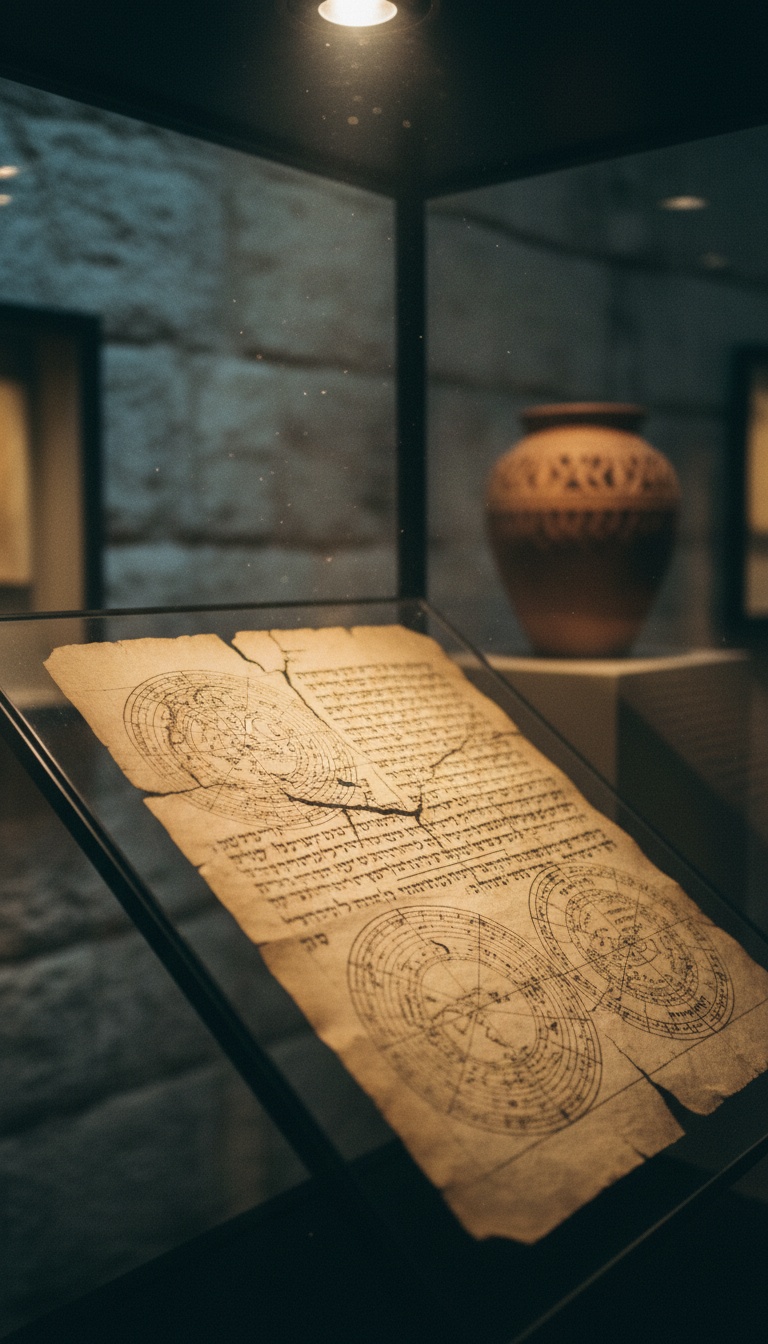
The church did not ban the Book of Enoch because of angels or giants. It banned Enoch because of a calendar.
A 364-day solar grid. Four seasons. Thirteen weeks each. Every Sabbath locked to the same weekday, forever. No priest required to announce it. That is the real heresy, and the Dead Sea Scrolls prove a whole community died defending it.

The 364-Day Grid Uriel Handed Enoch
The Astronomical Book of Enoch, chapters 72 through 82, lays out a year of exactly 364 days delivered by the angel Uriel. Four seasons of 91 days. Two 30-day months followed by a 31st day that closes the quarter and is named rather than numbered.
The math is not vague. 1 Enoch 74:10 gives the count of 2,912 days for 8 years, which divides cleanly to 364. No intercalation. No lunar patch. No fudge.
364 divides by 7 exactly 52 times. That is the whole point. Every date in the year falls on the same day of the week every year. Passover always Tuesday. Shavuot always Sunday. The calendar cannot drift off the Sabbath cycle because it is built from the Sabbath cycle.
Qumran Lived And Died By It
The community that hid the Dead Sea Scrolls above the western shore of the Dead Sea used this calendar for more than two centuries, from roughly the second century BCE until the Roman destruction of the site in 68 CE.
4Q320, 4Q321, and 4Q394, now housed in the Shrine of the Book at the Israel Museum in Jerusalem, are calendar texts that synchronize the 364-day year against the 24 priestly courses of 1 Chronicles 24. These are called the Mishmarot. They are working liturgical schedules, not theory.
4QMMT, the Halakhic Letter recovered from Cave 4 at Qumran, explicitly accuses the Jerusalem priesthood of following the wrong festival calendar. The sectarians called the Temple calendar corrupt and separated from it. They walked out of Jerusalem over this.
Why A Fixed Calendar Terrifies A Priesthood
The lunar calendar used by the Second Temple establishment required human observation. Priests on the Temple Mount watched for the new crescent moon, then declared the month begun. Fires were lit on hilltops from Jerusalem outward to signal the ruling.
The Mishnah, tractate Rosh Hashanah 2:1-2, describes this system in detail. Witnesses were interrogated. The Sanhedrin ratified the sighting. Only then did the month, and every feast in it, become official.
Control the sighting, control the feast. Control the feast, control when every Jew in the empire ate, fasted, worked, and worshipped. Enoch's calendar erased that leverage. A shepherd in Galilee with a scroll and a memory could calculate the Day of Atonement without asking anyone.
The lunar calendar required priests to announce feast days. Enoch's calendar required nothing but a shepherd who could count to seven.
The Fourth Century Shutout
The Book of Enoch was quoted as scripture by Jude 1:14-15 in the New Testament. Tertullian defended it around 200 CE in On the Apparel of Women 1:3. Irenaeus and Clement of Alexandria cited it without objection.
Then it vanished from the Western canon. Augustine argued against it in City of God 15:23, written between 413 and 426 CE. By the councils of the fourth and fifth centuries, Enoch was excluded from every Latin and Greek canon list. Only the Ethiopian Orthodox Tewahedo Church preserved the full text, in Ge'ez, which is why the oldest complete copies survive at the Ethiopian monastery libraries and later reached Europe via James Bruce in 1773.
The Council of Nicaea in 325 CE also fixed the date of Easter to a lunar calculation tied to the vernal equinox, ratified by Emperor Constantine. The fixed solar week of Enoch was incompatible with the new imperial system. One had to go.
The Scrolls Were Sealed For 1,900 Years
The Qumran library was hidden in clay jars in eleven caves along the Dead Sea cliffs sometime around 68 CE, as Roman legions under Vespasian advanced. They stayed sealed until a Bedouin shepherd named Muhammed edh-Dhib found the first jars in Cave 1 in the winter of 1946-47.
The calendar scrolls were not published quickly. 4Q320 through 4Q330, the Mishmarot texts, sat in the Rockefeller Museum in East Jerusalem for decades before Shemaryahu Talmon and others produced full editions in the 1990s, released in Discoveries in the Judaean Desert volume XXI in 2001.
The delay was not accidental. Access to the scrolls was restricted to a small editorial team until 1991, when Hershel Shanks and the Biblical Archaeology Society forced open publication by releasing a bootleg concordance. The calendar texts were among the last to reach the public.
Follow The Authority
Ask who benefits when God's appointments require a human announcer, and the answer names itself. A priesthood that controls the calendar controls when tithes are due, when pilgrims travel, when the shofar sounds.
A congregation that can calculate its own feasts from a fixed 364-day grid does not need that priesthood. It becomes ungovernable in the exact way Qumran was ungovernable.
The Rule of the Community from Cave 1, 1QS column 10, opens with the sectarians pledging to keep the appointed times "without transgressing His words in anything." They viewed calendar deviation as apostasy. The Jerusalem establishment viewed calendar deviation as insurrection.
Enoch was not buried because of watchers and Nephilim. Those chapters were quoted openly by early bishops. Enoch was buried because chapters 72 through 82 handed every literate believer a way to keep the feasts without asking permission.
The scrolls sat in caves for nineteen centuries. The Ethiopian church kept the book alive in a language almost no European could read. The calendar texts were the last to be published even after the scrolls surfaced. Every gate that could be closed on this document was closed.
Now ask yourself which feast you are keeping this year, and who told you when to keep it. Drop the date of your last Sabbath in the comments and I will tell you which calendar you are actually living by.
Before you go
7 books the Vatican doesn't want you reading. Free PDF, the texts they cut, with sources. Joined by 140+ Inner Circle members.
No spam. Unsubscribe anytime.
Go deeper
The Hidden Canon, Vol. I, Enoch. Jubilees. Thomas. Mary. Judas. 90 pages, 14 chapters, every receipt cited. The books your Bible quietly removed.
Read the Canon →Books that informed this investigation
As an Amazon Associate, Hidden Epoch earns from qualifying purchases. Cost to you: nothing.
Research safely
The VPN we use to research without being tracked. First 3 months free.
Get NordVPN →