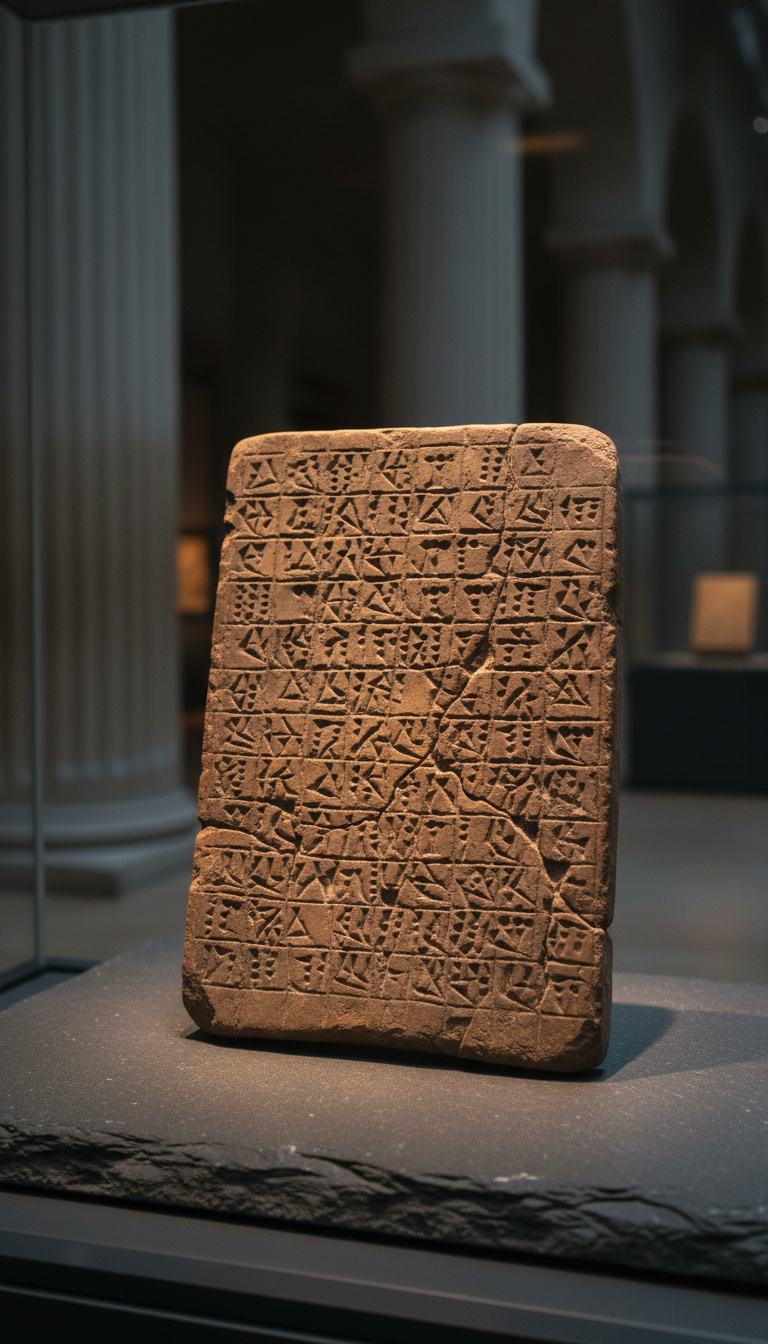
Enlil, the Sumerian lord of the air, is the figure the Bible calls Satan. The Babylonian epic of Atrahasis, copied in clay around 1640 BC and held today in the British Museum in London, records Enlil ordering a great Flood to wipe humanity off the earth. More than a thousand years after that tablet was signed, the New Testament named Satan the prince of the power of the air. That was the office Enlil had held in Mesopotamia since before Abraham was born.
The tablet is real. A scribe signed his name on it and a Babylonian king's reign dated it. The order to drown us is written in its lines. Lay it beside Genesis and the same story turns up a thousand years later with the boat, the warned man and the god who wanted us gone. The only thing missing is his name.
The Tablet in London
The oldest surviving copy of Atrahasis was cut in clay at Sippar, on the Euphrates, under King Ammi-saduqa of Babylon. He was the great-great-grandson of Hammurabi. The scribe closed his work with a colophon carrying his name, Ipiq-Aya, the date, and a running count of lines. The full epic ran to roughly 1,245 lines across three tablets. Those tablets came west in the excavation hauls of the late nineteenth century, and they sit in the British Museum collection today under museum numbers.
Wilfred Lambert and Alan Millard published the joined text in 1969 under the title Atra-hasis: The Babylonian Story of the Flood. A century earlier, on 3 December 1872, George Smith had stood before the Society of Biblical Archaeology in London and read out the Flood tablet from Nineveh, Gilgamesh Tablet XI. That night the room learned that Babylon had told the Flood first. Three receipts: a signed colophon, a dated reign, a museum number. This story did not come out of an ancient Hebrew camp. It was written in a Babylonian scriptorium, and London has kept the master copy for over a century.
A God Who Could Not Sleep
Atrahasis opens before humans exist, with the lesser gods digging the rivers and canals by hand. They revolt and burn their tools. Enki, the god of wisdom and the deep waters, solves the strike by making mankind out of clay mixed with the blood of a slain god, so that humans can carry the labor instead.
Then the humans multiply. The land grows loud, and the noise keeps one god awake. That god is Enlil. He does not reason with the problem. He tries to kill it in stages. First he sends plague. When it fails, he orders the storm god Adad to hold back the rain, and drought and famine follow. When the people survive that too, he takes the decision to the divine assembly and passes the final sentence. The Flood will erase them all. The gods are made to swear an oath to keep the plan secret.
The pattern matters more than any one disaster. Plague, famine, then water. It is a campaign of extermination run in escalating waves by one god against the creatures another god made.
The Oath Enki Broke
Enki is bound by the oath, so he does not speak to the man directly. He speaks to the reed wall of the man's house, and the man listens through it. The message is to tear down the house, build a boat, refuse the possessions and save life. Atrahasis, whose name means Exceedingly Wise, loads his family and the animals, seals the hatch with pitch, and the storm runs seven days and seven nights.
One god built mankind. Another god sat in council and voted to drown it. Genesis kept the vote and erased the voter.
When the waters drop, Enlil sees the boat and is furious that anyone lived. This is the hinge of the whole tablet. The god of the air is enraged to find a single human alive. In every Mesopotamian version, Enlil gives the order and Enki saves the line.
Genesis Kept the Job and Dropped the Name
Genesis 6 through 9 runs the same sequence. A divine decision to blot out mankind, one righteous man warned, a vessel sealed with pitch, animals loaded by kind, birds sent out to test the land, a sacrifice whose smell draws the divine presence. The structure carries over intact. The cast list was cut down.
| Element | Atrahasis (Sippar, c. 1640 BC) | Genesis 6 to 9 | New Testament |
|---|---|---|---|
| Who wants mankind gone | Enlil, lord of the air | The god of the text, unnamed as a separate actor | Satan, prince of the power of the air (Ephesians 2:2) |
| Who warns the survivor | Enki, through a reed wall | The same single god | Christ, the rescuer from the destroyer |
| Weapon of choice | Plague, drought, famine, flood | Flood | Wind and fire (Job 1), a flood from the serpent's mouth (Revelation 12:15) |
| Reaction to survivors | Fury that anyone lived | Covenant, no fury | Pursuit of the survivors to make war on them (Revelation 12:17) |
Genesis folded two gods into one, and the destroyer had to go somewhere. Follow the weapons and you find where he went.
Prince of the Power of the Air
The name tells you the job. In Sumerian, en means lord and lil means wind, air or breath. Enlil is Lord Wind. His temple was the Ekur, the Mountain House, at Nippur. Nippur was never an imperial capital, yet kings went to it for the right to rule. Ur-Nammu and Shulgi of Ur built for him there. The kings of Isin claimed his favor in their titles. Hammurabi opens his law code with Enlil handing out the power to rule over the land. Three dynasties went to the same god for their crowns.
Now read Ephesians 2:2. Paul calls the power working in the disobedient the prince of the power of the air. In 2 Corinthians 4:4 he goes further and calls that figure the god of this world. Paul was a trained Pharisee in a Roman province. He was describing an office every Mesopotamian scribe would have recognized on sight: a ruler of the air who stands over the kings of the earth.
The Accuser Uses Enlil's Weapons
The strongest objection says the satan of the Hebrew Bible is a courtroom prosecutor on heaven's staff and has nothing to do with a Babylonian storm god. Open the Book of Job and watch what that prosecutor does once he gets permission. Fire falls from the sky and burns the flocks (Job 1:16). Raiders sweep in from the desert (Job 1:17). Then a great wind comes across the wilderness, strikes the four corners of the house, and kills every one of Job's children (Job 1:19).
That is Enlil's arsenal: the sky, the raiders and the wind. The accuser fights with weather because weather was always his department. Revelation finishes the case. The ancient serpent, called the devil and Satan, spews water from his mouth like a flood to sweep away the woman (Revelation 12:9 and 12:15). The Flood god is still sending floods at the end of the Bible. You can trace the full lineage through the suppressed texts in our Lost Books collection and the Mesopotamian file in the Vault.
The Flood was never Enlil's final move. Read the end of the third Atrahasis tablet. Once the waters go down, the gods settle a new order. Some women will be unable to bear children. A demon called Pashittu will snatch infants from their mothers' laps. Whole classes of priestesses will be barred from motherhood. When the god of the air failed to drown us all at once, he wrote population control into the law of the world.
So ask the question Genesis never wanted you to ask. If the lord of the air lost the vote on the Flood but kept his seat in the council, what has he been ordering since? Tell us in the comments which modern plague, famine or drought you think carries his signature.
Frequently Asked
What is the Atrahasis tablet?
Atrahasis is a Babylonian epic copied in clay at Sippar under King Ammi-saduqa, around 1640 BC, by a scribe who signed himself Ipiq-Aya. It records the god Enlil ordering plague, famine and finally a Flood to wipe out mankind, and its tablets are held in the British Museum in London.
Why is Enlil connected to Satan?
Enlil's name means Lord Wind, and he ruled the air over the kings of Mesopotamia. Paul calls Satan the prince of the power of the air in Ephesians 2:2, and the satan of Job kills with fire from the sky and a great wind. It is the same office, carrying the same weapons.
Is the Babylonian Flood story older than Genesis?
Yes. The Ipiq-Aya copy of Atrahasis was signed around a thousand years before the Genesis Flood chapters reached their written form. The boat, the warned man, the pitch seal and the sacrifice all appear in Babylon first.
Who saved mankind in the Babylonian version?
Enki, the god of wisdom and the deep waters who made humans from clay, broke his oath of secrecy and warned Atrahasis through the reed wall of his house. Enlil was furious when he found anyone had survived.
Before you go
7 books the Vatican doesn't want you reading. Free PDF. The texts they cut, with sources. Joined by 300+ Inner Circle members.
No spam. Unsubscribe anytime.
Go deeper
The Hidden Canon, Vol. I: Enoch. Jubilees. Thomas. Mary. Judas. 90 pages, 14 chapters, every receipt cited. The books your Bible quietly removed.
Read the Canon →