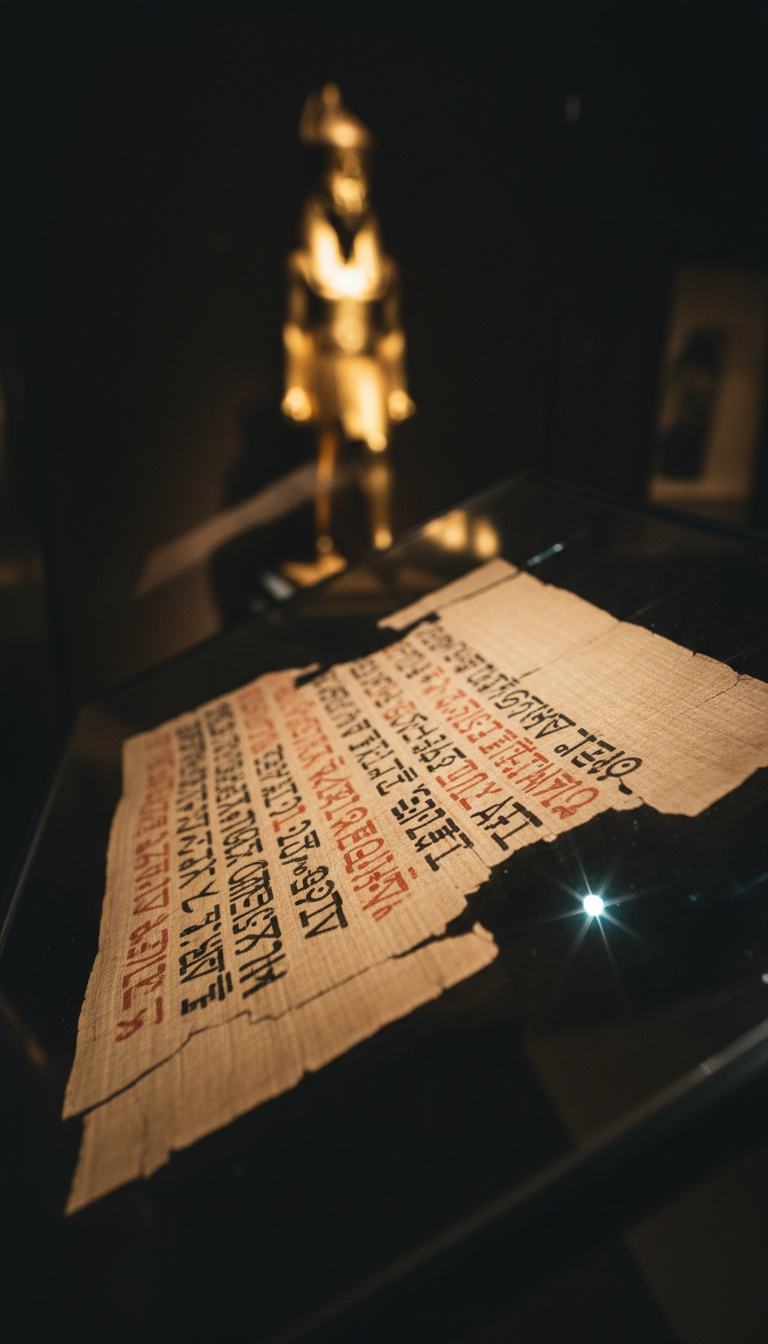
Egypt's own king list records the gods ruling first and then handing the throne to men. The Turin King List is a papyrus from the reign of Ramesses II, now in the Museo Egizio in Turin, Italy. It opens with gods on the throne, Geb, Osiris, Set, Horus and Thoth among them. Next come the spirits and demigods, and only after them a human king named Menes. The priest Manetho counted more than thirteen thousand years of divine rule before that handover. In December 2020, Haim Eshed, the retired brigadier general who ran Israel's space security program for nearly thirty years, said a Galactic Federation exists and keeps its distance because humanity is not ready. Egypt wrote down the withdrawal. Eshed described the rule behind it.
Put the two records side by side and you get one story. Beings ruled in the open, taught, built and kept the accounts. Then they stepped down from the throne, and a scribe logged the change as a new line in a ledger. A god does not give up a throne by choice. Someone above the gods gave the order.
The Papyrus That Opens On Gods
The Turin King List came out of the ground at Thebes, modern Luxor, and passed through the collection of the French consul Bernardino Drovetti before it reached the royal collection of Sardinia in Turin in the 1820s. It travelled in a box, unprotected, and arrived crumbled into fragments. Jean-François Champollion, the man who cracked hieroglyphs, bent over those pieces in Turin in 1824. The German scholar Gustavus Seyffarth spent years fitting them back together. Today the reassembled sheet sits under glass in the Museo Egizio.
The scribe wrote it in hieratic on the back of a used tax register. That detail matters. The list sits on a sheet that came out of an accounting office. Its first column was written as a record of who held the throne and for how long.
Gods, Then Spirits, Then A Man
The first entries on the papyrus are gods. Ptah and Ra lead the line, then Shu, then Geb, Osiris, Set and Horus, with Thoth and Maat following. Each name sits inside the same royal cartouche later used for pharaohs. Each one gets a reign length.
After the gods comes a block the scribe calls the akhu, the spirits, along with the Shemsu Hor, the Followers of Horus. These are the demigods, a middle rank between the makers and the men. They hold the throne for a span the papyrus measures in thousands of years.
Only then does Menes appear. He is the first human king, the founder of the First Dynasty, the man every chronology since has used as Year One of Egypt. On the papyrus he is a successor. He inherits a throne that was already ancient when he sat on it.
Three Witnesses, One Ledger
The Turin scribe was not alone. Manetho, a priest of Sebennytos in the Nile Delta, wrote the Aegyptiaca for Ptolemy II in the third century BC with temple archives open in front of him. His king lists survive through the chronicler Eusebius and the Byzantine monk George Syncellus. Manetho puts the gods first, counts their rule at roughly 13,900 years, and follows them with demigods and spirits of the dead before Menes.
Two centuries earlier, Herodotus sat with Egyptian priests and wrote down what they told him in Book II of his Histories. Before mortal kings, gods ruled Egypt and lived among men, and the last of them to hold the throne was Horus, son of Osiris. Four centuries after Herodotus, Diodorus Siculus recorded in Book I of his Library of History that gods and heroes ruled Egypt for a little under eighteen thousand years, with Horus again named as the last god-king.
That gives three separate hands across three separate centuries with one order of events. Gods sat on the throne, demigods followed, then men took over. The stories agree because they were all drawn from the same temple records.
| Source | Date | Who rules first | Length of divine rule | Last divine ruler |
|---|---|---|---|---|
| Turin King List (Museo Egizio, Turin) | Reign of Ramesses II, c. 1250 BC | Ptah, Ra, Shu, Geb, Osiris, Set, Horus, Thoth | Thousands of years, logged god by god | Followers of Horus, then Menes |
| Manetho, Aegyptiaca | 3rd century BC | The gods, then demigods | About 13,900 years | Demigods and spirits, then Menes |
| Herodotus, Histories Book II | c. 440 BC | Gods living among men | Spans beyond human count | Horus, son of Osiris |
| Diodorus Siculus, Book I | c. 60 BC | Gods and heroes | Just under 18,000 years | Horus, son of Isis |
The Bookkeeping Problem
The museum labels file this opening column as religious preamble, mythology placed in front of the real kings. That reading falls apart on the papyrus itself. The scribe wrote reign lengths for the gods in the same format he used for Menes and every pharaoh after him: a name, a cartouche, a count of years. Accountants do not mix myth into a column of numbers. The column was there to record how long each one held the office.
The gods got the same cartouche and the same count of years as the pharaohs. Egypt filed its makers under administration.
And the ledger records a handover. The gods give way to spirits, the spirits give way to a man, and there is no battle in between. Nobody records a war or the fall of an empire. The papyrus shows a transfer of office, and an office only changes hands that cleanly when someone with authority orders it.
Egypt held on to the memory of that moment for three thousand years. The temple builders at Edfu called the age of the gods Zep Tepi, the First Time, and carved its story into the temple walls. Every later pharaoh claimed to be Horus on earth, which makes every pharaoh a caretaker for a ruler who had left.
Eshed's Federation And The Rule Of Distance
Haim Eshed headed the Israeli Defense Ministry's space directorate from 1981 to 2010 and won the Israel Security Prize three times. In December 2020 he gave an interview to the newspaper Yedioth Ahronoth to promote his book The Universe Beyond the Horizon. He said a Galactic Federation exists and that humans and aliens have been in contact. He said the beings asked for their existence to stay quiet because humanity is not ready. He said they are waiting for us to develop to the point where we can understand.
That is a policy of distance, and it is the same rule written into the Egyptian ledger. Beings with the power to rule chose to hold back, and the choice came from a council. Eshed named the council. Egypt recorded the result three thousand years before he spoke.
Eshed's critics went after the man and left the claim alone. He spent three decades inside the most secretive space program in the Middle East. Nobody hands a clearance like that to a man who invents things. The newspaper ran his words, and he did not take them back.
The Order Above The Throne
The question the Turin papyrus raises is who outranks a god. Ptah, Ra, Osiris and Horus are written as kings, and a king answers to nobody inside his own kingdom. When Horus hands the throne to the spirits, the order has to come from outside Egypt, from a body Egypt had no word for. The scribes wrote that it happened and left the reason out.
We keep the full source trail on this in the Classified Case Files, along with the Egyptian records the textbooks skip. The older texts Egypt's neighbors buried tell the same story from the other side, and you can find them in the Lost Books.
Turin preserves the handover. Manetho, Herodotus and Diodorus give it a date. Haim Eshed, a man who kept Israel's space secrets for three decades, tells us the council that ordered it is still out there and still waiting for us to be ready.
So go back to the papyrus. The gods ruled Egypt for thousands of years and then stepped aside as if they were following a timetable. If the order came once, it can come again. The first time, it sent the makers away. What does the next order say, and who on Earth already knows the date?
Frequently Asked
What does the Turin King List say about gods ruling Egypt?
The Turin King List, a papyrus from the reign of Ramesses II held at the Museo Egizio in Turin, opens with gods on the throne, including Ptah, Ra, Geb, Osiris, Set, Horus and Thoth, each with a reign length. Spirits and the Followers of Horus come after them, and only then the first human king, Menes.
How long did Manetho say the gods ruled Egypt?
Manetho, a priest of Sebennytos writing for Ptolemy II, counted about 13,900 years of rule by the gods, followed by demigods and spirits before Menes. Diodorus Siculus later gave a figure of just under 18,000 years for gods and heroes together.
Who was the last god to rule Egypt?
Herodotus and Diodorus Siculus both name Horus, son of Osiris and Isis, as the last god to sit on Egypt's throne. Every pharaoh after him ruled as Horus on earth, a stand-in for a king who had left.
What did Haim Eshed say about the Galactic Federation?
In December 2020, Haim Eshed, head of Israel's space security program from 1981 to 2010, told Yedioth Ahronoth that a Galactic Federation exists and has been in contact with humanity. He said the beings asked to stay hidden because humanity is not ready yet.
Why would the gods leave Egypt's throne?
The king lists show a peaceful transfer of office from gods to spirits to men, with no war recorded. A handover that clean points to an order from above the throne, the same rule of distance Eshed says the Federation still follows.
Before you go
7 books the Vatican doesn't want you reading. Free PDF. The texts they cut, with sources. Joined by 300+ Inner Circle members.
No spam. Unsubscribe anytime.
Go deeper
The Hidden Canon, Vol. I: Enoch. Jubilees. Thomas. Mary. Judas. 90 pages, 14 chapters, every receipt cited. The books your Bible quietly removed.
Read the Canon →