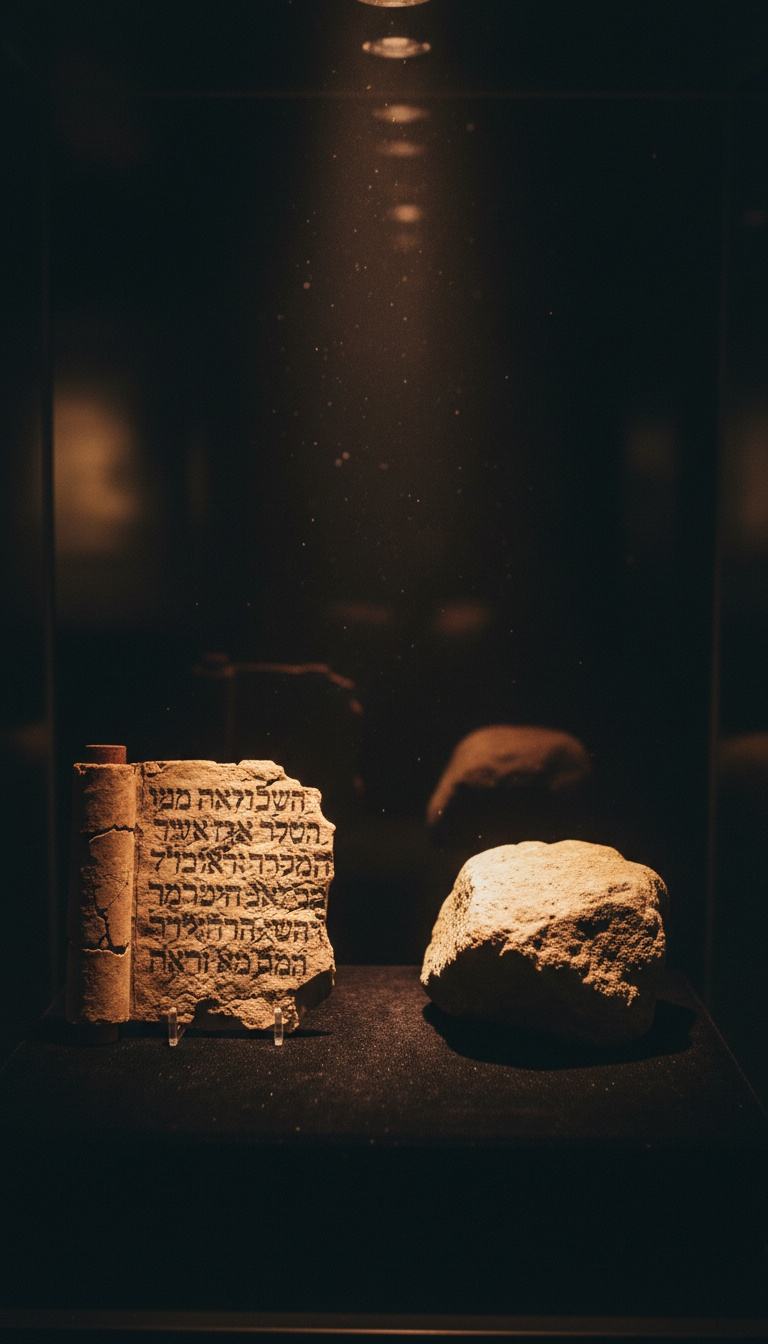
Cain died when his own house collapsed on him, in the same year Adam died, according to the Book of Jubilees, chapter 4, verse 31. Jubilees is a Hebrew scripture written in the second century BC. The Ethiopian Orthodox Tewahedo Church still keeps it in its Bible, and more than a dozen copies of it turned up among the Dead Sea Scrolls at Qumran. It says Cain was killed by the stones of his own house because he had killed Abel with a stone. Genesis records no death for Cain at all.
That one verse closes the story of the world's first murderer. It also names the weapon Genesis leaves out, puts Cain's death in the year of Adam's burial, and cites a law the book says was written on the heavenly tablets. The Bible on your shelf leaves all three out.
Where Genesis Lets Cain Walk Away
Read Genesis 4:8 slowly. "Cain rose up against Abel his brother, and slew him." That is the entire murder. The verse names no weapon and gives no method. The first killing in human history gets eleven words.
Then Cain gets a mark of protection in verse 15. In verse 16 he walks east of Eden into the land of Nod. In verse 17 he builds a city and names it Enoch after his son. Genesis follows his bloodline down to Lamech and then drops him for good. Adam gets a death notice in Genesis 5:5, nine hundred and thirty years and a funeral line. Cain, the man who brought death into the world, gets no death of his own.
A book that opens with a murder and never closes the murderer's file has had its ending cut. Jubilees still has it.
The Book the Ethiopian Church Kept
The Ethiopian Orthodox Tewahedo Church calls it Mets'hafe Kufale, the Book of Division. It sits in their canon beside Genesis and Exodus, and the only complete copies that survive anywhere are in Ge'ez, the church's ancient liturgical language. The German orientalist August Dillmann published the Ge'ez text in 1859. R. H. Charles published the standard English translation at Oxford in 1902.
The early Christian West knew the book too. Jerome cited it by the name "Little Genesis" in his letter to Fabiola at the end of the fourth century. Epiphanius of Salamis quoted it in the same era. It was read and quoted, and for a time it was trusted. Then it disappeared from every Bible in Europe. Read the full story of how books vanish from scripture in our Lost Books collection.
The Caves of Qumran Held More Than a Dozen Copies
In 1947 Bedouin shepherds found the first Dead Sea Scrolls in the cliffs above Qumran. Over the next decade, excavators pulled Hebrew fragments of Jubilees from Caves 1, 2, 3, 4 and 11. They count more than a dozen separate manuscripts, which puts Jubilees in the same range as some books of the Hebrew Bible itself.
The oldest of them, catalogued as 4Q216, is dated by its handwriting to roughly 125 to 100 BC. The fragments are held today by the Israel Antiquities Authority in Jerusalem. The community at Qumran treated the book as an authority. Their own rulebook, the Damascus Document, cites it by name as "the Book of the Divisions of the Times into their Jubilees and their Weeks" to settle a point of law.
For with a stone he had killed Abel, and by a stone was he killed in righteous judgment.
The Verse: Killed by Its Stones
Jubilees 4:29 records Adam's death at nine hundred and thirty years and calls him the first man buried in the earth. Two verses later the book turns to Cain. In the Charles translation, chapter 4, verse 31 reads: "At the close of this jubilee Cain was killed after him in the same year; for his house fell upon him and he died in the midst of his house, and he was killed by its stones; for with a stone he had killed Abel, and by a stone was he killed in righteous judgment."
Verse 32 shows why the death matters. "For this reason it was ordained on the heavenly tablets: With the instrument with which a man kills his neighbour with the same shall he be killed." Cain's death is the founding case for a law. The first murderer is killed by the weapon he used, inside the house he built, in the year the father he shamed went into the ground.
So the first murder in Jubilees comes with a weapon, a death date and a ruling. Genesis gives none of the three.
The Lamech Arrow Story Breaks Against the Older Text
The strongest rival ending comes from rabbinic tradition. Midrash Tanhuma, and later Rashi in eleventh-century France, tell a story in which Cain's blind descendant Lamech goes hunting, mistakes Cain for an animal and shoots him with an arrow. Rabbis who knew the arrow story would have had no reason to keep the house story alive.
Look at what the arrow legend was written to do. It was built to explain one strange line, Genesis 4:23, where Lamech says he has killed a man. It is commentary on a verse, and it shows up in writing more than a thousand years after Qumran scribes were already copying Jubilees. The house collapse is the older ending, kept by a community that buried its scriptures in sealed jars. The arrow came centuries later to fill a gap that Jubilees never had.
| Question | Genesis 4 | Jubilees 4:31-32 | Rabbinic Lamech legend |
|---|---|---|---|
| Weapon used on Abel | Unnamed | A stone | Unnamed |
| How Cain dies | Never recorded | His house falls on him, killed by its stones | Shot by blind Lamech with an arrow |
| When Cain dies | Never recorded | The same year Adam dies | Seven generations later |
| Oldest written copy | Qumran scrolls | Qumran scroll 4Q216, around 125 to 100 BC | Medieval midrash and Rashi |
| Law attached | None | Heavenly tablets: killed by the instrument you killed with | None |
Who Cut the Ending
A Latin list of approved and rejected books circulated under the name of Pope Gelasius I in the sixth century. Among the rejected titles it names the "Book of the Daughters of Adam," the Leptogenesis, which is Little Genesis, the same book Jerome had quoted. Once that list spread, the West had its verdict on Jubilees. The book survived in the Ethiopian highlands and in the caves at Qumran. Everywhere else it was lost.
The Hebrew canon left it out. The Catholic canon left it out, and the Protestant canon followed. Three separate gatekeepers made the same cut, and that same cut took Cain's ending, Abel's murder weapon and the heavenly-tablets law along with it. Track the full chain of who kept what in The Canon, and open the scroll evidence in The Vault.
Count what went missing with this one book. The weapon of the first murder went with it, and so did the date of the first murderer's death. So did a law the text says came from the heavenly tablets. A community that copied this book more than a dozen times in the second and first centuries BC treated all of it as scripture. Those same pages were later cut from the Bible that reached you.
Jubilees has fifty chapters. Cain's death takes up one verse of them. If the gatekeepers cut a law written on the heavenly tablets, think about what else went out of the canon with it.
Frequently Asked
How did Cain die according to the Bible?
Genesis never records Cain's death. The Book of Jubilees, chapter 4, verse 31, says his house fell on him and he was killed by its stones in the same year Adam died.
What weapon did Cain use to kill Abel?
Genesis 4:8 does not name one. The Book of Jubilees says Cain killed Abel with a stone, and that is why Cain was later killed by stones.
Is the Book of Jubilees in the Bible?
It is in the Bible of the Ethiopian Orthodox Tewahedo Church, where it is called Mets'hafe Kufale. The Jewish, Catholic and Protestant canons all left it out, even though more than a dozen copies were found among the Dead Sea Scrolls.
How old is the Book of Jubilees?
It was written in the second century BC. The oldest surviving manuscript, the Qumran scroll 4Q216, dates to roughly 125 to 100 BC.
What are the heavenly tablets in Jubilees?
Jubilees says God's laws were written on heavenly tablets. Right after Cain's death it cites one: whoever kills his neighbour with an instrument is to be killed with that same instrument.
Before you go
7 books the Vatican doesn't want you reading. Free PDF. The texts they cut, with sources. Joined by 300+ Inner Circle members.
No spam. Unsubscribe anytime.
Go deeper
The Hidden Canon, Vol. I: Enoch. Jubilees. Thomas. Mary. Judas. 90 pages, 14 chapters, every receipt cited. The books your Bible quietly removed.
Read the Canon →