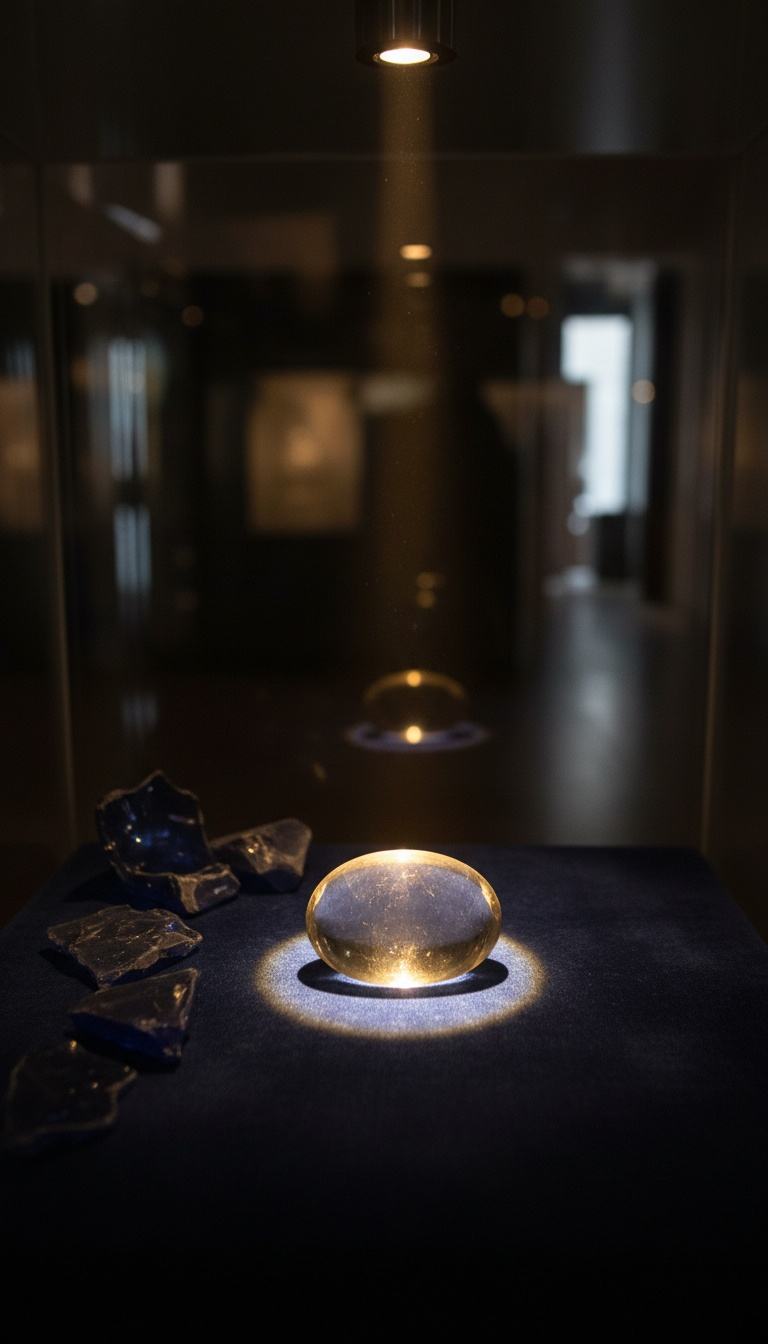
The Assyrians ground a working optical lens from rock crystal around 750 BC, about 2,300 years before the Dutch spectacle maker Hans Lippershey asked for a telescope patent in 1608. The object is the Nimrud lens. Austen Henry Layard dug it out of the North West Palace at Nimrud, in modern Iraq, in 1850. It sits today in the British Museum in London. It is a polished oval of rock crystal about 38 millimetres across, and it brings light to a focus about 12 centimetres behind its face. That makes it a magnifier, made by hand, in an empire whose astronomers recorded the sky for centuries.
That would be enough to rewrite one chapter of the history of science. The real problem is where the lens is kept and what the label says. The British Museum catalogues the most important optical object of the ancient world as a piece of decorative inlay. A focal length is a measurement of what a lens does to light, and decoration has no use for one. Somebody cut that curve on purpose. This article is about who held it up to the sky, and why the people who own it now prefer to call it furniture trim.
Room AB, North West Palace, 1850
Austen Henry Layard was a young British adventurer who became the man who dug up Assyria. Between 1845 and 1851 he cut trenches into the mound of Nimrud, the ancient Kalhu, which served as the royal capital of Ashurnasirpal II and his successors. The North West Palace was Ashurnasirpal's showpiece, finished around 879 BC and occupied by Assyrian kings for more than a century afterward.
In 1850 Layard's workmen opened a chamber holding a cache of royal objects. Bronze bowls. Glass vessels. Fragments of opaque blue glass that had once been fitted into something precious. Lying among the blue glass was a disc of clear, hard crystal, polished on one face into a gentle convex curve and left flat on the other. Layard published the find in 1853 in Discoveries in the Ruins of Nineveh and Babylon, and the word he chose was lens. He named it for what it was the moment he held it.
What the Crystal Actually Does
The Nimrud lens is quartz, the same rock crystal later prized by Roman and medieval gem cutters. Quartz sits at 7 on the Mohs hardness scale, harder than steel files and harder than iron tools. To shape it you need abrasive grit and patience measured in days. A craftsman sat with this stone and ground one face into a controlled convex curve, then polished it until light passed through clean.
The result focuses. Hold it in sunlight and it gathers the beam to a bright point about 12 centimetres behind the glass. Hold it over a clay tablet and the wedges of cuneiform swell to a readable size. In 1853, the same year Layard's book came out, the Scottish physicist Sir David Brewster examined the piece and presented it to the British Association for the Advancement of Science as an optical lens. The man who invented the kaleidoscope, and who spent his life on the physics of light, looked at Assyrian quartz and recognised his own field.
Decoration does not need a focal length. Someone ground a curve into crystal harder than steel, and that curve bends starlight to a point.
The Inlay Label, and Why It Breaks
The British Museum's catalogue entry treats the object as a probable inlay, a piece of shiny trim that was set into a box or a piece of furniture alongside the blue glass it was found with. That is the strongest counter-argument on the table, so here it is in full. The blue glass sat with the crystal. Inlays sat with other inlays. Therefore the crystal was an inlay.
The argument collapses on the stone itself. An inlay needs to catch light. Any flat polished crystal does that, and it takes an afternoon. This one carries a deliberate convex profile on one side and a flat back on the other, which is the exact geometry of a plano-convex magnifier, the same shape a jeweller's loupe uses today. Nobody spends days grinding a focusing curve into quartz so that it can sit flush inside a cabinet door and never be looked through. The flaws in the crystal that critics point to are tiny cavities inside the stone, the natural inclusions of quartz, and they sit off the main optical path. The curve works. Brewster tested it. You can test it yourself with a photograph and a ruler.
| Question | Our Reading | British Museum Catalogue |
|---|---|---|
| What is it? | A plano-convex rock crystal magnifying lens | Rock crystal piece, probable inlay |
| Why the convex curve? | To focus light about 12 cm behind the face | Decorative polish |
| Who used it? | Royal scribes and the astronomers of Kalhu | Furniture or box makers |
| What Layard called it | A lens | Filed under decoration |
| What Brewster called it | An optical lens, 1853 | Left out of the label |
An Empire of Sky Watchers
Assyria and Babylon ran the most disciplined astronomical program of the ancient world. The tablet series known as Enuma Anu Enlil logged omens from the moon, the sun, the planets and the weather across thousands of entries. Babylonian astronomical diaries, kept from around 652 BC onward, recorded nightly positions of the planets for six centuries straight. Royal correspondence from the Assyrian court at Nineveh shows astronomers writing directly to kings Esarhaddon and Ashurbanipal about what they had seen overhead the night before.
These men worked for the same palace system that owned the lens. In 1999 the Italian Assyriologist Giovanni Pettinato of the University of Rome La Sapienza argued exactly this. He proposed that the Nimrud lens served Assyrian astronomy, and he pointed to Assyrian imagery of the god Ninurta, the deity tied to the planet Saturn, ringed by serpents. Pettinato read that ring as an observation. Saturn's rings are invisible to the naked eye. You need magnification to see them.
Put the receipts in a row. A palace that funded professional sky watchers. A focusing lens buried in that same palace. A planetary god drawn with a ring the eye alone cannot resolve. Three facts, one building, one story.
1608: The Rediscovery
On 2 October 1608 the spectacle maker Hans Lippershey of Middelburg petitioned the States General of the Netherlands for a patent on a device for seeing distant things as if they were near. The patent was refused, partly because other men claimed the same idea within weeks. A year later Galileo Galilei turned his own version on the sky and saw the moons of Jupiter. The textbooks start optical astronomy there.
The Nimrud lens says the starting line is drawn 2,300 years too late. Ancient writers kept leaking the knowledge. Aristophanes joked about a burning glass in The Clouds in 423 BC. Pliny the Elder described glass and crystal spheres that concentrate sunlight. Seneca wrote that letters look larger seen through a globe of water. The idea of bending light never vanished. The craft of using it to look upward did, and Europe had to find it again in a Dutch workshop. The Vault holds more objects that predate the inventions they should not be able to exist without.
Who Held It to the Light
Layard's trench sat in the heart of a royal residence. The rooms around it held the king's own treasures. The blue glass shows the crystal was valuable enough to keep with precious material, and that fits a lens perfectly. A rare instrument goes where the rare things go. It stays close to the king and to the men who read the sky on his behalf.
Picture the scene. A palace scribe on a roof terrace at Kalhu, the Tigris below, the clay tablet of the night's observations at his elbow. He lifts a polished crystal to his eye, adjusts the distance, and the planet he has watched his whole life swells and sharpens. The stars grow closer. That moment is preserved in quartz in a London display case, and the label underneath it describes a cabinet fitting. Our Case Files track how many times that same museum logic has turned a working instrument into an ornament.
The telescope did not arrive in 1608. It came back. The Nimrud lens is the receipt, ground into crystal harder than steel, focused at 12 centimetres, dug from a royal palace by the man who named it a lens on sight. Layard called it a lens. Brewster tested it as a lens. Pettinato tied it to Assyrian astronomers. The British Museum calls it an inlay. Only one of those four never held it up to the light.
And the Nimrud lens is the one that survived. Assyria fell in 612 BC when Nineveh burned, and Kalhu was sacked with it. If one lens made it through a palace fire and 2,500 years underground, how many more were carried off, melted down, or sit tonight in museum storerooms under the word decoration? What did the astronomers of Kalhu see through them that never made it onto a tablet we have read? Tell us in the comments which museum label you think is hiding the next one.
Frequently Asked
What is the Nimrud lens?
The Nimrud lens is a ground rock crystal lens made in Assyria around 750 BC and excavated by Austen Henry Layard at the North West Palace of Nimrud in 1850. It focuses light about 12 centimetres behind its face, which makes it a working magnifier. It is held by the British Museum in London.
Did the Assyrians have telescopes?
The Assyrians had the core optical component of one: a deliberately ground convex lens, owned by a palace that funded professional astronomers. The Italian Assyriologist Giovanni Pettinato argued in 1999 that the lens served Assyrian sky watching, which puts optical astronomy 2,300 years ahead of the 1608 Dutch patent.
Why does the British Museum call it an inlay?
Because it was found beside fragments of blue glass inlay, so the catalogue grouped it with them. That reading ignores the stone's plano-convex shape, the exact geometry of a magnifier. Decoration does not need a focal length.
How old is the Nimrud lens?
The lens dates to the Neo-Assyrian period, around 750 to 710 BC, making it roughly 2,700 years old. That is about 2,300 years before Hans Lippershey's 1608 telescope patent application in the Netherlands.
Can you see the Nimrud lens today?
Yes. It is in the British Museum's Middle East collection in London. The curve that focuses light is still on it, under a label that calls it decoration.
Before you go
7 books the Vatican doesn't want you reading. Free PDF. The texts they cut, with sources. Joined by 300+ Inner Circle members.
No spam. Unsubscribe anytime.
Go deeper
The Hidden Canon, Vol. I: Enoch. Jubilees. Thomas. Mary. Judas. 90 pages, 14 chapters, every receipt cited. The books your Bible quietly removed.
Read the Canon →