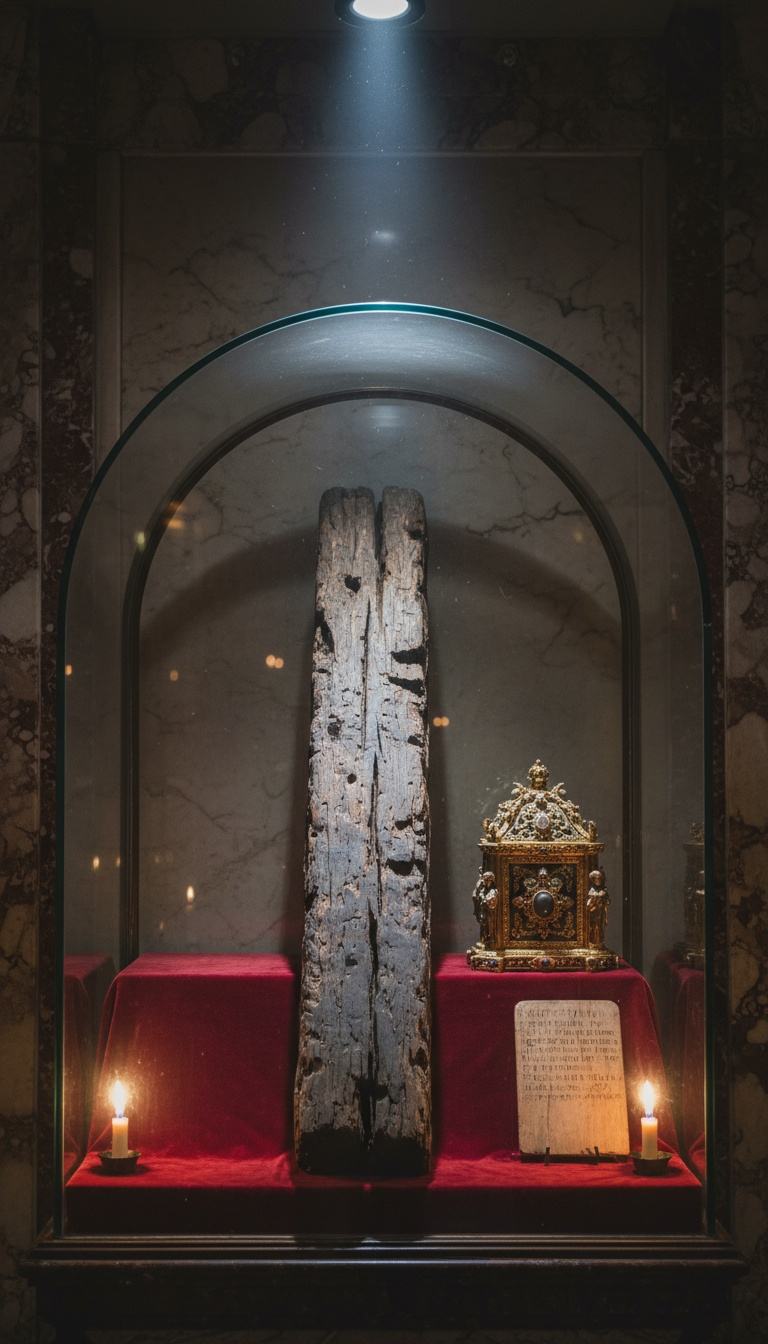
Rome keeps the cross of the repentant thief who died beside Jesus in the Chapel of the Relics at the Basilica of Santa Croce in Gerusalemme. The book that names him is the Gospel of Nicodemus, also called the Acts of Pilate, and the Church left it out of the Bible. That gospel calls the repentant thief Dysmas and the mocking thief Gestas. The Church kept his wood and dropped his name.
Look at what that means. One institution has guarded a wooden beam since the days of Empress Helena, built a chapel around it and put it behind glass for pilgrims. The same institution closed its Bible without the only ancient text that tells you whose beam it is.
Luke Gives Him Five Verses and No Name
Open the Gospel of Luke to chapter 23, verses 39 to 43. One criminal mocks Jesus. The other rebukes him and speaks the only line of his life that survives in your Bible: "Lord, remember me when thou comest into thy kingdom." Jesus promises him paradise that same day. Then Luke cuts away, and the man never appears again.
The other three gospels give him even less. Matthew 27:44 says both thieves reviled Jesus. Mark 15:32 says the same. John 19:18 calls them "two other" and moves on. Four gospels stand at the foot of the cross and none of them records the name of the first man promised paradise.
Somebody knew that name. A man who hung beside the most watched execution in history had a name, a crime and a family. The canon wiped all three.
The Gospel of Nicodemus Names Both Men
The Gospel of Nicodemus fills the hole Luke leaves open. In its account of the crucifixion it places Dysmas on the right hand of Jesus and Gestas on the left. It gives Gestas the taunt, "If thou be the Christ, save thyself and us." It gives Dysmas the rebuke and the plea. The same scene Luke tells, with the faces put back in.
The book reaches further than the cross. It records the trial before Pilate line by line: the Roman standards bowing on their own as Jesus entered, the warning from Pilate's wife about her dream, and the parade of healed witnesses who testified for him. It reads like a court file because that is what it claims to be.
The early Church cited a Pilate record openly. Justin Martyr, writing in Rome around 155 AD, told the emperor in his First Apology that the facts of the crucifixion could be checked in the Acts of Pontius Pilate. Tertullian, around 197 AD, wrote in his own Apology that Pilate reported everything about Jesus to Tiberius. Two Church Fathers, two generations, one Pilate file pointed at as proof.
Dysmas Walks Into Paradise Carrying His Cross
The second half of the book, the Descent into Hell, gives Dysmas the ending Luke never wrote. Two men raised from the dead, Karinus and Leucius, the sons of the priest Simeon, write down what they saw below. In paradise, Enoch and Elijah meet a humble man carrying a cross on his shoulder.
The man tells them he was the thief crucified with Jesus. He says Jesus handed him the sign of the cross and told him to carry it to the angel guarding the gate of paradise. The angel saw the cross and opened the gate. In that book the thief's cross is his passport.
In the book they threw out, the thief's cross opens the gate of paradise. In Rome, the same cross sits behind a locked pane of glass.
That is the detail that should stop you. The text the Church refused is the text that explains why anyone would preserve the thief's cross at all. The relic only makes sense inside the story the Bible does not contain.
Believers Read It for a Thousand Years
The Gospel of Nicodemus was the popular gospel of the Middle Ages. Monks translated it into Old English in the eleventh century. Jacobus de Voragine pulled from it for the Golden Legend around 1260, the most copied book in Europe after the Bible itself. The York and Chester mystery cycles staged its Harrowing of Hell in the streets for whole towns to watch.
Ordinary Christians knew Dysmas by name for centuries. They prayed to him, named churches after him and acted out his entry into paradise every Easter. The name lived in the people long after the scholars stopped copying the book.
Then the doors closed. On 8 April 1546 the Council of Trent fixed the Catholic canon by decree, and the Gospel of Nicodemus stood outside it. The Protestant Bibles printed in the same century left it out as well. Rome and the Reformers fought over almost everything, and they agreed on this one silence. You can read the full story of how those lists were drawn in our canon files.
The Beam Inside Santa Croce in Gerusalemme
The Basilica of Santa Croce in Gerusalemme rises on the site of the Sessorian Palace, the Roman residence of Empress Helena, mother of Constantine. Tradition holds that Helena brought relics back from Jerusalem around 326 AD and spread soil from Calvary under the floor of her chapel. The church carries the name of Jerusalem because it was built to hold a piece of it.
The Chapel of the Relics, built in the 1930s, keeps the collection together. Behind the glass sit three fragments of the True Cross, a nail, two thorns from the crown and the Titulus Crucis, the board inscribed in Hebrew, Greek and Latin that hung above Jesus. Workers found the Titulus sealed inside the wall of the basilica in 1492, hidden behind a brick marked with its name.
Beside those relics rests a heavy wooden beam. The basilica presents it as part of the cross of the Good Thief. A Roman church keeps the board from above Jesus and the beam from the man at his right hand, side by side, in one room.
| Detail | Luke 23 (in your Bible) | Gospel of Nicodemus (left out) | Santa Croce, Rome |
|---|---|---|---|
| The thief's name | None | Dysmas | Shown as "the Good Thief" |
| The other thief | Unnamed criminal | Gestas, on the left | No relic shown |
| What the thief says | One plea | Full rebuke and plea | Silent |
| His cross after death | Never mentioned | Carried into paradise as his key | Kept behind glass |
| Pilate's trial | A short summary | Recorded scene by scene | His Titulus kept beside the beam |
A Feast Day for a Man With No Official Name
The Church honors this thief as a saint. The Roman Martyrology commemorates the holy thief on 25 March, the day medieval tradition gave to the crucifixion itself. He is the only man in history canonized by the direct word of Jesus.
Look at how the Martyrology names him. It calls him the holy thief who confessed Christ on the cross. The name Dismas lives on parish signs, prison chapels and holy cards across the world, and it comes from one source, the book Trent left outside the canon.
So the Church carries three receipts for this man. It keeps his cross in Rome. It keeps his feast on its calendar. It keeps his name out of its scripture.
Somebody decided which half of the thief you were allowed to have. You got the wood, the feast day and one line in Luke. You lost the name, the conversation on the cross and the gate of paradise swinging open for a man carrying a beam on his shoulder. More of what was cut sits in our lost books archive.
And the thief is the smallest thing in that book. The same pages record what the sons of Simeon wrote after they walked out of their graves: who was waiting in the dark when Jesus arrived, what he broke on the way in, and what he said to the ruler of that place. Rome kept the cross. Ask yourself what it did with the testimony of two men who came back from hell.
Frequently Asked
What was the name of the good thief crucified beside Jesus?
The Gospel of Nicodemus, also called the Acts of Pilate, names him Dysmas and places him on the right hand of Jesus. The unrepentant thief on the left is named Gestas. Neither name appears anywhere in the Bible.
Where is the cross of the good thief kept?
A large wooden beam presented as part of the Good Thief's cross is kept in the Chapel of the Relics at the Basilica of Santa Croce in Gerusalemme in Rome. It sits beside fragments of the True Cross and the Titulus Crucis, the board that hung above Jesus.
Why is the Gospel of Nicodemus not in the Bible?
The Council of Trent fixed the Catholic canon on 8 April 1546 and left the Gospel of Nicodemus outside it, and Protestant Bibles of the same century dropped it too. Christians had read it for a thousand years before that, and it shaped Easter plays and the Golden Legend across medieval Europe.
Is Saint Dismas a real saint?
Yes. The Roman Martyrology commemorates the holy thief on 25 March, and he is the only man canonized directly by the words of Jesus. The name Dismas itself comes from the Gospel of Nicodemus, the book the Church left out of scripture.
Before you go
7 books the Vatican doesn't want you reading. Free PDF. The texts they cut, with sources. Joined by 300+ Inner Circle members.
No spam. Unsubscribe anytime.
Go deeper
The Hidden Canon, Vol. I: Enoch. Jubilees. Thomas. Mary. Judas. 90 pages, 14 chapters, every receipt cited. The books your Bible quietly removed.
Read the Canon →