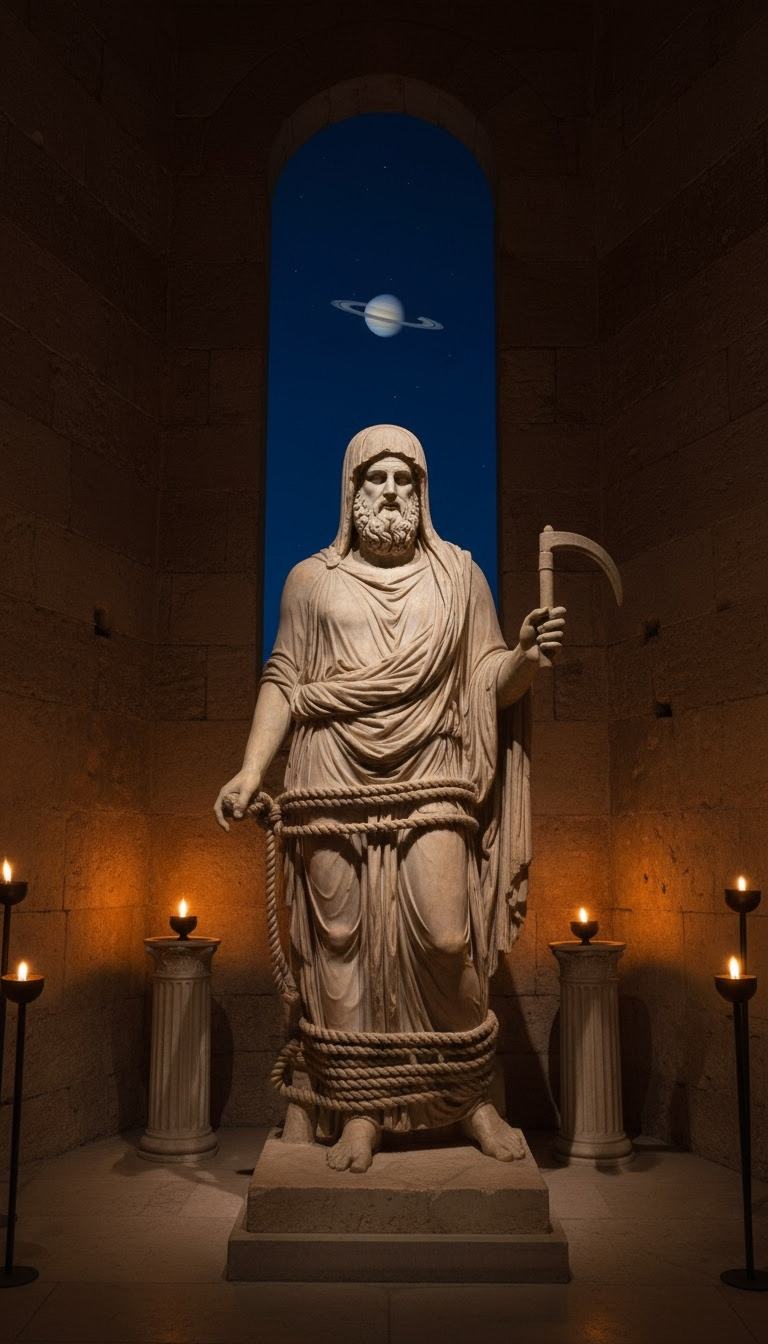
Rome kept the statue of Saturn in the Roman Forum bound at the feet with wool ropes all year because the Romans remembered Saturn as a prisoner. He was a power that had to stay chained, except for one controlled week of release at the Saturnalia. The Book of Enoch explains the crime behind the chains. Seven stars broke the command of the Lord and were bound in a burning prison at the edge of heaven for ten thousand years. Rome's ritual is the earthly copy of that sentence.
The Romans wrote down the binding. The Greeks wrote down the prison. A Hebrew prophet named the star. Then in 1981 a spacecraft photographed something on the planet itself that has held one fixed shape for more than four decades. That makes four records of the same prisoner.
The Statue in the Forum Wore Wool Shackles
The Temple of Saturn sits at the foot of the Capitoline Hill in the Roman Forum. Tradition dates its dedication to 497 BC, and eight granite columns from its fourth-century rebuild still stand there today. Inside stood the cult statue of the god. Pliny the Elder records in his Natural History, book 15, that the statue was hollow and filled with oil.
The binding is on the record. Macrobius, writing his Saturnalia in the early fifth century AD, cites the Greek scholar Apollodorus: Saturn was bound through the year with a woolen bond and loosed only on his feast day. A Roman senator-scholar wrote it down as plain fact about the most sacred building in the city.
Rome built a temple for its oldest god and then tied him to the floor. Worshippers do not shackle a statue they trust. They shackle one they remember.
One Week of Release, Then the Ropes Go Back On
The Saturnalia opened on December 17 and grew into a seven-day festival. Masters served their slaves at table. Citizens put on the pileus, the felt cap of a freed slave. A mock king was crowned to rule the chaos. For one week the order of Rome turned upside down.
Then the ropes went back on. The festival worked like parole. The prisoner was let out under watch, the world bent around him for seven days, and the city locked him up again before the year turned.
The material matters. Wool is soft, so the binding was built to contain him and leave him unharmed. That is how you hold a power you cannot destroy and do not dare release.
Enoch Saw the Prison
The Book of Enoch, chapters 18 through 21, takes the prophet to the edge of heaven and earth. There he sees seven stars "like great burning mountains," bound in a place of fire. The angel Uriel tells him why. These stars "transgressed the commandment of the Lord" because they did not come forth at their appointed times. Their sentence runs ten thousand years.
The text is ancient. Aramaic fragments of Enoch came out of Qumran Cave 4 in 1952, copied before the time of Christ. The Scottish explorer James Bruce brought complete Ethiopic manuscripts back from Abyssinia in 1773, and one of them sits in the Bodleian Library at Oxford. The church dropped the book. Ethiopia kept it. We break down the full text in our Lost Books archive.
Now read the crime again. Seven stars that refuse their appointed times are the seven wanderers of the ancient sky: the Sun, the Moon, Mercury, Venus, Mars, Jupiter, and Saturn. Saturn is the seventh and the last, the slowest and farthest of them, taking 29.5 years to circle the zodiac. Enoch's prison holds the planets, and Saturn sits at the outer wall.
Rome bound him. Enoch jailed him. A hexagon holds him still.
Kronos in Tartarus, and in a Cave Beyond Britain
The Greeks called him Kronos. Hesiod's Theogony, composed around 700 BC, tells how Zeus and the younger gods overthrew the Titans and chained them in Tartarus, as far below the earth as the sky is above it, behind bronze gates set by Poseidon. The god Rome bound in wool, Greece locked in the abyss.
Plutarch gives a second prison. In his dialogue On the Face in the Moon, written around 100 AD, a traveler describes an island far west of Britain where Kronos lies confined in a deep cave. His chain is sleep, and the giant Briareus stands guard over him. The god survived his own defeat and stayed under watch.
Three traditions, three prisons, one inmate. Rome used rope, Greece used bronze gates, and Plutarch's island used sleep.
| Source | Date | Who Is Bound | The Prison | Release |
|---|---|---|---|---|
| Macrobius, citing Apollodorus | c. 430 AD | Saturn | Wool ropes on the statue's feet, Roman Forum | One week a year, at the Saturnalia |
| Hesiod, Theogony | c. 700 BC | Kronos and the Titans | Tartarus, behind bronze gates | Never |
| Plutarch, On the Face in the Moon | c. 100 AD | Kronos | Island cave west of Britain, chained by sleep | Never |
| 1 Enoch 18 to 21 | 3rd century BC or earlier | Seven stars | Burning abyss at the edge of heaven | After ten thousand years |
| Amos 5:26 | 8th century BC | Kiyyun, the star god | Carried in a portable shrine | Paraded, then returned |
| Voyager and Cassini | 1981 to 2017 | Saturn's north pole | A six-sided jet stream | Held since 1981 |
Israel Carried the Star in a Box
The prophet Amos, preaching in the eighth century BC, condemns Israel in Amos 5:26 for carrying "Sakkuth your king and Kiyyun your star god." Hebrew scholars match Kiyyun to the Akkadian Kayamanu, the Babylonian name for Saturn, meaning "the steady one." Centuries later Stephen quotes the same verse in Acts 7:43 just before his execution, rendering the name as Rephan.
Israel carried the star god in procession, housed in a portable shrine. Rome loosed its god for one week of festival. Both peoples moved Saturn on a schedule and kept him in a structure built to hold him.
Rome went further. The aerarium, the state treasury, sat inside the Temple of Saturn. The gold reserves, the bronze tablets of law, and the public accounts of the Republic all lay under the bound god's roof. You keep your vault where the guard is strongest, and that tells you how seriously Rome took its prisoner.
The Hexagon on the Pole
Now look up. The Voyager flybys of 1980 and 1981 photographed a six-sided storm locked around Saturn's north pole. It is about 30,000 kilometers across, wider than two Earths side by side. Each of its six straight walls runs longer than the diameter of our planet.
Cassini reached Saturn in 2004 and watched the hexagon for thirteen years before its final plunge into the atmosphere on September 15, 2017. It photographed the shape in color as the season turned it from blue to gold. The walls never broke. Gas giants are made of moving storms, and this one has held its geometry through every year we have watched it.
The planet named for the bound god wears a geometric cage on its crown. The Romans tied his feet. The sky drew six walls around his head.
Enoch's sentence runs ten thousand years, and the text never says when the clock started. Rome counted the god's days of freedom and cut the ropes on schedule. Somebody, somewhere, was keeping the calendar of a prisoner.
So ask the question the Romans answered every December. If the ropes came off for one week a year and the whole world turned upside down while they were off, what did they believe walked out of that temple? And when the ten thousand years run out, who loosens the knot this time?
Frequently Asked
Why was the statue of Saturn tied with wool in Rome?
Macrobius, citing Apollodorus, records that the statue of Saturn in the Roman Forum was bound with a woolen bond all year and released only on his feast day. Rome treated its oldest god as a prisoner held under controlled confinement, loosed for one week at the Saturnalia and bound again after.
What does the Book of Enoch say about bound stars?
In 1 Enoch 18 to 21, Enoch sees seven stars like great burning mountains bound in a fiery prison at the edge of heaven. The angel Uriel says they broke the Lord's command by not rising at their appointed times, and their sentence lasts ten thousand years.
Is Saturn the same god as Kronos?
Yes. The Romans identified Saturn with the Greek Titan Kronos, whom Zeus overthrew and imprisoned in Tartarus according to Hesiod. Plutarch adds a second prison, an island cave west of Britain where Kronos sleeps under guard.
Who is Kiyyun in the Bible?
Kiyyun is the star god Amos condemns Israel for carrying in Amos 5:26. Scholars match the name to the Babylonian Kayamanu, meaning Saturn, and Stephen quotes the verse in Acts 7:43.
What is the hexagon on Saturn?
It is a six-sided jet stream around Saturn's north pole, about 30,000 kilometers across, first photographed by Voyager in 1981 and tracked by Cassini until 2017. It has held its shape for more than four decades.
Before you go
7 books the Vatican doesn't want you reading. Free PDF. The texts they cut, with sources. Joined by 300+ Inner Circle members.
No spam. Unsubscribe anytime.
Go deeper
The Hidden Canon, Vol. I: Enoch. Jubilees. Thomas. Mary. Judas. 90 pages, 14 chapters, every receipt cited. The books your Bible quietly removed.
Read the Canon →