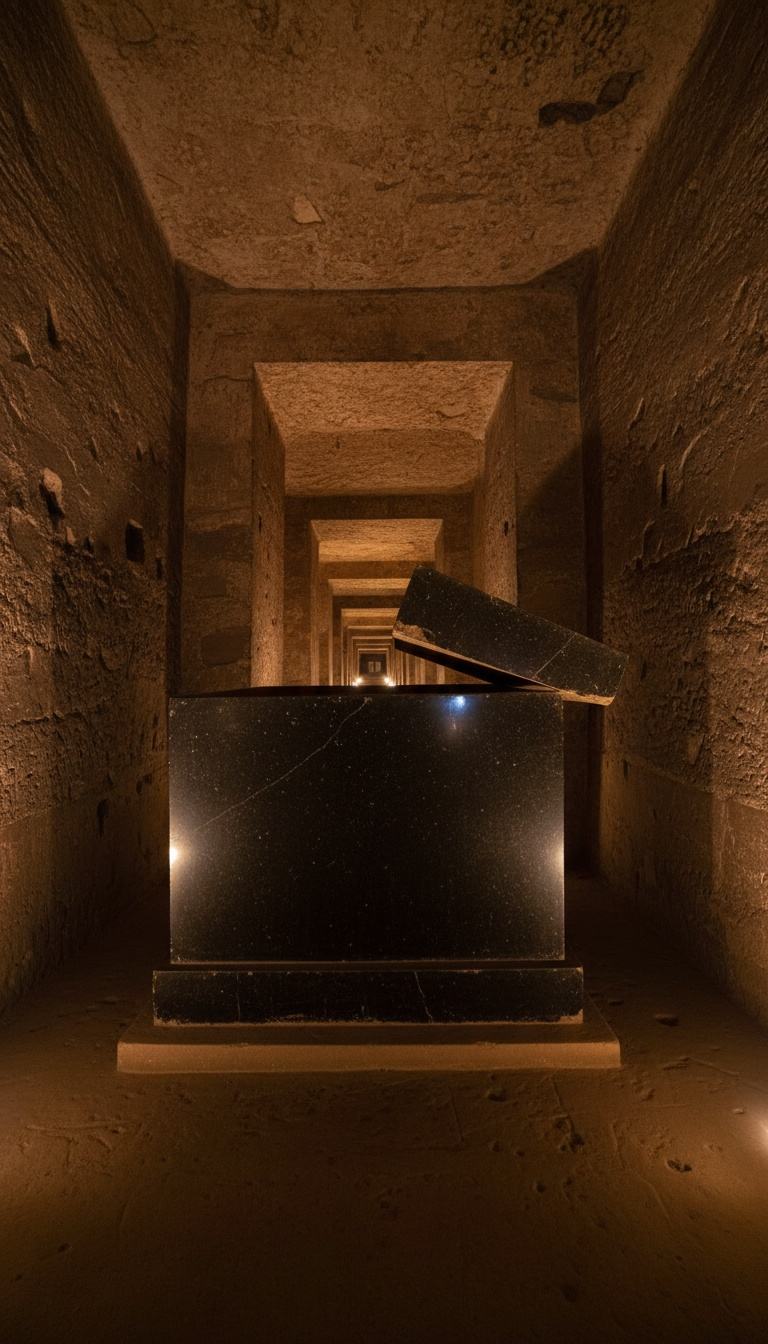
The 24 granite boxes of the Serapeum of Saqqara are older than the pharaohs who buried their sacred Apis bulls in them. Each one is cut from a single block of Aswan granite and weighs around 70 tons. Each was hauled almost six hundred miles down the Nile, and its inner walls are finished flat and square to a standard modern stone shops struggle to reach. The Egyptian kings of the Late Period inherited these vaults from an earlier builder and used them as tombs.
Read that again. The kings that Egyptologists credit with the Serapeum were tenants. They moved into a structure that was already ancient, cut their names into the stone, and left the real architects out of the record entirely.
A Frenchman Spends the Louvre's Money
In 1850 the Louvre sent Auguste Mariette, a 29-year-old junior assistant in its Egyptian department, to Cairo with one job: buy Coptic and Syriac manuscripts. He never bought them. At Saqqara he spotted the head of a sphinx sticking out of the sand. He remembered a line from the Greek geographer Strabo, who described a Serapeum near Memphis with an avenue of sphinxes so deep in sand that only their heads showed.
Mariette spent the manuscript money on workmen. He followed the buried road of sphinxes into the desert for months, sphinx after sphinx, until it ended at the mouth of a tunnel cut into the bedrock. By November 1851 he was standing inside the Greater Vaults. Several of those sphinxes and the limestone Apis bull statue from the site now sit in the Louvre in Paris, bought with money meant for books.
Seventy Tons, Six Hundred Miles
The tunnel runs about 400 feet through solid rock, with side chambers cut on both sides. In 24 of those chambers sits a granite box. Most are cut from Aswan granite, the same hard stone used in the King's Chamber at Giza. A box alone weighs around 70 tons. Add the lid and some reach 100 tons. A loaded semi truck tops out near 40.
Aswan sits almost six hundred miles up the Nile from Saqqara. Each block had to be quarried whole, hollowed, finished, floated downriver and dragged across the desert plateau. Then it had to be pulled down a corridor barely wider than the box itself and lowered into a chamber whose floor sits below the corridor floor.
Three facts sit together here. The stone is among the hardest in Egypt. The distance is a third of the length of the country. The space to maneuver is almost zero. No Egyptian text records how any of it was done, who did it, or when.
The Black Mirror
Visitors who shine a flashlight into the boxes see their own reflection. The inner walls are polished to a dark gloss. In 1995 the American engineer and machinist Christopher Dunn brought a precision straightedge and a machinist's square into the tunnel. He laid them against the inner walls and the underside of a lid.
Dunn reported surfaces flat and corners square to tolerances he compared to modern precision-machined parts. He published the findings in his 2010 book Lost Technologies of Ancient Egypt. The inside corners are the hardest part: a tool has to reach into a closed box and cut two walls and a floor so they meet at a true right angle.
Copper chisels and sand do not polish the inside corner of a 70-ton granite box to a mirror. Something else did, and Egypt never wrote down what.
Egyptologists say workers used copper tools, dolerite pounders and quartz sand. Those tools exist. The Unfinished Obelisk at Aswan shows exactly what they leave behind: rough, scalloped trenches you can see from across the quarry. The Serapeum walls show none of that. Two different finishes point to two different toolkits.
The Name on the Box
The strongest card Egyptologists hold is an inscription. One box carries the name of Amasis II, a pharaoh of the 26th Dynasty, dated to his 23rd year, about 548 BC. Egyptologists use it to date the box and, by extension, all of the Greater Vaults to the reign of Psamtik I and his successors.
Look at the carving itself. The Amasis text is cut shallow and uneven, a crude band of hieroglyphs scratched onto the outside of a box whose inner walls are machine-flat. The precision and the writing come from two different hands working at two different standards. A name on a box is a label. Putting a label on a crate does not mean you built it.
Of the 24 boxes, only a handful carry any text at all. The rest are blank. Twenty silent boxes and one crude label is the whole case for Late Period construction.
| Question | What Egyptologists claim | What the stone shows |
|---|---|---|
| Who built the boxes? | Workers of Psamtik I and later kings, from about 612 BC | No text names a builder; the only names are later labels |
| What tools? | Copper chisels, dolerite pounders, quartz sand | Mirror-polished inner walls with none of the scalloped marks those tools leave |
| How were they moved? | Sledges, ramps and river barges | 70 to 100 tons lowered into chambers from corridors barely wider than the box |
| What were they for? | Burial of the sacred Apis bulls | Mariette found them empty, lids shifted, no bull remains inside |
The Box That Stopped Mid-Cut
Near the entrance of the tunnel sits one box that never reached its chamber. Its outer surface is rough. Its lid lies apart from it. It sits in the corridor as if the work stopped on an ordinary day and nobody ever came back to finish.
A workforce that finished 23 flawless boxes does not walk away from the 24th for no reason. Something ended that project. The record Egypt kept does not mention it, because the people who kept that record were not the people holding the tools.
Empty When Mariette Opened Them
Mariette found the lids of the Greater Vault boxes pushed aside and the interiors empty. One box was still sealed. He forced it open and found nothing inside. No bull, no bones, no wrappings, no gold.
That sealed, empty box is the receipt that breaks the bull-tomb story. A bull burial leaves something behind. A box sealed shut with nothing inside was made for a purpose that had nothing to do with bulls. The pharaohs later turned the tunnel into a bull cemetery, and the original purpose went into the dark with the original builders. We track the full Saqqara record in our Case Files, and the site itself is plotted on our ancient maps.
Twenty-four boxes. Seventy tons each. Mirror-flat inside, square to a fraction of a degree, carried six hundred miles and lowered into rock. One sealed box with nothing in it, and one abandoned in the corridor mid-cut.
Egypt filled these vaults. Somebody else made them. And if a lost age could cut granite like this at Saqqara, the next question is what else that age left under the sand that Egypt simply moved into and signed. So tell us: what do you think was inside that sealed box before anyone ever thought of a bull?
Frequently Asked
How old are the Serapeum granite boxes?
They are older than the Late Period pharaohs who used them for Apis bull burials. The only dated inscription, from Amasis II around 548 BC, is a crude later label cut onto a box that was already finished to machine precision.
How heavy are the boxes in the Serapeum of Saqqara?
Each granite box weighs around 70 tons, and with its lid some reach 100 tons. They were cut from Aswan granite almost six hundred miles up the Nile.
Who discovered the Serapeum?
Auguste Mariette, a young assistant from the Louvre, found it in 1850 after following a buried avenue of sphinxes into the Saqqara desert. He paid for the dig with money the Louvre gave him to buy manuscripts.
Were Apis bulls found inside the granite boxes?
Mariette found the Greater Vault boxes empty with their lids shifted. The one box he found still sealed was also empty, which points to a purpose older than the bull burials.
Is there an unfinished box in the Serapeum?
Yes. A rough-surfaced box sits in the corridor near the entrance with its lid lying apart. It never reached its chamber, as if the builders stopped work and never returned.
Before you go
7 books the Vatican doesn't want you reading. Free PDF. The texts they cut, with sources. Joined by 300+ Inner Circle members.
No spam. Unsubscribe anytime.
Go deeper
The Hidden Canon, Vol. I: Enoch. Jubilees. Thomas. Mary. Judas. 90 pages, 14 chapters, every receipt cited. The books your Bible quietly removed.
Read the Canon →