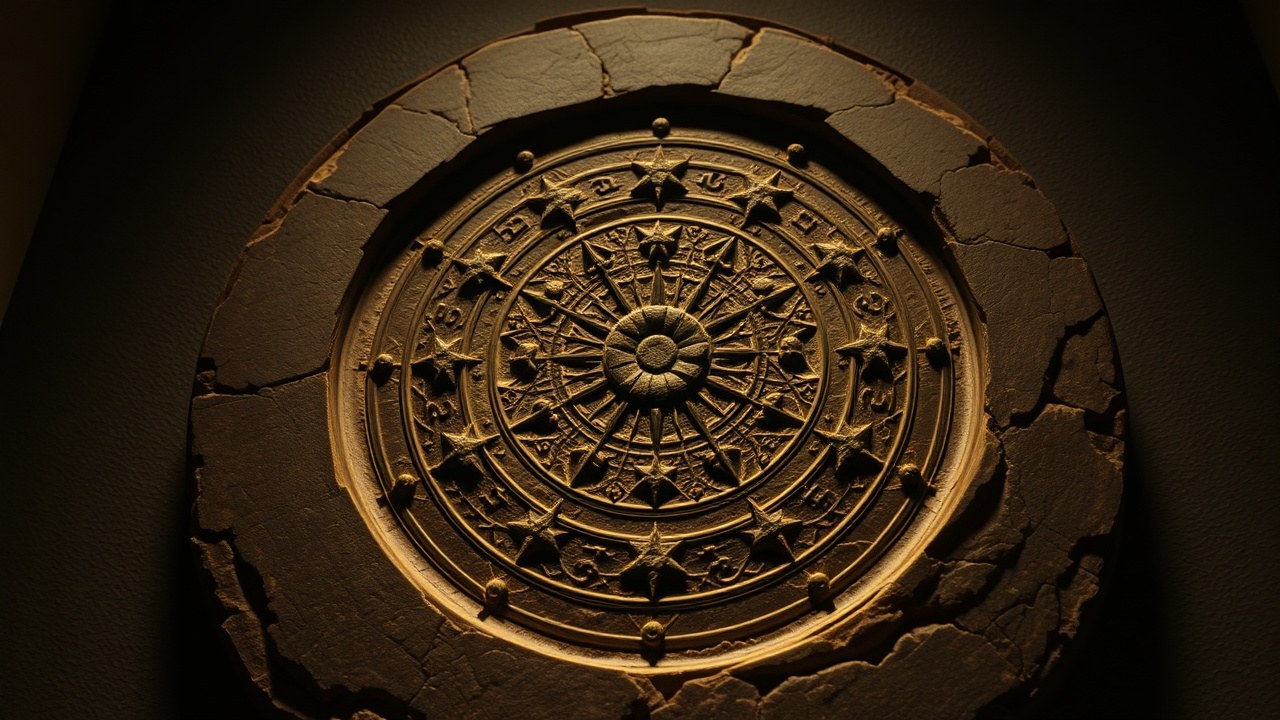
Twelve tribes of Israel. Twelve disciples. Twelve Olympian gods. Twelve Imams in Twelver Shia Islam. Twelve Hopi clans. Twelve signs of the zodiac. Twelve stones in the high priest's breastplate. Twelve hours, twelve months, twelve cranial nerves, twelve knights of the round table.
These are not connected civilizations. The Hopi are in Arizona. The Twelver Shia tradition begins in seventh-century Arabia. The Olympian pantheon is Greek. The breastplate is Hebrew. There are no shared trade routes. No common language. No common continent.
Why the same number?
The Babylonian Sky Division
The clearest documentary trace of where the number twelve came from is Babylonian. Around 1200 BCE, Babylonian astronomers divided the visible night sky into exactly twelve sectors along the ecliptic, the path the sun appears to follow over a year. Each sector was assigned a constellation. Each constellation was assigned a governing function.
This was not a numerology choice. It was an astronomical one. The Babylonian year contains roughly twelve lunar cycles. The ecliptic naturally divides into twelve roughly equal arcs. The number twelve is what the sky physically gives you if you do the math correctly.
The Babylonian framework was inherited by the Greeks, formalized by Ptolemy, transmitted into Roman, Christian, Islamic, and Renaissance astrology, and is the direct ancestor of the modern Western zodiac.
That accounts for the zodiac. It does not account for the Hopi.
The Hopi Twelve
The Hopi people of northeastern Arizona have a creation tradition recorded in detail by Frank Waters in The Book of the Hopi (1963), based on direct interviews with elders. The cosmology divides creation into four worlds, each ruled by specific clan groupings descended from "star brothers" who returned periodically.
The Hopi clan structure resolves into twelve principal lineages, each with a distinct origin narrative tracing back to a specific celestial location. The clan organization predates European contact by centuries and shows no documented Babylonian, Greek, or Christian influence.
The Hopi divided their governing structure into twelve. Independently. With no exposure to the Babylonian sky map.
The Dogon, And Why The Sirius Story Won't Go Away
The Dogon people of Mali are the case that academic anthropology has tried to dismiss the longest and least successfully.
In 1931, French anthropologists Marcel Griaule and Germaine Dieterlen began documenting Dogon religious cosmology. The Dogon described twelve founding ancestor groups, the Nommo, who they said arrived from the star Sirius. Specifically from a companion to Sirius that orbited the main star in roughly fifty years and was extraordinarily dense.
The companion star Sirius B was not photographed by Western astronomy until 1970. Its existence was inferred from gravitational perturbations of Sirius A in the nineteenth century, but no Western publication describing its orbital characteristics or density existed in any form the Dogon could have plausibly accessed in 1931.
The Dogon priests gave Griaule the orbital period and the density information directly. They said it was ancestral knowledge. They said it had been passed down for centuries. They counted twelve principal lineages, each tied to the celestial source.
The standard skeptical response, that a missionary or trader briefed the Dogon between 1893 and 1931, has been investigated and rejected by multiple subsequent fieldworkers. There is no evidence of a transmission corridor. The Dogon variant predates every plausible contact event.
"The Dogon counted twelve. The Babylonians counted twelve. The Hopi counted twelve. The Old Testament counted twelve. The four civilizations did not communicate."
The Book of Enoch describes the original Watchers, two hundred celestial beings who descended on Mount Hermon and assigned twelve principal lineages to govern human affairs. The earliest written instance of "twelve as celestial council" surviving in Western tradition. Excluded from the Christian canon at the Council of Laodicea, 364 AD.
Get The Book of Enoch on Amazon →The Modern Contactee Mapping
This is the part that academic anthropology refuses to engage with. The contemporary UFO and contactee literature, taken as a body, repeatedly produces the same count. Pleiadians, Sirians, Arcturians, Andromedans, Lyrans, Vegans, Orions, Nordics, Reptilians, Greys, Mantids, Tall Whites, twelve principal "star species" recur across reports collected by separate researchers from witnesses with no exposure to one another.
You can dismiss the contactee literature as fabrication. The dismissal does not explain why the fabricators independently produced the same number that Babylon, Hopi, Dogon, the Hebrew tribal census, and the Olympian pantheon also produced.
The simplest explanation that fits every data point is that the number twelve was originally embedded somewhere in human cognition or human memory or both, and that every culture that subsequently developed governance frameworks pulled on the same residual structure.
The Jury
Every Western legal system that adopted a twelve-person jury borrowed it from a framework codified before Rome existed. Roman law itself borrowed it from earlier Etruscan and Greek precedent. Greek precedent reaches back to the Solonic reforms, which referenced what the Greeks already understood as a divinely ordained number for governing bodies, divinely ordained because the gods themselves numbered twelve.
The reason a person on trial in Toronto in 2026 faces a jury of twelve, rather than ten or fifteen, is because the number is older than every legal tradition that produced the courtroom they are standing in.
If This Is Coincidence
Independent invention has to be considered. People count fingers. Twelve is divisible. The lunar cycle is roughly twelve per year. There are mundane reasons why a numerical convention could arise more than once.
But the convention is not random. It is structurally specific. Twelve as a count of founding tribes. Twelve as a count of celestial governors. Twelve as a count of star-origin lineages. Twelve as a count of ruling Imams. Twelve as a count of seated divine bodies.
Convergent fabrication produces this much specificity once. Maybe twice. Not in seven independent traditions on five continents.
The simpler hypothesis is that humans inherited a memory of being divided into twelve at some original point, and every culture that subsequently rebuilt itself, rebuilt the same structure, because the structure was the only one they remembered.
Whether that original division was social, biological, or celestial is the open question. The number is not.